Update — June 2026
Much has changed since Google’s AI Search Expands to India and Japan was first reported in September 2023. In May 2024, Google officially rebranded the Search Generative Experience (SGE) as AI Overviews and launched it publicly in the U.S. By August 2024, Google expanded AI Overviews to six more markets — the UK, India, Japan, Indonesia, Mexico, and Brazil — transforming the opt-in Search Labs experiment into a mainstream product for those regions. Then, in Google’s largest expansion yet, AI Overviews launched in more than 100 countries and territories in late October 2024, with language support extended to include English, Hindi, Indonesian, Japanese, Portuguese, and Spanish.
The pace of change accelerated further in 2025. In March 2025, Google upgraded AI Overviews in the U.S. to be powered by Gemini 2.0, a more advanced model enabling AI Overviews to appear for more complex queries such as coding questions, advanced math, and multimodal queries with images. At Google I/O in May 2025, Google announced AI Overviews were launching in even more countries and languages, reaching over 200 countries and territories with support for more than 40 languages, including Arabic, Chinese, Malay, and Urdu. In key markets like the U.S. and India, AI Overviews drove over a 10% increase in Google usage for queries that trigger these summaries.
Beyond reach, Google also introduced a next-generation conversational feature. Google announced AI Mode — a new Labs experiment allowing users to ask complex, multi-part questions and dig deeper with follow-ups. AI Mode rolled out to all U.S. users on May 20, 2025. As of March 2026, Google AI Overviews appear on more than 48% of total Google Search queries, compared to just 6.49% the previous year — a 58% year-over-year growth. For more detail, see Google’s official AI Overviews expansion announcement.
Google announced today that it is expanding its generative AI search experience to the first countries outside the U.S., starting with India and Japan. Through Google’s AI Search Labs in those markets, the new AI-powered search feature, SGE (Search Generative Experience) will offer a new feature to make it easier to find information in its AI-powered overviews.
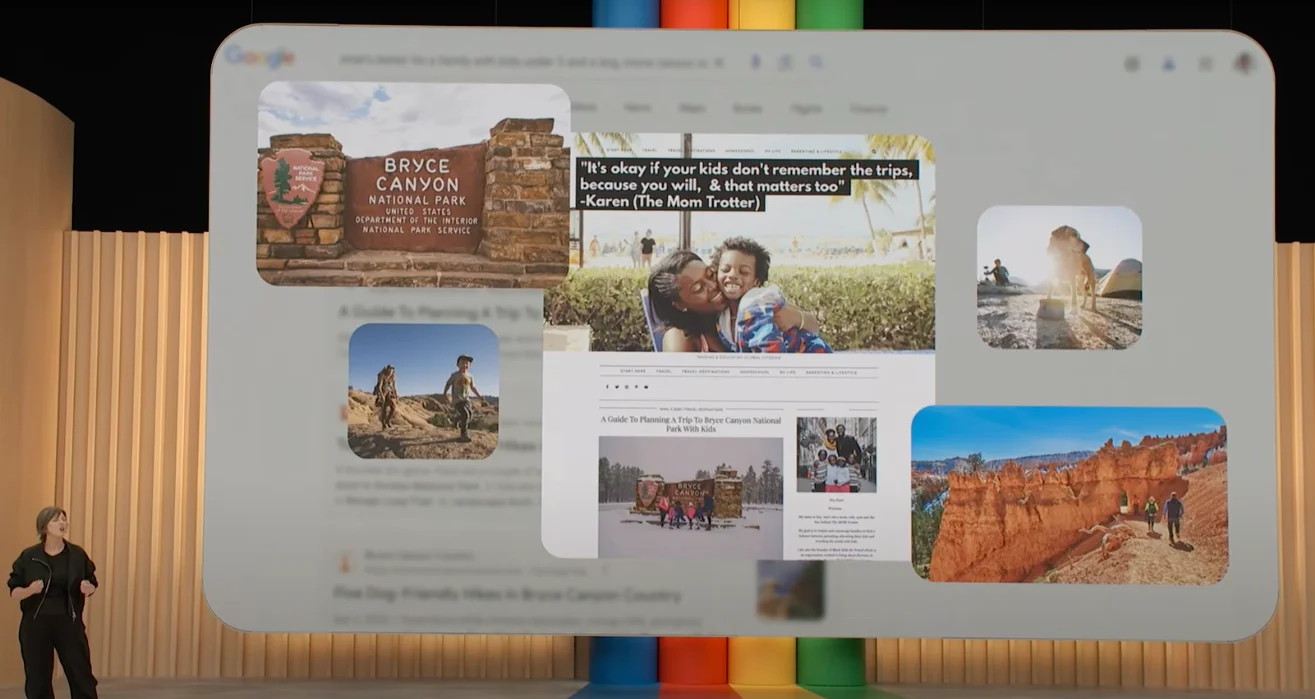
This May, at the Google I/O Developer conference, Google’s AI Search unveiled its new conversational mode. You can ask it questions about a topic and it will respond, similar to an AI chatbot. Recently, Google has updated the experience with the addition of videos and images, local info, travel recommendations, summaries, definitions, and coding assistance.
SGE is customizing its global expansion for newly supported regions. In Japan, it is enabling generative AI in the local language, and in India, it is supporting both English and Hindi with a language toggle for users to switch between the two. Additionally, SGE is experimenting with ads integrated with its AI-generated responses to capitalize on the dedicated AI chat real estate.
SGE is enabling users in India and Indonesia to search using voice input and listen to responses. Additionally, search ads will remain visible in designated slots on the page. To better help people find and access the web pages that support the AI’s responses, SGE is introducing a new feature.

Beginning today, users will notice a new arrow icon next to information in an AI-powered overview. Upon clicking the icon, users can access the source of the AI’s information and learn more about their queries. Initially, this feature is available in the U.S. and will roll out to India and Japan in the following weeks. The company has observed that the SGE feature is particularly popular among younger users.
People ages 18-24 reported the highest satisfaction scores when asking questions in a conversational manner. They also enjoyed the ability to ask follow-up questions and expressed that they were now asking longer, more conversational questions in full sentences, rather than just typing in a few keywords like they would in a traditional Google search.
People find the integrated ads useful, but Google did not give data on click-through rates. To use SGE, users can locate it in the Google’s AI Search Labs section of the Google app on Android and iOS and on Chrome on the desktop.