

Table of Contents
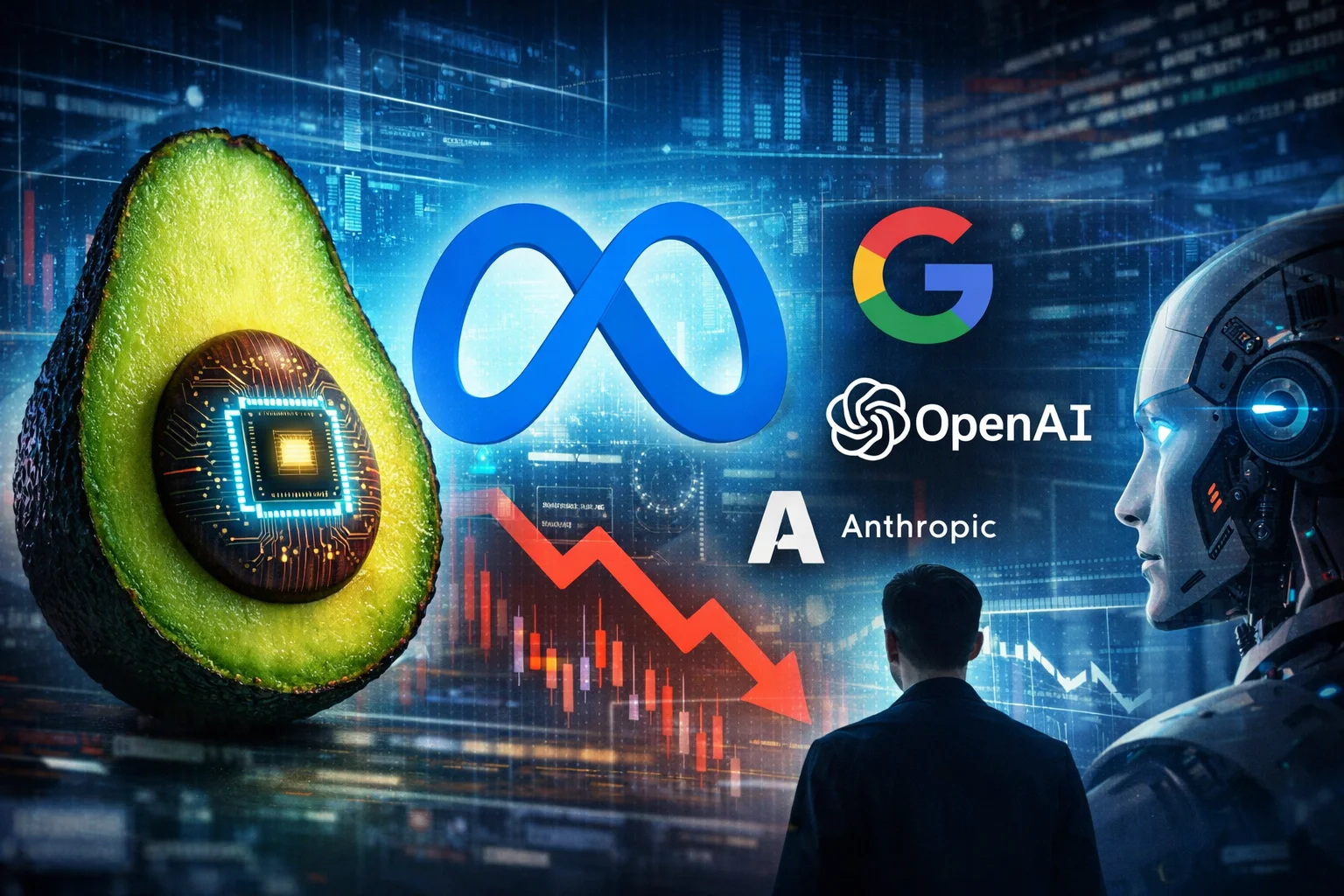
The Meta AI model Avocado delay highlights a turning point in the company’s effort to compete with the fastest moving artificial intelligence developers. According to reports citing internal sources, Meta has postponed the release of its next foundation model, code named Avocado, from March 2026 to at least May. The decision followed internal tests that compared the system with rival models built by Google, OpenAI, and Anthropic. Engineers found that Avocado improved on Meta’s earlier models but still struggled to match the performance of the newest systems from competitors.
In reasoning, coding, and long form writing benchmarks, Avocado reportedly fell short of the newest version of Google’s Gemini models. For a company that has invested heavily in artificial intelligence infrastructure and talent, the delay reflects the difficulty of keeping pace in a field where improvements arrive every few months.
Internal testing shows progress but not leadership
Meta’s testing results show that Avocado represents a technical improvement inside the company even though it does not yet reach the highest benchmark scores. Engineers found that the system performed better than Meta’s earlier Llama based models and also scored ahead of an earlier release of Gemini 2.5. However it could not match the capability of the more recent Gemini 3.0 model. The results reportedly led executives to consider short term options that would keep Meta’s AI products competitive while Avocado continues development.
One option discussed internally involved licensing technology from Google’s Gemini models to power certain services. No agreement has been reached, but the discussion alone shows how quickly the competitive landscape has shifted. Companies building foundation models now measure progress in months rather than years, and even a small gap in reasoning or programming ability can affect developer adoption.
Selected Internal Benchmark Positioning
| Model | Reasoning | Coding | Writing |
|---|---|---|---|
| Meta Llama generation | Moderate | Moderate | Moderate |
| Avocado prototype | Improved | Improved | Improved |
| Gemini 3.0 | High | High | High |
The table reflects the pattern reported by internal testing: Avocado moves Meta forward internally but still trails the strongest systems from competitors.
Billions invested as Meta restructures its AI strategy
The delay arrives during a period of major investment directed by Mark Zuckerberg, who has positioned artificial intelligence as the central focus for Meta’s future products. The company has allocated tens of billions of dollars to data center infrastructure and advanced computing resources needed to train foundation models. Meta also invested $14.3 billion in the startup Scale AI and brought its chief executive, Alexandr Wang, into a leadership role overseeing a new frontier research group known internally as TBD Lab.
That group is responsible for several upcoming systems, including Avocado and another model code named Mango that focuses on image and video generation. A larger model currently planned under the name Watermelon could follow later. These fruit themed names reflect internal research stages rather than product branding, but they show that Meta intends to release multiple AI systems during the next development cycle.
Another strategic debate inside the company concerns whether future models should remain open source. Meta gained early attention by releasing the Llama model family with publicly accessible code. That approach helped attract developers and researchers. Recently some executives have explored the idea of closed models that keep the underlying architecture private, a strategy used by OpenAI and Anthropic.
For the near term, the Meta AI model Avocado delay suggests that the company is adjusting expectations rather than abandoning its plan. Artificial intelligence models often require additional training cycles before release, and the next few months will determine whether Avocado can close the performance gap. For Meta, the outcome will influence its ability to compete for researchers, developers, and enterprise partnerships as the AI race continues to accelerate.
Stay Updated: Artificial Intelligence

