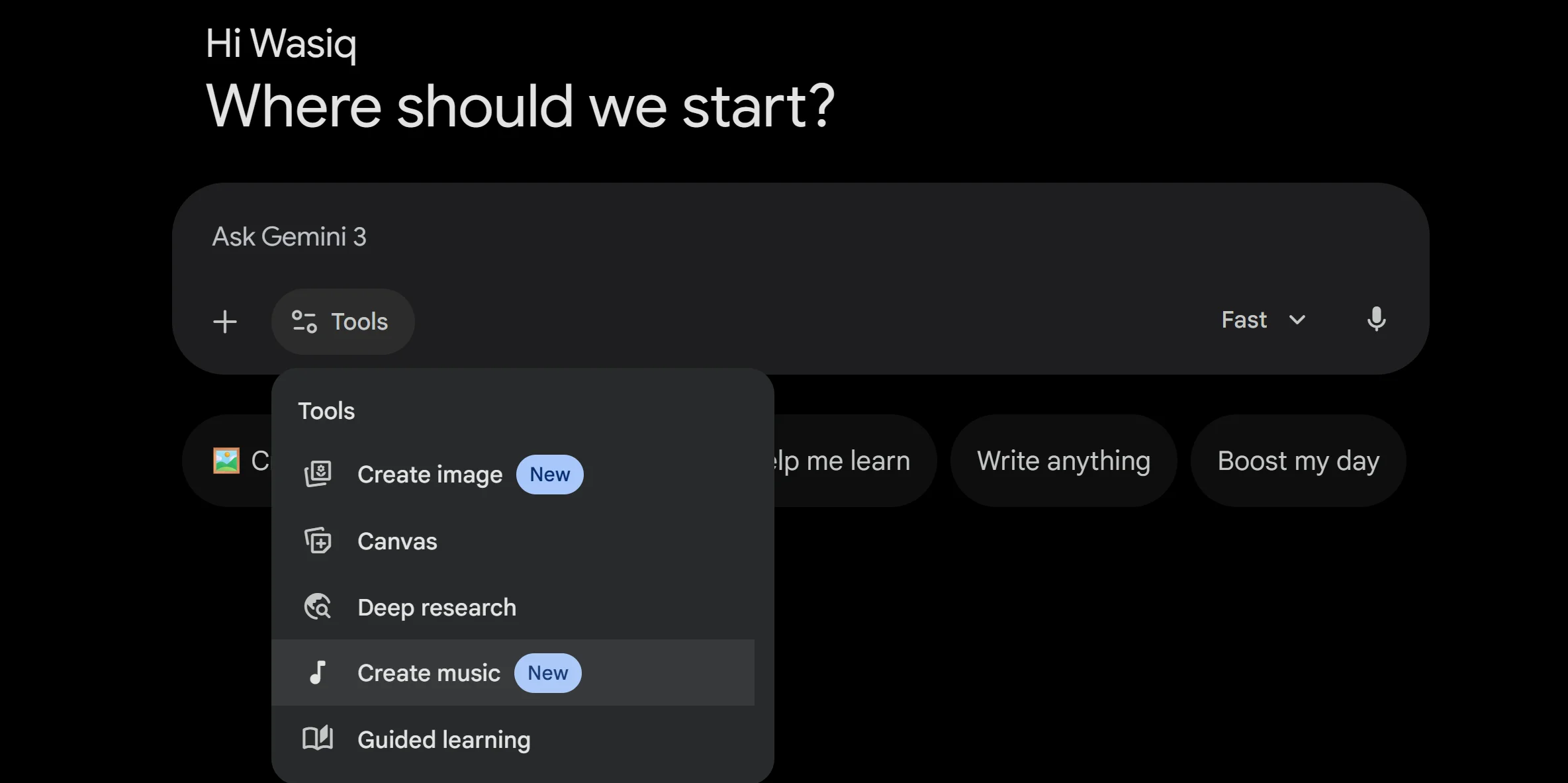
Gemini music generation now includes Lyria 3, a Google DeepMind model that turns simple prompts into 30 second music tracks. A user can begin with something as open-ended as a mood, a memory, or a concept, then receive a complete audio output with lyrics and structure. That is a meaningful shift in what “making music” means inside a general-purpose AI product: the starting point is no longer musical technique, but an idea expressed in ordinary language.
The appeal is obvious. People who cannot play an instrument, write a verse, arrange a track, or work in audio software can still test a creative instinct quickly. Gemini has already emphasized image and video creation, and music extends that multi format approach. A visual post, short clip, or personal photo no longer has to stop at the image itself; it can become the basis for an accompanying soundtrack.
That does not make the result equivalent to a finished song made through a traditional recording process. It does, however, make music generation more practical for the kind of fast, disposable, and highly shareable media that now dominates many online spaces. The point is less to replace the entire craft of music production than to give users a direct route from prompt to usable audio.
The example associated with this rollout captures the intended use case. A track blends hyperpop and glitch pop elements, including punchy digital drums, shimmering synth layers, and processed vocals, to reflect the fast-paced, innovative spirit of a technology and gadgets news platform. Its lyrics are woven into the rhythm to give the brand a modern, “next-gen” feel. Whatever a listener thinks of the aesthetic, the example shows how a text description can be translated into choices about genre, instrumentation, vocals, and branding.
Table of Contents
Gemini Music Generation Improves Control and Output Quality
Gemini music generation offers more control than earlier audio tools by letting users define genre, tempo, and vocal tone while Lyria 3 generates lyrics automatically. That division of labour matters. Automatic lyrics reduce the effort required from people who do not write songs, while prompt controls give them a way to steer the result beyond a vague request for “music.” A creator can approach the system as a collaborator with limits rather than as a black box that produces an unrelated track.
There is a tension here that Google appears to be addressing directly: too much automation can make every result feel generic, but too many settings can recreate the complexity that keeps casual users away from music software. Gemini’s approach is built around a simpler balance. Users supply the creative direction; the system handles the arrangement, lyrics, and production work needed to turn that direction into a track.
The system also produces more realistic and layered audio, improving the listening experience within a short format. That qualifier is important. Thirty seconds is enough time to establish a hook, mood, vocal idea, or musical identity, but it is not long enough to prove that an AI tool can sustain a full composition without repetition or drift. The format sets a useful constraint: it encourages immediate ideas and reduces the expectation that every output must carry the weight of a conventional song.
Gemini can also create music from images or videos. Users can upload a photo, and the system interprets visual context to produce a matching soundtrack. This is one of the more interesting parts of the feature because it connects visual memory with audio output. A still image normally invites captions, filters, or edits. Here, it can also prompt a musical response, turning the soundtrack into part of the storytelling rather than an asset chosen afterward.
Each track includes generated cover art as well, allowing users to share their work quickly across platforms. That may sound secondary, but packaging matters in creator tools. Audio without a visual identity is harder to present in feeds built around thumbnails, clips, and profile-driven sharing. The 30 second limit may seem restrictive, yet it closely fits short form content trends and fast distribution. It is a format designed for circulation, not patient listening.
Gemini Music Generation Connects With Creator Platforms
Gemini music generation also reaches YouTube through Dream Track, allowing creators to generate custom audio for Shorts without relying on external tools. From an editorial perspective at SquaredTech.co, this is where the product strategy becomes clearer. Google is not presenting music generation as a standalone novelty. It is linking creation, editing, and publishing across connected platforms.
That integration reduces friction. A creator who has to move between separate services for ideas, visuals, audio, editing, and distribution faces more opportunities to abandon the process. Keeping those steps inside a connected ecosystem makes experimentation easier and, just as importantly, makes the tool more likely to become part of a routine. The convenience is the feature as much as the generated music itself.
The system supports multiple languages and is available to users above 18 years of age. It is rolling out across desktop and mobile, while paid subscribers receive higher usage limits. The tiered access model suggests Google is testing demand while reserving more use for people likely to treat the feature as part of an active creation workflow. It also points toward a broader possibility: AI music tools may become a standard layer in content creation, much like image generation and video assistance are becoming familiar parts of the same workflow.
For creators, the immediate advantage is speed. For platforms, the advantage is a larger supply of audio tailored to the visual content being posted. That does not guarantee originality or cultural impact. It does mean that custom music is becoming easier to generate at the moment it is needed, rather than being a separate production problem.
Gemini Music Generation Raises Questions About Ownership and Trust
As generated media becomes more convincing, the question is not only whether people can make it, but whether other people can identify it. Gemini music generation includes verification tools intended to address that problem. Each track contains a SynthID watermark that helps identify AI generated audio, and users can upload files to check whether they were created using Google AI.
That is a practical form of transparency rather than a complete solution to trust. A watermark can help establish provenance, but it does not settle every question around context, authorship, or acceptable use. Still, giving users a way to check files is more useful than treating AI disclosure as an afterthought. It acknowledges that generated audio will increasingly circulate beyond the place where it was created.
Google has also added safeguards aimed at limiting misuse. The system avoids direct imitation of specific artists and applies filters to reduce copyright risks. When a user includes an artist name in a prompt, the system treats it as general inspiration rather than a direct copy. That distinction is sensible in principle, even if it also exposes the difficult line AI music systems must walk: users often describe music through familiar references, while artists have legitimate concerns about work that feels too close to their identity or catalogue.
Those rules do not end the ownership debate. They show that Google recognizes the debate is central to the product, not a legal footnote. AI music is easier to embrace when creators, listeners, and platforms can understand where it came from and what boundaries shaped it. Without that trust, better audio quality alone will not be enough.
From our analysis at SquaredTech.co, Gemini music generation reflects a wider shift in AI development from technical capability toward real world usability and trust. Lyria 3 offers a fast, accessible route from an idea to music, with controls that matter, links to creator platforms, and early safeguards around identification and imitation. In the near term, tools like Lyria 3 will likely expand in length, quality, and integration. For now, the more relevant question is how people use a 30 second track: as a finished post, a soundtrack for a memory, a creative prompt, or the first draft of something that goes further.
Stay Updated: Artificial Intelligence