Table of Contents
Google Photos AI Editing changes how people fix their pictures. Users type simple commands, and artificial intelligence handles the rest. Squaredtech watches this development closely. We analyze tech trends for content creators and everyday users. This expansion reaches India, Australia, and Japan. It builds on a feature Google first tested in the U.S. last year.
Google announced the rollout on Tuesday. The tool lets people describe edits in plain words. No one needs sliders or software lessons. This move opens Google Photos AI Editing to millions. It supports local languages too. Squaredtech sees this as a step that democratizes photo fixes. Average users gain pro-level results without effort.
Google Photos AI Editing Expands to New Countries with Easy Access
Google Photos AI Editing started as a Pixel 10 exclusive in the U.S. back in August 2025. Engineers at Google Labs developed it to simplify edits. They drew from years of AI research in image processing. The core technology comes from Google’s Nano Banana model. This model analyzes pixels and predicts changes based on text inputs.
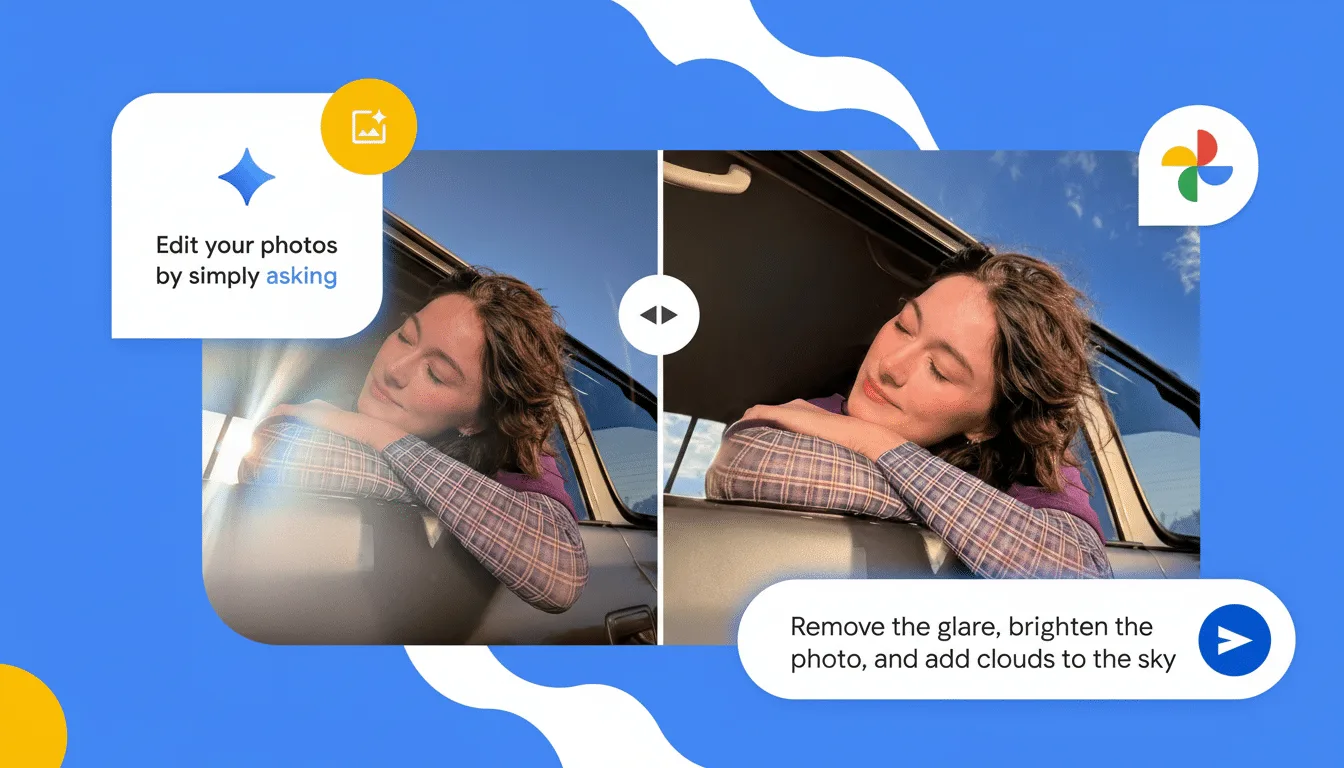
Now, Google Photos AI Editing rolls out to Australia, India, and Japan. Users tap the edit button on any photo. A “Help me Edit” box appears. People pick from suggested prompts or type their own. For instance, someone types “remove the motorcycle in the background.” The AI scans the image, identifies the object, and erases it seamlessly. It fills the space with matching elements from surroundings.
This works offline too. The app processes everything on the device. No internet slows it down. Google Photos AI Editing requires Android 8.0 or higher with 4GB RAM. That covers billions of phones, not just Pixels. Our team notes this inclusivity. Budget Android users in India now edit like pros. They fix family photos or social media shots without apps like Photoshop.
Consider background stories. Google built Nano Banana from datasets of millions of images. It learns patterns like lighting, textures, and poses. When a user says “reduce the background blur,” the AI sharpens focus. It detects the main subject and adjusts depth. Specific requests shine brightest. Users ask to change a friend’s pose. The AI repositions limbs naturally. It removes glasses or opens closed eyes in blink shots.
We analyzed the impact. In India, where smartphones dominate photography, this feature empowers creators. TikTok users craft perfect clips. Families restore old photos with “restore this old photo.” Colors brighten, scratches vanish, and faces clarify. Google Photos AI Editing processes these tasks in seconds. It predicts user intent from natural language, much like ChatGPT handles text.
Google Photos AI Editing Adds Local Languages for Broader Reach
Language barriers once limited tools like Google Photos AI Editing. Google fixes that now. The expansion includes Hindi, Tamil, Marathi, Telugu, Bengali, and Gujarati. Speakers of these languages type commands in their native tongues. No English translation needed. This serves over 500 million people in India alone.
Google trained the AI on multilingual datasets. It understands regional nuances. A Hindi user types “paar ke motorcycle ko hatao,” meaning “remove the motorcycle from behind.” The AI responds accurately. We highlighted the engineering feat. Google used transfer learning from English models. They fine-tuned Nano Banana with local scripts and idioms.
This push aligns with global trends. India leads in Android adoption. Over 90% of smartphones run Android here. Google Photos AI Editing taps that market. Users in rural areas edit photos offline. Students create projects without computers. Content editors at Squaredtech use similar tools daily. We optimize images for tech articles. This feature speeds workflows.
Broader context matters. Google Photos hit 1 billion users years ago. AI integrations started small. In November 2025, AI search expanded to 100 countries. It supported 17 languages for finding photos by description. Users typed “beach vacation with dog,” and results appeared. Google Photos AI Editing builds on that foundation. It shifts from search to creation.
Just last week, Google added “Meme me.” Users mix templates with personal images. They generate funny edits fast. We see a pattern. Google Photos AI Editing forms part of a full AI ecosystem. Each update layers intelligence. Photos become canvases for expression.
Google Photos AI Editing Introduces C2PA for Trust and Transparency
AI edits raise questions about authenticity. Google Photos AI Editing addresses this with C2PA Content Credentials. This standard adds metadata to images. It records when AI created or changed a photo. Platforms detect these markers easily.
C2PA started as an industry effort. Companies like Adobe and Microsoft joined. They aimed to combat deepfakes. Social media sites struggle with unlabeled AI content. Meta tested tags in 2024. Now, Google Photos AI Editing embeds credentials automatically. Users see a badge or check metadata.
In Australia, Japan, and India, this rolls out together. A edited photo carries proof. Viewers know “this image used AI for background removal.” We value this transparency. As tech writers, we verify sources. Readers trust labeled content more. Fake images spread fast on platforms like TikTok.
Technical details clarify the process. C2PA uses cryptography. It signs metadata with private keys. No one alters it without breaking the chain. Google Photos AI Editing applies this on-device. Edits finish, and credentials attach. Export to Instagram or WhatsApp? The proof travels.
Analytically, this sets standards. Regulators watch AI closely. India’s IT rules demand disclosure for deepfakes. Japan focuses on privacy. Australia pushes consumer protection. Google Photos AI Editing complies ahead of mandates. We predict wider adoption. Other apps will follow.
Past Google moves provide context. AI templates launched with search expansions. They turned photos into art styles like watercolor or cyberpunk. “Meme me” followed, blending humor with AI. Google Photos AI Editing ties it all. It makes editing intuitive for all.
Our team observes the strategy. Google invests billions in AI. Gemini models power these features. Nano Banana specializes in images. The result? Everyday tools rival studios. Users save time and money. No subscriptions needed.
Challenges remain. AI sometimes errs on complex scenes. A crowded background might leave artifacts. Google iterates fast. User feedback refines models. Squaredtech recommends testing prompts clearly. Specific works best, like “open her eyes gently.”
In summary, Google Photos AI Editing transforms photography. It reaches new countries with language support and trust features. Squaredtech urges users to try it. Update Google Photos today. Type a command and watch magic happen. This tool levels the playing field for creators worldwide.
Stay Updated: TechNews