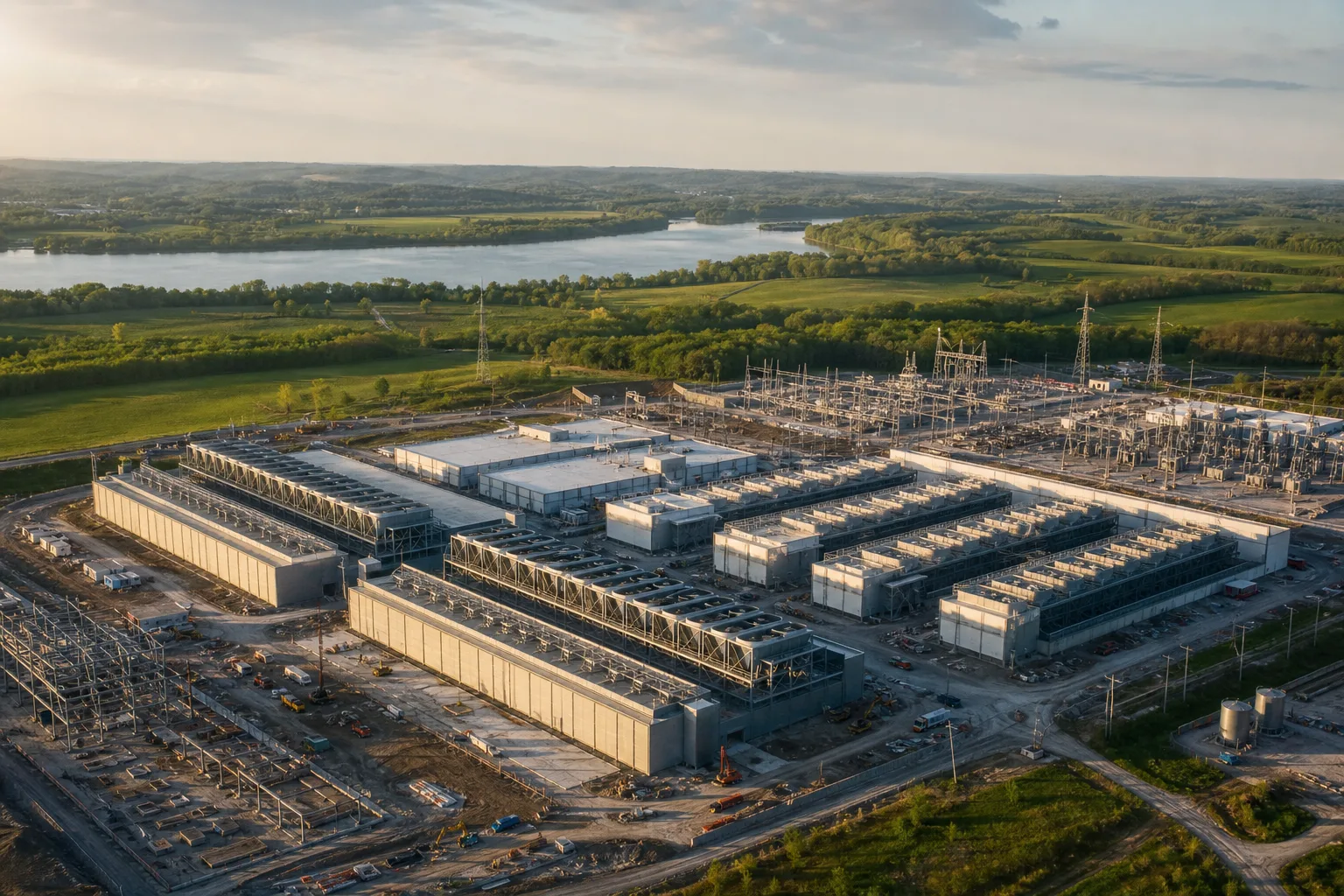
The TeraWulf Anthropic lease announced this week is the kind of contract that redefines a company overnight. TeraWulf — a firm that started life as a Bitcoin miner — has signed an agreement with Anthropic to host the AI lab at its Justified Data site in Hawesville, Kentucky. The deal will see Anthropic draw on 401 MW of IT load capacity. To put that number in perspective, 401 MW is enough to power a small city.
- Under the TeraWulf Anthropic lease, Anthropic will occupy the Justified Data site in Hawesville, Kentucky, pulling 401 MW of IT load.
- The deal is one of the largest single-tenant AI infrastructure commitments from a frontier AI lab to date.
- TeraWulf, originally a Bitcoin mining company, is completing a dramatic pivot toward high-density AI data center hosting.
Table of Contents
What the TeraWulf Anthropic Lease Actually Covers
The headline figures are striking, but the details matter here. The TeraWulf Anthropic lease centres on the Justified Data campus in Hawesville, which sits in western Kentucky, a region that has attracted data center developers partly because of its access to relatively low-cost electricity — a critical variable when you’re moving hundreds of megawatts around the clock. For an AI lab running continuous inference and training workloads at Anthropic’s scale, power cost isn’t a footnote; it’s one of the defining factors in where infrastructure gets built.
The 401 MW IT load figure refers to the actual computing power Anthropic will consume at the site — not the total facility draw, which would be higher once you factor in cooling, lighting, and other overhead. At typical power usage effectiveness (PUE) ratios for a modern hyperscale facility, total power draw could easily sit above 500 MW. That’s a substantial footprint even by the standards of Amazon Web Services or Microsoft Azure buildouts.
TeraWulf hasn’t disclosed the specific annual payment structure of the TeraWulf Anthropic lease or whether there are escalation clauses tied to inflation or energy costs.
Why Anthropic Is Betting on Owned and Leased Infrastructure
Anthropic’s decision to anchor a major chunk of its compute in a dedicated, single-tenant facility rather than purely in hyperscale cloud environments signals something important about where frontier AI development is heading. The company has existing relationships with both Amazon Web Services through its Bedrock platform and Google Cloud, which has poured billions into Anthropic as a strategic investor. So this isn’t a company that lacks cloud access.
What dedicated colocation or build-to-suit facilities offer that the public cloud doesn’t is control — over hardware configuration, network topology, power redundancy design, and ultimately cost at scale. When you’re spending billions of dollars on compute annually, the economics of owning or leasing your own infrastructure start to look very different from paying cloud on-demand rates. Microsoft figured this out for its own Azure buildout years ago. Meta has been running its own data centers for over a decade. The frontier AI labs are now following the same path, just at an accelerated pace.
There’s also a strategic calculus around supply security. The global market for high-quality data center capacity near reliable power sources is genuinely constrained right now. The TeraWulf Anthropic lease, which locks in 401 MW, means Anthropic doesn’t have to compete for that capacity in 2028 or 2031 when demand will almost certainly be even more intense than it is today.
TeraWulf’s Pivot From Bitcoin to AI Is Now Complete
The TeraWulf Anthropic lease is the clearest signal yet that TeraWulf’s transformation from crypto miner to AI infrastructure provider isn’t a side project — it’s the whole company now. TeraWulf was founded in 2021 with a focus on environmentally conscious Bitcoin mining, emphasising nuclear and hydroelectric power sources. That origin story still shapes the company’s infrastructure approach, but the business model has shifted dramatically.
It’s a pivot that mirrors what several other crypto-adjacent infrastructure companies have attempted with mixed results. The difference here is that TeraWulf appears to have secured an anchor tenant before doing the full buildout — which is exactly the right order of operations. Building speculative data center capacity hoping an AI lab shows up is a risky game. Having Anthropic signed before the concrete is poured changes the financing picture entirely.
For investors, the TeraWulf Anthropic lease will land as validation that the company’s strategy has attracted exactly the kind of counterparty it was positioning for. Whether TeraWulf can execute on the construction, power procurement, and operational side is the next question. A contract at this scale comes with delivery obligations that will be scrutinised closely.
The Bigger Picture for AI Infrastructure in 2025
This deal doesn’t exist in isolation. It’s part of a broader wave of AI infrastructure investment that’s reshaping the energy and real estate landscapes in ways that would have seemed implausible five years ago. Microsoft has committed to over $80 billion in data center spending for fiscal year 2025. Google and Meta have made similarly eye-watering pledges. The US government is pushing the Stargate initiative, which envisions hundreds of billions in domestic AI infrastructure investment.
Against that backdrop, a deal for a 401 MW facility in Kentucky isn’t an outlier — it’s a data point in a rapidly normalising category of infrastructure mega-deal. What’s notable is that Anthropic, which positions itself as the more safety-conscious, research-focused alternative to OpenAI, is moving just as aggressively on the infrastructure build-out as its more commercially aggressive peers. The gap between “AI safety company” and “hyperscale infrastructure operator” is apparently narrowing fast.
The TeraWulf Anthropic lease will also put pressure on other smaller data center operators to sharpen their pitches to AI labs. If a company like TeraWulf — with Bitcoin mining in its recent past — can land an anchor tenant at this scale, the race to position purpose-built AI campuses near affordable power is well and truly on. Expect more announcements like this over the next 12 to 18 months as AI labs scramble to lock in the physical capacity their model ambitions will require.