

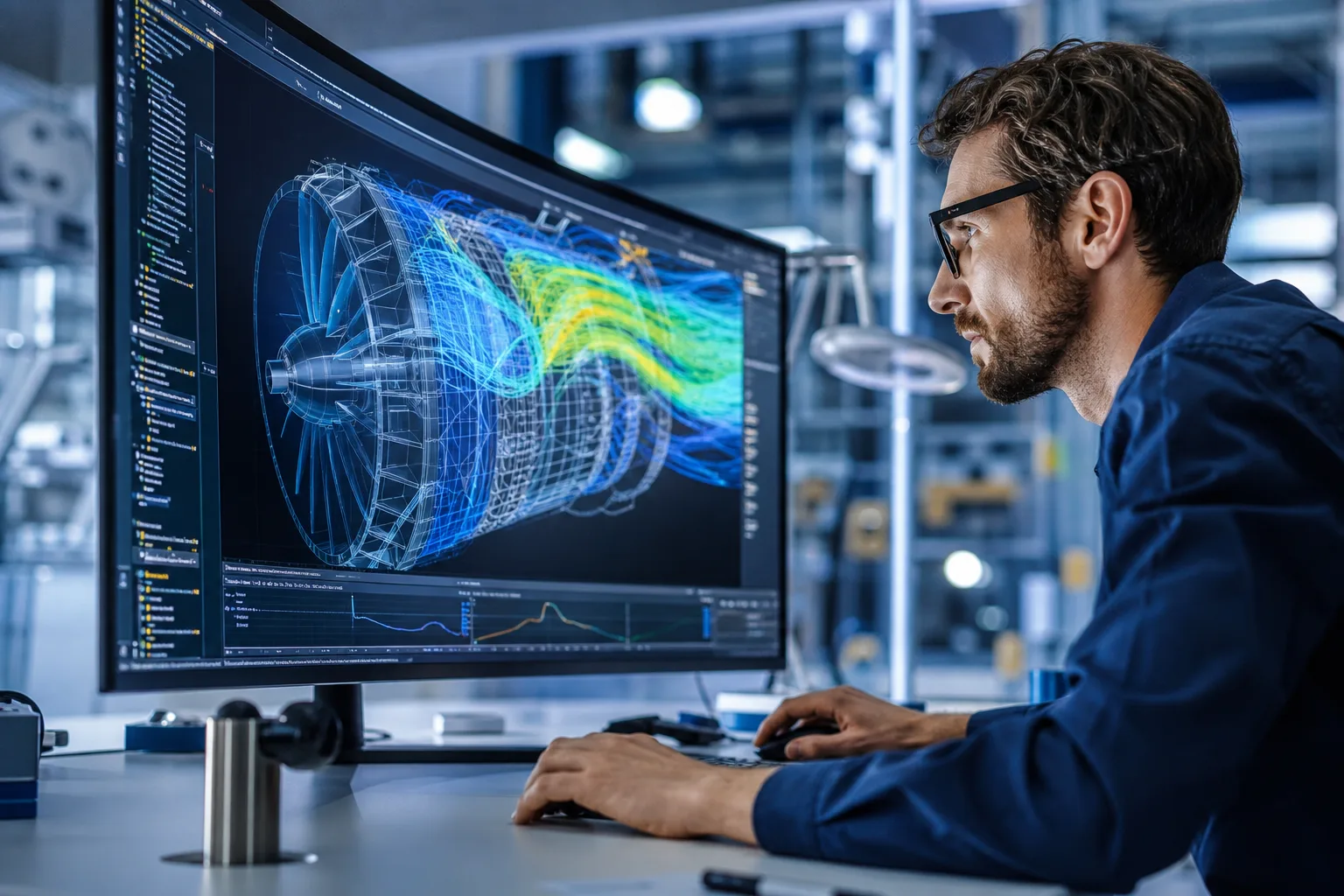
- Mistral AI is acquiring Emmi AI to build a leading industrial AI stack targeting aerospace, automotive, and semiconductor sectors.
- The industrial AI stack will combine Mistral’s platform with Emmi’s Physics AI models for real-time simulation and digital twins.
- Emmi AI’s 30-plus researchers will join Mistral in May 2026, with Linz becoming an official Mistral office.
- The deal signals Europe’s growing ambition to compete with US and Chinese firms in high-stakes engineering AI.
Mistral AI Is Building the Industrial AI Stack Europe Has Been Waiting For
Mistral AI is acquiring Emmi AI, and if you care about where European AI is actually headed, this deal deserves your full attention. The Paris-based AI company — already one of the continent’s most prominent players — is absorbing an Austrian startup that’s been quietly doing some of the most technically ambitious work in the industrial AI stack space. We’re talking Physics AI models capable of simulating fluid dynamics, power grid stabilisation, and injection moulding at scales that traditional computational methods simply can’t match in real time.
Emmi AI was founded in Linz and raised a €15 million seed round — reportedly the largest seed round ever raised by an Austrian startup — from investors including 3VC, Speedinvest, Serena, and PUSH. That funding gave Emmi the runway to build out a team of more than 30 researchers and engineers, now described as among the leading experts in engineering AI globally. Those people, along with Emmi’s co-founders, will formally join Mistral’s Science and Applied AI teams in May 2026.
What Makes Emmi AI Worth Acquiring
To understand why Mistral wants Emmi, you need to understand what Physics AI actually is — and why it’s a genuinely hard problem. Traditional industrial simulation relies on methods like computational fluid dynamics, or CFD, and discrete element methods, or DEM. These approaches are accurate but brutally slow. Running a single CFD simulation for an aircraft wing or an automotive crash test can take hours or days on expensive hardware. That latency is a fundamental bottleneck in engineering R&D.
Emmi’s answer was to train neural networks directly on physical systems, producing what the company calls neural surrogates — models that can approximate the outputs of physics-based simulations at a fraction of the compute cost. Their AB-UPT architecture, for instance, scales neural surrogates for CFD to industrial-scale problems with over 100 million mesh cells, achieving what the company claims is state-of-the-art accuracy with mesh-free inference and physics-consistent predictions. That’s not a toy demo. That’s the kind of capability that aerospace engineers and semiconductor fabs would pay serious money to access as part of a modern industrial AI stack.
Then there’s NeuralDEM, which Emmi introduced in November 2024 as the first end-to-end deep learning alternative to CFD-DEM multiphysics simulations. In early 2025, the company open-sourced the model and dataset, enabling real-time simulation of industrial particulate flows at production scale. Open-sourcing it was a bold move — it built credibility in the research community while signalling that Emmi’s real moat was the team and the proprietary models still in development, not any single released artefact.
What Mistral Gets — and What It’s Building
Mistral AI has spent the past two years positioning itself as Europe’s answer to OpenAI and Anthropic. Its models — Mistral 7B, Mixtral, and more recently Mistral Large — have earned genuine respect among developers for their efficiency and openness. But language models alone don’t win enterprise contracts in aerospace or semiconductors. Those sectors need something more specific: an industrial AI stack that speaks the language of physics, tolerates no hallucinations in safety-critical outputs, and integrates with existing simulation pipelines.
That’s exactly what this acquisition delivers. As Mistral CEO Arthur Mensch put it: “This strategic acquisition cements Mistral AI’s leadership in industrial AI and positions us as the partner of choice for manufacturers in high-stakes sectors like aerospace, automotive, or semiconductors.” It’s a clear statement of intent — Mistral isn’t just trying to be a general-purpose AI platform. It wants to own the industrial vertical.
Chief Science Officer Guillaume Lample went further, framing the combined capability around real-time simulations and digital twins: “We aim to break through long-standing technical barriers that have slowed progress for decades, enabling our partners to solve the world’s most daunting engineering challenges.” Digital twins — virtual replicas of physical systems that update in real time — have been a buzzword in industrial tech for years. The gap between the promise and the reality has always been compute cost and simulation speed. If Mistral and Emmi can genuinely close that gap with a unified industrial AI stack, the addressable market is enormous.
Johannes Brandstetter, Emmi AI’s co-founder and Chief Science Officer, framed the scope of what the combined team is targeting: “From the real-time stabilization of power grids to the intricate simulation of injection molding and automotive safety testing… we are positioned to revolutionize core R&D.” Power grids, injection moulding, automotive safety — these aren’t adjacent problems. They’re wildly different physical systems. The fact that Emmi’s models span that range suggests an architectural flexibility that’s genuinely impressive.
The European Angle Is Real, Not Just PR
There’s a tendency to dismiss

