

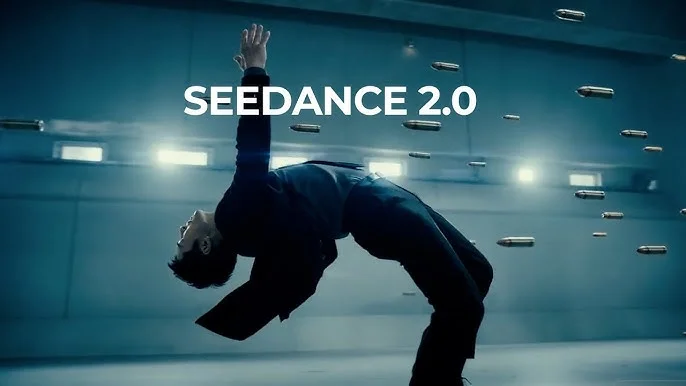
The launch of Seedance 2.0 has triggered a direct confrontation between AI developers and major film studios. At SquaredTech.co, we see Seedance 2.0 as a flashpoint in the larger dispute over generative video and copyright law: not because AI video is new, but because the quality and accessibility of these tools are bringing longstanding arguments into a much sharper commercial conflict.
The tool, released by ByteDance, allows users to create short fifteen second videos from simple text prompts. Reports indicate that the model is available to users of Jianying in China and will expand globally through CapCut. Like Sora from OpenAI, Seedance 2.0 can generate cinematic scenes that resemble professional productions. That comparison matters. Video generation is no longer being discussed only as a technical curiosity or an experimental production aid. It is increasingly being judged by whether its output can convincingly stand in for material associated with established entertainment brands.
The controversy stems from how easily users can recreate the likeness of actors and characters owned by major studios. Within days of release, sample clips circulated online that appeared to depict well known performers in fabricated scenarios. For Hollywood, the concern is not limited to a single clip or a single prompt. A system that can produce a large volume of recognizable, highly polished imitation material changes the practical burden of enforcement. Rights holders are used to responding to unauthorized uploads after they appear. Generative video raises the harder question of what happens when the means of making those uploads is built into a widely available product.
Table of Contents
Industry Groups Demand Immediate Action
The strongest response came from the Motion Picture Association. Its CEO Charles Rivkin accused ByteDance of enabling large scale copyright infringement and called for the company to halt the service. The Human Artistry Campaign described the model as an attack on creators, while SAG-AFTRA publicly supported the studios’ position.
Those statements reflect overlapping interests, but they are not identical. Studios are protecting valuable characters, franchises, footage, and distribution businesses. Performers and creator groups are also focused on the use of human likenesses and the possibility that fabricated material can be mistaken for authorized work. In a conventional copyright dispute, the argument may center on a particular film, image, or upload. With generative video, the debate expands to the underlying system, its training, its guardrails, and the degree to which a company can reasonably prevent predictable misuse.
Studios have also begun direct legal steps. The Walt Disney Company reportedly sent a cease and desist letter alleging that Seedance 2.0 reproduced and distributed derivative works featuring characters such as Spider Man, Darth Vader, and Grogu. Paramount Global followed with its own notice, arguing that many generated clips were visually and audibly indistinguishable from its films and television content.
“Indistinguishable” is an especially consequential allegation in this context. The closer generated work appears to an existing production, the less persuasive it may be to describe the output as merely inspired by a genre, style, or broad cultural reference. At the same time, visual similarity alone does not settle every legal question. Courts will have to examine what was allegedly used, what was generated, how specific the resemblance is, and whether the output crosses the line from imitation into an unlawful derivative work.
These claims focus on two core legal issues. First, whether training data included copyrighted material without permission. Second, whether user generated outputs constitute unlawful derivative works. Both questions will shape future court battles.
The distinction between those issues is important. Training-data disputes ask whether a model was built using protected material in a way that requires authorization. Output disputes ask what the public can actually make and share with the finished tool. A platform could face pressure on either front, or on both. For entertainment companies, that makes the problem difficult to contain through moderation alone. Blocking certain prompts may address some visible examples, but it does not necessarily resolve questions about the material used to develop a model. Conversely, arguments about training do not erase the immediate concern created when users can generate recognizable characters or performances on demand.
A Divided Approach To AI Partnerships
The reaction from Hollywood does not signal a full rejection of AI tools. Disney has pursued licensing discussions with Google over similar concerns, and it signed a multiyear licensing agreement with OpenAI. This contrast reveals a key distinction. Studios may accept AI systems that operate under negotiated agreements. They oppose systems that allow open replication of protected characters and performances without clear safeguards.
That is the most useful way to read the apparent contradiction. Hollywood is not choosing between AI and no AI. It is trying to establish who gets to set the terms. Licensing can create boundaries around what material is used, what types of output are permitted, and which party bears responsibility when problems arise. It also gives rights holders a route to compensation and a measure of control over how their most valuable properties are presented.
Open, consumer-facing generation tools present the opposite model. Their appeal is the simplicity of the experience: users type prompts and receive video. But that same simplicity can turn a famous character, a recognizable performer, or the visual language of a major production into raw material for countless unauthorized experiments. The scale is central. A studio may be able to challenge a single unauthorized video. It is far harder to police an environment where similar videos can be made repeatedly by different users, then circulated across platforms.
There is also a reputational issue that goes beyond lost licensing revenue. Characters such as Spider Man, Darth Vader, and Grogu are not simply pieces of content in a corporate catalogue. They are closely managed identities with expectations around tone, quality, audience, and brand association. Fabricated scenarios involving well known performers create a related risk: viewers may not know whether what they are seeing is official, endorsed, or entirely artificial. That uncertainty is likely to make studios and performer groups less willing to treat generative video as a neutral creative tool.
What the Seedance 2.0 dispute could establish
In the near term, Seedance 2.0 will likely face mounting legal pressure in the United States. Lawmakers and courts must clarify how existing copyright law applies to generative video. ByteDance must also decide whether to introduce stricter content controls.
The answers will affect far more than one product. AI companies need to know whether they can build broadly capable media models first and deal with disputes as they emerge, or whether formal permission and narrower deployment must come before scale. Media companies need to know whether their existing rights are sufficient to control AI-generated uses of their properties, or whether new agreements and new legal approaches will be required.
At SquaredTech.co, we view this dispute as a defining test for AI video platforms. If courts side with studios, companies will need formal licensing deals before deploying similar tools at scale. That could push the industry toward partnership-driven models in which major rights holders have a stronger role in deciding what systems can generate. If rulings favor AI developers, entertainment firms may accelerate their own in house models to protect intellectual property. In that scenario, control over the technology may become as important as control over the catalogue itself.
Either outcome will reshape how digital video creation intersects with copyright enforcement in the months ahead. The immediate argument is about Seedance 2.0, ByteDance, and clips that allegedly resemble protected work. The larger argument is about whether generative systems can remain open-ended when their output can reproduce the cultural and commercial value created by other people.
Stay Updated: Tech News

