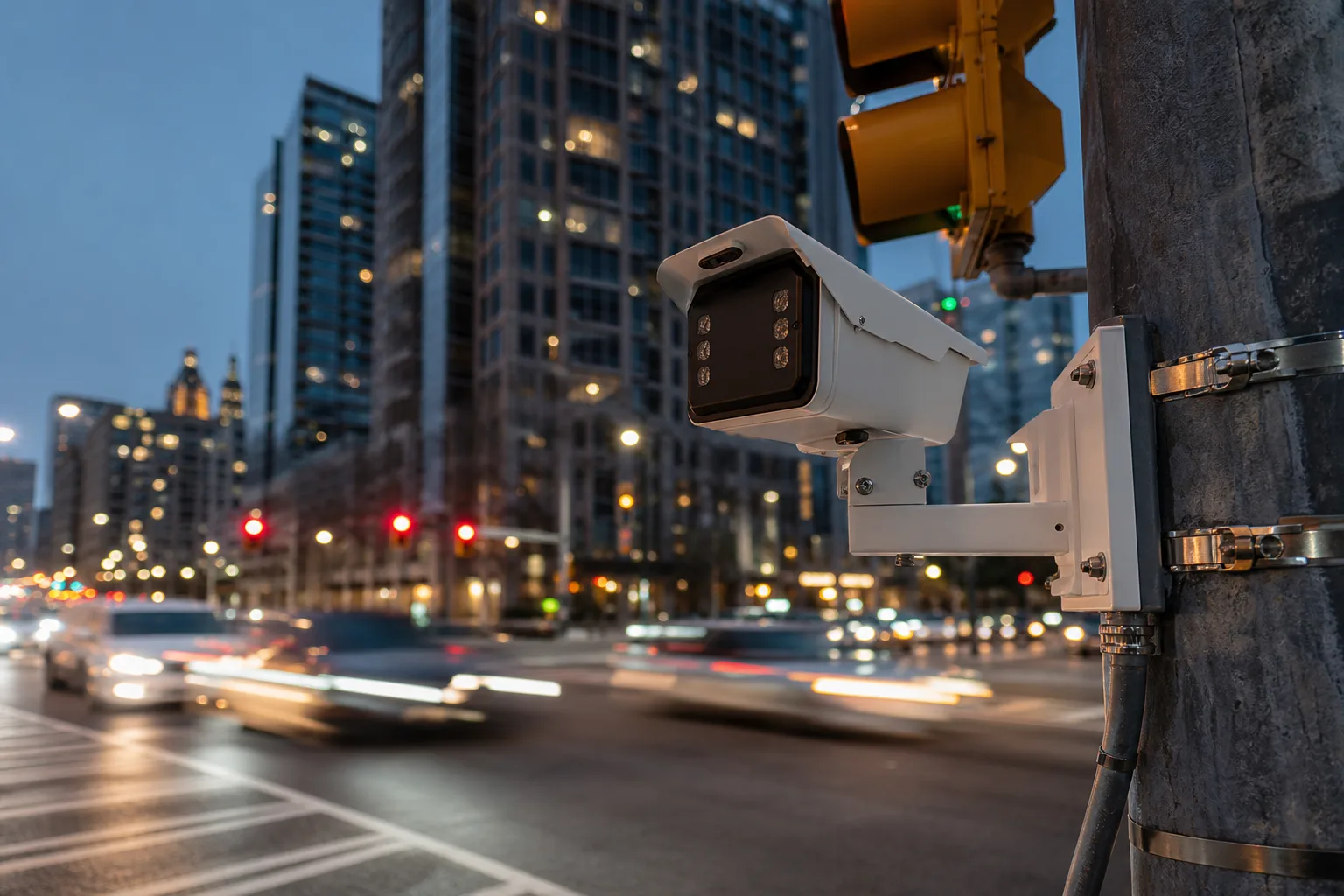
- A bipartisan amendment would ban license plate tracking by police as a condition of receiving federal highway funding.
- The license plate tracking restriction spans a single sentence but could force thousands of agencies to dismantle their camera networks.
- Flock Group, which operates around 88,000 ALPR cameras nationwide, is already under fire for sharing data with federal immigration authorities.
- Courts have so far declined to rule that ALPR queries constitute a Fourth Amendment search, leaving the legal status of these systems unresolved.
Table of Contents
One Sentence That Could Shut Down License Plate Tracking Across America
License plate tracking by law enforcement could be headed for a nationwide reckoning. A proposed amendment set for markup in the House Transportation and Infrastructure Committee would bar any recipient of federal highway funding from using automated license plate readers (ALPRs) for anything beyond tolling. That’s essentially every state, county, and city in the country — and it would mean tearing down one of the most quietly pervasive surveillance systems Americans have never voted on.
The amendment is co-sponsored by Representative Scott Perry, a Pennsylvania Republican and Freedom Caucus member, and Representative Jesús “Chuy” García, an Illinois progressive. The two sit at opposite ends of the ideological spectrum, which makes their collaboration here telling. When a right-wing fiscal hawk and a left-wing civil liberties advocate agree on something, it’s usually because the underlying issue has become impossible to ignore.
The bill they’re amending is no small thing. It’s a $580 billion, five-year reauthorization of federal surface transportation programs — the kind of legislation that sets infrastructure policy for the better part of a decade. Attaching a license plate tracking restriction to it is a sharp move. Federal highway money flows under Title 23 of the US Code, which covers roughly a quarter of all public road mileage in the country. Conditioning that funding on an ALPR ban gives the amendment real teeth.
How License Plate Tracking Actually Works — and Why Critics Are Alarmed
ALPR cameras are mounted everywhere: on utility poles, overpasses, traffic signals, and police cruisers. Every plate they photograph gets logged — time, location, image — and fed into searchable databases that are routinely shared across agencies and jurisdictions. Most drivers have no idea their movements are being catalogued this way. License plate tracking infrastructure has expanded so rapidly that even many local officials don’t have a clear picture of how many cameras operate within their own jurisdictions.
The scale is staggering. Flock Group, the Atlanta-based company that operates the largest ALPR network in the US, had approximately 88,000 cameras active at the time court records examined by the Electronic Frontier Foundation were filed. San Jose, California alone operates a 474-camera network that captured more than 360 million photographs in 2024 and was searched roughly 15,000 times a day by police across California in the second half of 2025, according to a class action complaint filed by the Institute for Justice in April.
That’s not a tool. That’s infrastructure — and it’s been built almost entirely without public deliberation.
Privacy advocates have argued for years that the aggregation of this data amounts to warrantless mass surveillance. The Brennan Center for Justice at NYU School of Law has documented how license plate tracking feeds are integrated into police data-fusion systems that combine plate data with video surveillance and social media monitoring. The EFF has documented specific misuse cases, including past deployment of the technology to monitor mosques and disproportionate placement of cameras in low-income neighborhoods.
The most chilling documented case involved a Texas sheriff’s deputy who used Flock’s nationwide network to engage in license plate tracking of a woman because, he wrote in records obtained by the EFF and reported by 404 Media, she “had an abortion.” That’s the kind of sentence that tends to change minds in Congress.
Flock’s Illinois Problem — and What It Reveals About the Broader System
Illinois has become a key battleground in this fight, which is part of why García’s involvement matters. Last August, Illinois Secretary of State Alexi Giannoulias announced that an audit had found Flock in violation of state law — specifically for giving US Customs and Border Protection access to Illinois ALPR data. Giannoulias ordered Flock to cut off federal access to the state’s network.
What followed was remarkable for its candor. Flock CEO and founder Garrett Langley acknowledged that the company had made public statements that “inadvertently provided inaccurate information” — meaning Flock had previously denied that federal pilot arrangements existed. They did exist. That kind of admission doesn’t build public trust, and it hasn’t.
Flock spokesperson Josh Thomas, responding to press inquiries about the Perry-García amendment, pointed to cases in Austin, Texas, where police in the nearby suburb of Manor said they used license plate tracking data to help apprehend a suspect connected to a series of shootings. “We hope the Committee members review this amendment carefully before heading down a similar path that would leave our first responders without the tools they need to keep residents safe,” Thomas said. It’s a fair point to raise — but it sidesteps the central question of whether these systems, as currently structured, can be trusted not to be weaponized against ordinary people.
Austin’s city manager TC Broadnax effectively ended the city’s use of Flock cameras last year over privacy concerns, despite pushback from the Austin Police Department. It wasn’t an isolated decision — dozens of municipalities across the country have now restricted or banned license plate tracking technology outright.
The Legal Landscape Around License Plate Tracking Is Shifting
Federal courts have been reluctant to rule that ALPR queries automatically constitute a Fourth Amendment search. The prevailing logic has been that people have no reasonable expectation of privacy in public spaces, including on public roads. Driving past a camera isn’t the same as being searched.
But that reasoning was formulated before anyone imagined a system capable of logging every vehicle movement across an entire metropolitan area for months or years on end. A Congressional Research Service brief published earlier this year noted that “state and federal courts have cautioned that the technology could run afoul of the Fourth Amendment moving forward,” with one court even suggesting that, given rapid advancements in ALPR capabilities, “that day might well be on the horizon.”
The Supreme Court’s 2018 ruling in Carpenter v. United States — which held that prolonged cell phone location tracking requires a warrant — is the obvious precedent that privacy advocates want applied here. The Court recognized that the sheer volume of location data collected over time creates a qualitatively different kind of surveillance than a single observation. The same logic applies to license plate tracking networks that can reconstruct months of someone’s movements from a database query.
The Institute for Justice’s class action against San Jose is pushing exactly this argument. The city’s mayor, Matt Mahan, is also named as a defendant in a separate state-court challenge filed by the EFF and the ACLU of Northern California. San Jose hasn’t yet filed a substantive response to the federal suit, but the litigation is likely to produce significant legal record regardless of outcome.
What Happens If the Amendment Passes — or Doesn’t
The amendment’s single-sentence structure is either elegant or blunt depending on your perspective. It doesn’t attempt to regulate license plate tracking — it bans it outright as a condition of funding. There’s no carve-out for serious crimes, no warrant requirement, no retention limit. That’s going to draw opposition from law enforcement groups and the companies that sell these systems, and it may not survive the markup process intact.
But even if it fails at committee, the Perry-García amendment puts license plate tracking on the legislative agenda in a way it hasn’t been before at the federal level. The bipartisan coalition behind it — however unusual the pairing looks — signals that the political calculus around surveillance technology is changing. The post-9/11 consensus that more data collection is always better public safety policy is fraying, and it’s fraying across party lines.
Flock and its competitors are going to face a harder environment regardless of what happens Thursday. The Illinois audit, the Texas abortion-tracking case, the San Jose lawsuit, the Austin reversal — each incident chips away at the “we’re just helping catch bad guys” framing that has shielded ALPR expansion from scrutiny. At some point, the burden of proof shifts: instead of privacy advocates having to prove that the system is dangerous, vendors will need to prove it isn’t. That shift may already be underway.