
Strategy’s dividend coverage has gone from a comfortable seven-year cushion to a precarious 14-month runway in the space of one year — and one of the most closely watched Bitcoin analytics firms is now publicly calling on Michael Saylor’s company to stop buying Bitcoin and fix its balance sheet before things get worse.
- Strategy dividend coverage has plummeted from seven years to just 14 months as cash reserves fell 38% year-to-date.
- CryptoQuant CEO Ki Young Ju says Strategy dividend coverage must be rebuilt to ~$2.8 billion before STRC can recover to par.
- STRC preferred stock fell to a record 17.5% below its $100 par value, limiting Strategy’s ability to raise fresh capital.
- MSTR common stock briefly traded below $100 in pre-market trading for the first time since March 2024.
Table of Contents
Strategy Dividend Coverage: From Seven Years to 14 Months
The numbers are stark. At the start of 2026, Strategy dividend coverage was sufficient to fund preferred dividend obligations for roughly seven years. Today, that buffer has shrunk to just 14 months. CryptoQuant, the Seoul-based on-chain analytics firm, published the analysis this week, and its CEO Ki Young Ju didn’t soften the message. Writing on X, he said Strategy should ‘pause Bitcoin purchases, rebuild cash reserves, and adopt a systematic framework for purchase timing.’ He also called for what he described as a ‘disciplined selling framework’ ahead of the next bull market.
The mechanics behind the collapse are worth unpacking. Strategy’s cash reserve fell 38% year-to-date after the company repurchased $1.5 billion of its 2029 senior notes at a discount earlier this year. At the same time, its annual dividend obligations have nearly quadrupled to $1.2 billion, largely because Strategy issued a significant volume of STRC preferred stock carrying an 11.5% annual yield. Those two forces — a shrinking reserve and a surging liability — have compressed Strategy dividend coverage at an alarming rate.

The company has taken some steps to stabilise things. It sold $335.5 million in MSTR shares earlier this week, adding around $300 million back into its US dollar reserve, lifting total cash to approximately $1.4 billion. It also stated publicly that it plans to ‘continue replenishing’ its USD reserve to ‘support the credit quality of its Digital Credit securities.’ But $1.4 billion against $1.2 billion in annual dividend obligations leaves very little room for error — and CryptoQuant’s analysis makes clear that Strategy dividend coverage remains close to a record-low position.
STRC Preferred Stock Feeling the Strain
The pressure isn’t staying contained to abstract balance sheet metrics. Strategy’s STRC preferred shares — the instrument the company uses as one of its primary tools to fund Bitcoin accumulation — fell to $82.50 last week. That’s 17.5% below the $100 par value at which they were issued, and a record low for the security. CryptoQuant attributed the drop to the combination of Bitcoin’s ongoing bear market correction and the simultaneous drain on cash reserves. Weak Strategy dividend coverage is a central factor driving that investor concern.
The consequences of trading below par are significant and somewhat self-reinforcing. When STRC sits below $100, Strategy loses the ability to raise fresh capital at reasonable terms through new STRC issuances. Investors simply won’t buy a new tranche of preferred stock at par when they can buy existing shares at a 17% discount in the open market. That forces the company into an awkward position: either raise the nominal dividend yield to attract buyers — which increases the very liability it’s struggling to manage — or find another way to signal financial strength.
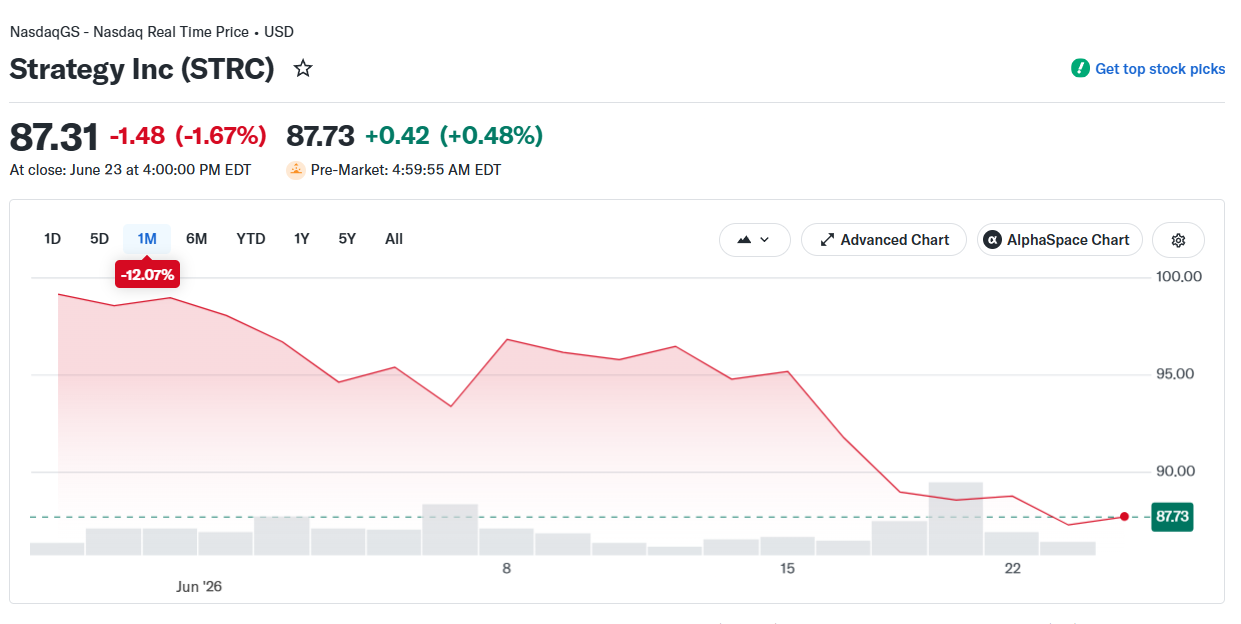
As of Tuesday’s close, STRC was sitting at $87.31, down 12% over the previous month according to Yahoo Finance data. Wednesday’s pre-market session showed little movement. The recovery path, according to CryptoQuant’s head of research Julio Moreno, runs directly through Strategy’s cash reserve. He attributed STRC’s decline to a ‘deterioration in Strategy’s fundamentals,’ specifically calling out the falling Strategy dividend coverage ratio and the fourfold increase in annualised dividend obligations through 2026.
The Bitcoin Cushion Is More Illusion Than Reality
One obvious question is whether Strategy could simply sell some of its Bitcoin holdings to shore up its position. The company is, after all, the largest public Bitcoin treasury holder in the world. But CryptoQuant’s analysis exposes why that option is far less straightforward than it appears.
Strategy is currently sitting on approximately $10.6 billion in unrealised losses on its Bitcoin holdings. Selling into today’s prices wouldn’t raise capital so much as permanently destroy shareholder value by crystallising those losses on the income statement. CryptoQuant’s conclusion is blunt: Bitcoin provides only a ‘limited emergency cushion,’ and a forced sale at current market rates would do more damage than good. The company has no contractual obligation to sell Bitcoin to defend STRC’s price — it can theoretically raise the dividend yield, issue MSTR stock, or wait for Bitcoin to recover — but none of those paths are quick or painless. Crucially, none of them directly address Strategy dividend coverage in the near term.

The math CryptoQuant lays out for a genuine recovery is demanding. To bring STRC back to its $100 par value, the firm says Strategy needs to rebuild its cash reserve to roughly $2.8 billion — enough to cover 24 months of dividend obligations. Restoring Strategy dividend coverage to that level is double where the reserve sits today, and it would require sustained, disciplined capital raising without simultaneously deploying that capital into Bitcoin purchases. For a company whose entire identity is built around perpetual Bitcoin accumulation, that’s a significant strategic pivot to ask for.
MSTR Common Stock Breaks a Key Psychological Level
The stress has spilled into Strategy’s common equity too. MSTR — the Nasdaq-listed common stock that became something of a retail trading phenomenon during the 2024 bull run — briefly dipped below $100 in pre-market trading on Wednesday. According to Yahoo Finance data, the last time MSTR traded below $100 was March 1, 2024, when it touched $99.20 intraday. The psychological significance of that level isn’t trivial. A sub-$100 MSTR price signals to the market that the premium investors once paid for Strategy’s Bitcoin-per-share exposure has evaporated — at least for now.
Strategy dividend coverage, STRC’s discount to par, and the MSTR price level are all ultimately symptoms of the same underlying problem: the company built its financial architecture on the assumption that Bitcoin would continue appreciating, that capital markets would remain receptive to its preferred stock issuances, and that it could service its growing dividend obligations without difficulty. The current bear market correction has stress-tested all three assumptions at once.
What Happens Next
CryptoQuant’s recommendation — pause Bitcoin buying, rebuild reserves, establish a systematic framework for both purchases and sales — reads as sensible risk management advice. Whether Michael Saylor follows it is another matter entirely. His public statements have been consistently maximalist on Bitcoin accumulation, and pausing purchases would represent a meaningful departure from the strategic identity he’s built for Strategy over the past five years.
The deeper issue is structural. Strategy has essentially turned itself into a leveraged Bitcoin fund wrapped in a software company shell, funding its accumulation through a combination of debt and yield-bearing preferred equity. That structure works elegantly when Bitcoin is rising and capital markets are eager. It creates significant pressure when both reverse simultaneously — and Strategy dividend coverage metrics make that pressure clearly visible. The company isn’t alone in this — other corporate Bitcoin holders face similar dynamics — but none have taken the model as far, or as publicly, as Strategy. If Saylor does blink and pivot toward reserve preservation, it would signal something important about the limits of the corporate Bitcoin treasury model that much of the industry has been watching closely. And if he doesn’t, the next few months of Bitcoin price action will determine whether the bet holds together or starts to crack further.
Source: Cointelegraph
Frequently Asked Questions
What does Strategy dividend coverage of 14 months actually mean?
It means Strategy’s current cash reserve can cover only 14 months of preferred dividend payments before running dry. That’s a dramatic fall from a seven-year coverage buffer, driven by a 38% drop in reserves and a near-quadrupling of annual dividend obligations to $1.2 billion.
Why is STRC trading below its $100 par value?
STRC fell to $82.50, about 17.5% below par, because of the Bitcoin bear market correction and the simultaneous depletion of Strategy’s cash reserve. When dividend coverage weakens and the underlying asset falls, the preferred stock loses its appeal to income-focused investors.
Is Strategy obligated to sell Bitcoin to protect STRC’s price?
No. According to CryptoQuant, Strategy has no obligation to sell Bitcoin to defend STRC. It can instead raise the 11.5% dividend yield, issue MSTR shares, or rebuild its cash reserve. Selling Bitcoin at current prices would crystallise roughly $10.6 billion in unrealised losses.
How much cash does Strategy need to stabilise its financial position?
CryptoQuant says Strategy needs to rebuild its cash reserve to approximately $2.8 billion — equivalent to 24 months of dividend coverage — before STRC can realistically recover back to its $100 par value and the company’s credit profile stabilises.