

Table of Contents
As editors at Squaredtech.co, we have followed Neural DSP closely since the original Quad Cortex changed expectations for digital guitar rigs in two thousand twenty. The Quad Cortex mini launch confirms what users have requested for years. Players wanted the same Quad Cortex power, screen, and workflow in a smaller body. Neural DSP has now delivered that vision without stripping away core features.
Quad Cortex mini arrives as Neural DSP answers years of demand
The Quad Cortex mini is Neural DSP’s most significant hardware release since the original unit. From the start, the company built the Quad Cortex around machine learning based modeling and fast touch driven control. That approach reshaped the multi effects market and forced major brands to respond. Fender, Line 6, IK Multimedia, and Fractal all adjusted their strategies as players demanded more realistic sound modeling in flexible formats.
Demand later shifted again. Guitarists began asking for smaller rigs that fit into travel setups, studio desks, and compact pedalboards. Neural DSP tested that space with the Nano Cortex in two thousand twenty four. That device served a different role and did not mirror the full Quad Cortex feature set. Many users still waited for a true downsized Quad Cortex. The Quad Cortex mini now fills that gap directly.
Quad Cortex mini packs full processing power into a smaller format
Neural DSP states that the Quad Cortex mini delivers the same processing architecture as the flagship unit. That claim stands out because compact units often sacrifice speed or depth. The Quad Cortex mini supports Neural Capture V1 and V2, allowing users to clone real amplifiers, cabinets, and pedals with high accuracy. This feature remains central to the Quad Cortex identity and now exists unchanged in the smaller unit.
The Quad Cortex mini includes access to over ninety amp models, more than one hundred effects, one thousand impulse responses, and two thousand captures. These numbers matter because they show that Neural DSP did not limit content to fit the form factor. The device also connects to Cortex Cloud, which allows users to manage presets and browse shared captures easily.
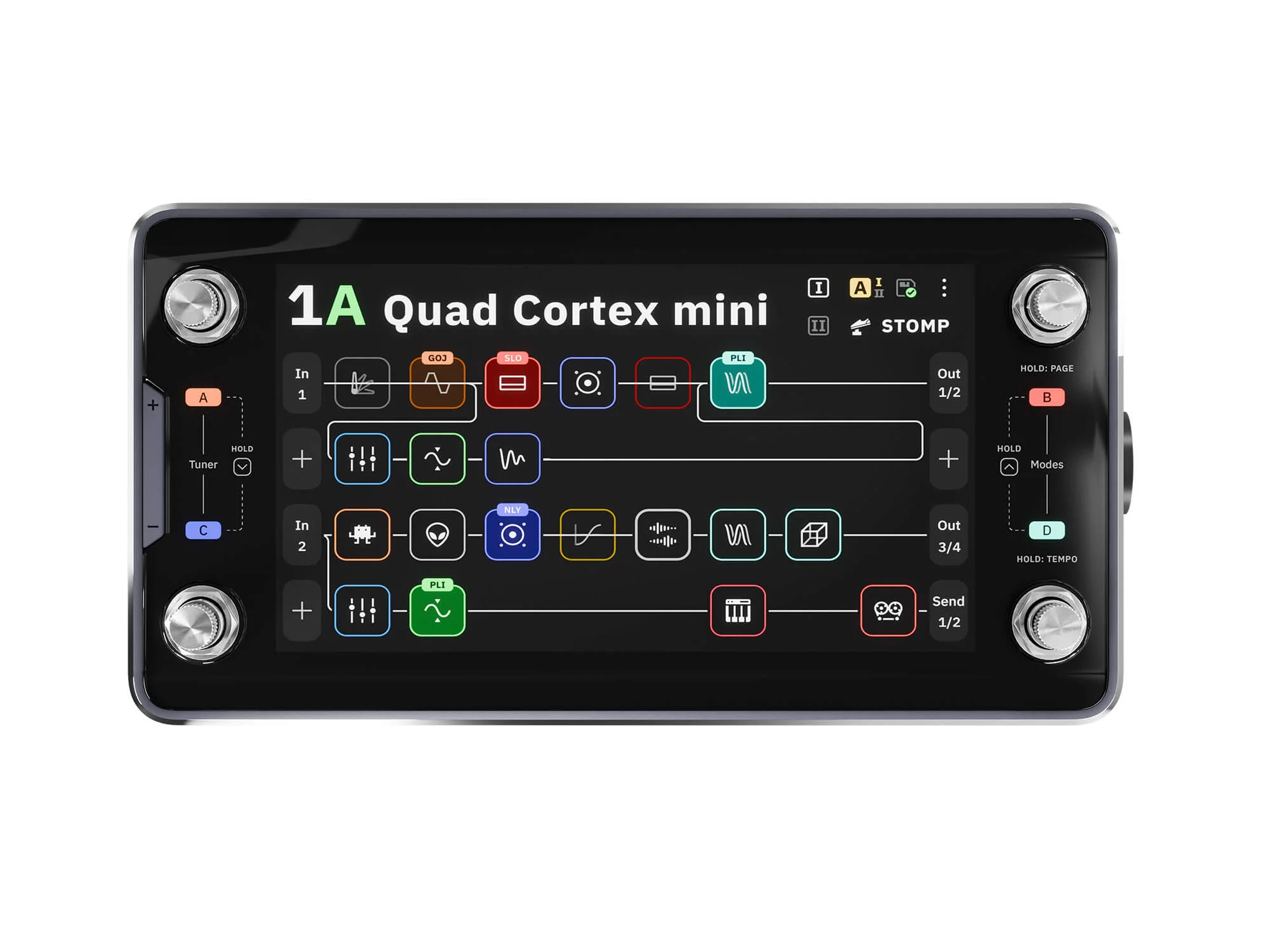
Physically, the Quad Cortex mini weighs about three point three pounds and measures under nine inches wide. Neural DSP redesigned the layout around a seven inch touchscreen. Four rotary footswitches sit at each corner of the screen, creating a clean and symmetrical interface. This design may surprise players who expected a layout similar to other compact modelers. Neural DSP clearly prioritized portability and screen driven control over traditional footswitch rows.
The company positions the Quad Cortex mini as rack friendly and desk friendly. While Neural DSP confirms that the unit works for live performance, the design strongly suits studio use, home recording, and mobile sessions. USB C support allows the Quad Cortex mini to function as a sixteen channel audio interface. This makes it useful for players who want to record directly into a computer without extra hardware.
Quad Cortex mini targets a competitive market with premium pricing
The Quad Cortex mini includes a wide range of connectivity options. It offers quarter inch and XLR inputs and outputs in mono and stereo configurations. A dedicated headphone output supports silent practice. A Gig View mode simplifies performance control. Preset, Scene, Stomp, and Hybrid modes remain available just like on the larger Quad Cortex. These features show that Neural DSP focused on consistency rather than reinvention.
Neural DSP leadership framed the launch around philosophy rather than compromise. CEO Douglas Castro stated that the company aims to define the standard for all in one digital rigs. Co founder Francisco Cresp reinforced the message by saying that size should not define professional capability. From a Squaredtech.co perspective, these statements align with the hardware itself. The Quad Cortex mini exists because Neural DSP chose not to dilute performance.
Pricing places the Quad Cortex mini in an interesting position. At one thousand three hundred ninety nine dollars or twelve hundred ninety nine euros, it sits between the original Quad Cortex and the Nano Cortex. The price reflects its full feature set, but it also limits accessibility for casual players. The Nano Cortex remains the entry option, while the flagship Quad Cortex still appeals to users who want a larger control surface.
The timing of the Quad Cortex mini matters. Line 6 recently revealed the Helix Stadium XL and signals point to new compact releases from competitors. Fender and IK Multimedia also remain active in this space. By launching now, Neural DSP positions itself ahead of the next wave of compact professional modelers.
From our analysis at Squaredtech.co, the Quad Cortex mini serves two purposes. It protects Neural DSP’s leadership position and responds directly to long standing community demand. Whether competitors can match its feature set at a lower price remains uncertain. What is clear is that the Quad Cortex mini raises expectations again and proves that compact guitar rigs no longer need to sacrifice depth, control, or sound quality.
Stay Updated: Gadgets

