
Table of Contents
MacBook Neo changes the pricing structure of Apple laptops in a visible way. At $599, and $499 with education pricing, MacBook Neo sits far below the $1,099 starting price of the M5 MacBook Air and even undercuts discounted M4 Air models that often sell around $899. That price gap reshapes the decision tree for buyers who once had to stretch their budget to enter the Mac ecosystem.
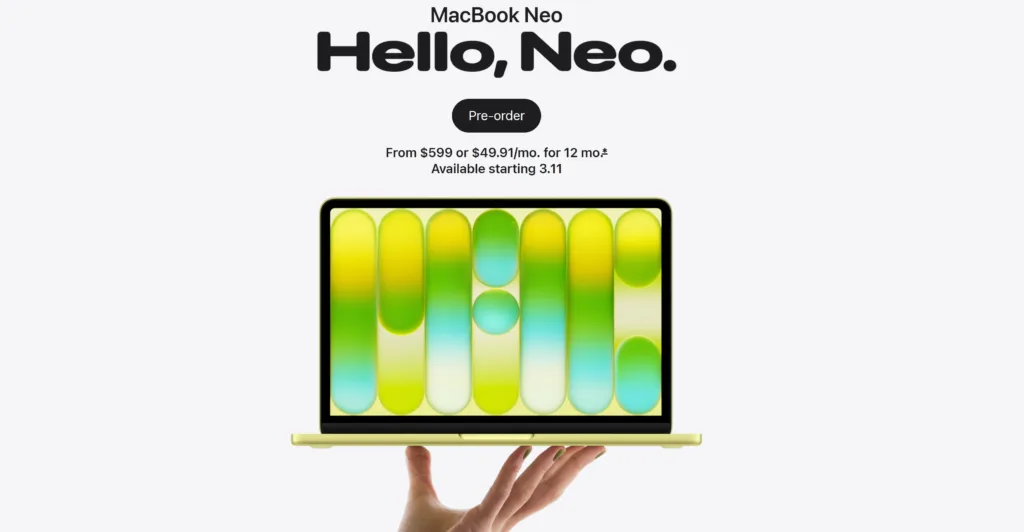
MacBook Neo Lowers the Entry Point for Mac Buyers
From our perspective at SquaredTech.co, the key issue is segmentation. Apple now offers three distinct tiers. MacBook Neo targets entry level buyers. The M4 MacBook Air occupies the middle ground. The M5 MacBook Air pushes performance forward with a higher ceiling. The unusually large price jump between Neo and Air suggests Apple intends Neo to protect market share against Chromebooks and low cost Windows systems rather than disrupt the Air directly.
Yet hardware trade offs define the real story. MacBook Neo runs on the A18 Pro with six CPU cores and five GPU cores, paired with 8GB of memory. The Air models offer ten core CPUs, stronger graphics, and 16GB of memory as standard. Storage begins at 256GB on Neo and scales higher on the Air. On paper, the Air maintains a clear performance advantage for sustained workloads.
Where MacBook Neo Makes Sense
MacBook Neo makes sense for light productivity and content consumption. Web browsing, document editing, video streaming, and casual photo edits fall well within the capability of its processor. For many households, it functions like a large screen iPad with a fixed keyboard and full macOS support. Its 13 inch Liquid Retina display avoids the compromise many expected at this price, and its aluminum body keeps weight aligned with the Air.
However, missing features matter. The keyboard lacks backlighting. The base model omits Touch ID. The trackpad uses a mechanical design instead of Apple’s haptic system. Ports drop from Thunderbolt 4 on the Air to slower USB C standards, and there is no MagSafe charging connector. These choices reduce cost, but they also create friction for power users who rely on fast external drives or multiple high resolution displays.
Memory is the most important constraint. Eight gigabytes remains workable for casual multitasking, but modern creative software and AI driven tools demand more headroom. Upgrading storage to 512GB costs an extra $100, yet memory cannot scale beyond 8GB. Buyers who attempt to compensate with higher storage still face the same performance ceiling.
The Near Term Outlook for Buyers
MacBook Neo will likely dominate school campuses because price remains decisive in education purchasing. For general consumers, the decision hinges on workload. If daily tasks involve writing, streaming, email, and light editing, MacBook Neo provides strong value. If tasks include video production, AI workloads, or heavy multitasking, the MacBook Air with 16GB of memory delivers longer useful life.
In our assessment, MacBook Neo strengthens Apple’s entry strategy without replacing the Air. It expands access while preserving performance separation. Buyers should view Neo as a cost efficient gateway, not a long term power machine.
Stay Updated: Gadgets