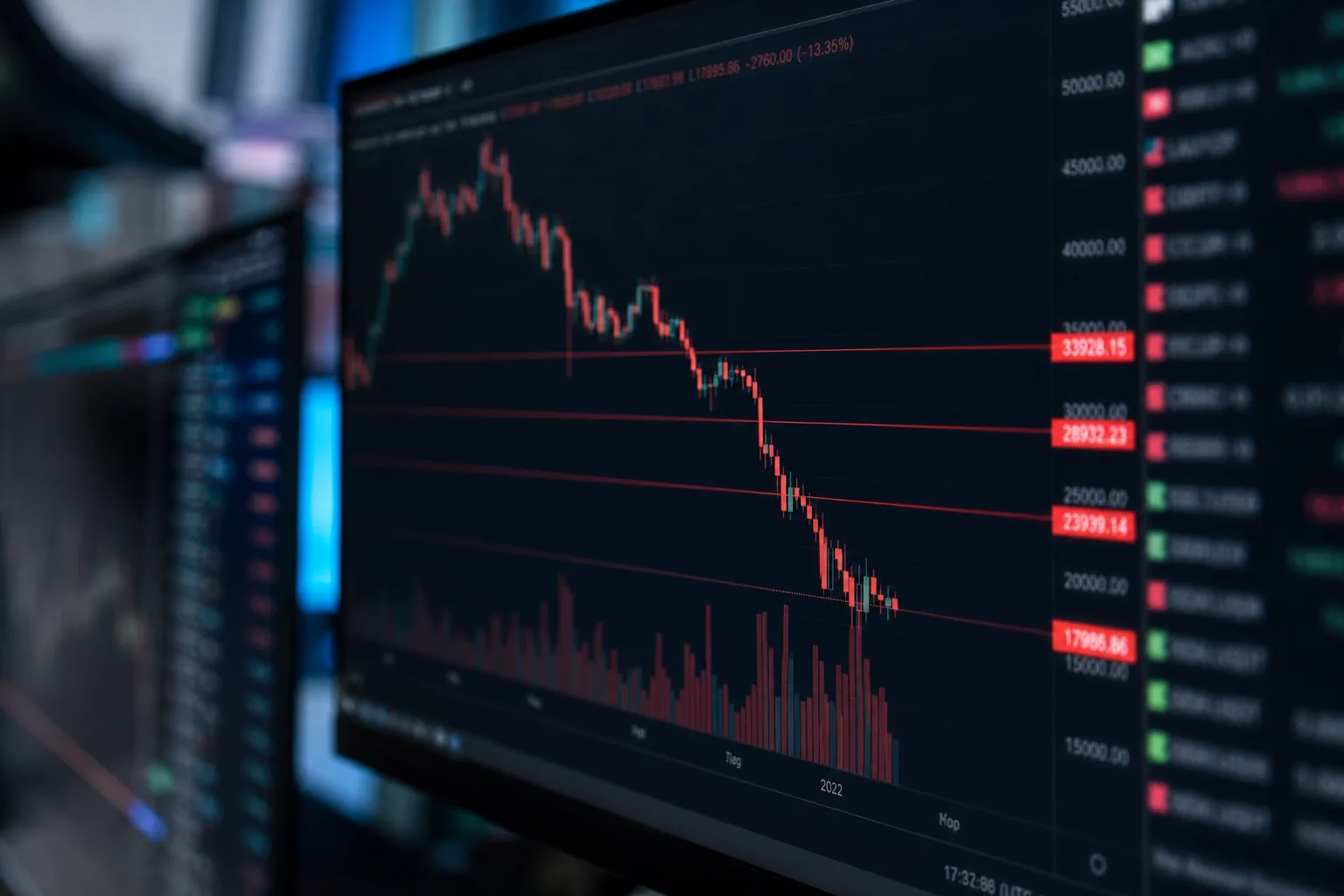
- The XRP price drop to a 15-week low near $1.20 came despite shrinking exchange balances and strong ETF inflows.
- XRP price drop below $1.25 flipped that level into resistance, trapping bulls in a descending price structure.
- Over 25 million XRP left exchanges recently, a supply signal that the market has completely ignored.
- Traders are now watching the $1.20–$1.21 zone — a breakdown there could push XRP toward $1.13.
Table of Contents
The XRP Price Drop That Defies Easy Explanation
The XRP price drop this week wasn’t supposed to happen — at least not according to the usual playbook. Exchange balances are falling. Binance inflows hit their lowest point of 2026. Spot crypto ETFs pulled in roughly $1.42 billion in fresh capital. And yet XRP still shed more than 5% in a single session, breaking through the $1.25 support level and touching a 15-week low near $1.1858 before recovering slightly to hover around $1.20. If you were designing a bullish setup for XRP, this would be it. So why is the price still falling?
The short answer is that the market doesn’t care about your thesis right now. The slightly longer answer is that when an asset starts ignoring positive fundamentals, it’s usually telling you something important about who’s actually in control of the tape. Right now, that’s sellers.
What Actually Happened During the Selloff
The decisive move came during the June 2 14:00 UTC trading session. Volume spiked to 205.7 million — well above recent norms — and price cut through $1.25 without much of a fight. XRP opened that 24-hour window at $1.2712 and closed near $1.2026, with an intraday low of $1.1858. That’s not a quiet drift lower. That’s a deliberate breakdown, the kind that leaves a mark on the chart and reshapes how traders think about the structure going forward.
The $1.25 level had been acting as a floor. Once it broke, the math changed. That support became resistance almost immediately — meaning any rally attempt now runs into overhead selling pressure right at the point where bulls used to feel comfortable. It’s a classic momentum trap, and XRP is sitting squarely inside one. This XRP price drop has effectively reset the technical landscape for the near term.
Why the XRP Price Drop Is Ignoring the Bullish Supply Data
Here’s where it gets genuinely interesting. More than 25 million XRP left exchanges in recent days. On-exchange supply dropping is almost always interpreted as a bullish signal — it suggests holders are moving coins into self-custody, reducing the amount available for sale. Binance inflows, which can act as a leading indicator of selling pressure, fell to their lowest levels of the entire year. And broader crypto market appetite remains healthy, with spot ETF data from CoinGlass and other trackers confirming sustained institutional interest in the asset class.
Any one of those data points, in a healthy trending market, would be reason for optimism. Together, they read like a perfect storm of bullish conditions. And yet the XRP price drop continued regardless. That divergence between fundamentals and price action is the real story here — and it’s not as rare as it sounds.
Late-stage downtrends do this. Traders who’ve been burned stop trusting the supply signals. They’ve seen the “exchange balances are falling” headline before, watched the price rally weakly, then roll over. After enough of those false dawns, the market starts pricing technicals rather than on-chain data. The chart becomes self-fulfilling. Lower highs breed lower lows, and the fundamental case gets buried under the weight of negative sentiment.
The Technical Picture: Lower Highs and No Follow-Through
Strip away the on-chain narrative and what you’re left with is a clean descending structure. XRP has been printing lower highs for weeks. Each recovery attempt has faded before reclaiming meaningful resistance, and follow-through buying — the kind that suggests genuine conviction from bulls — has been conspicuously absent throughout this XRP price drop cycle.
The bounce from below $1.19 showed some signs of short-term exhaustion from sellers. Volume dried up briefly, price stabilized, and there was a modest recovery toward the $1.20 handle. But “modest recovery to $1.20 after breaking $1.25” isn’t exactly a ringing endorsement of bull strength. It’s more consistent with dead-cat territory than a genuine reversal setup.
For the chart to change character, bulls need to reclaim $1.25 first — and hold it, not just poke above it intraday. That level has now flipped to resistance, which means it’ll attract sellers who bought there previously and are now underwater, looking to exit at breakeven. Getting back above it requires enough buying pressure to absorb that overhead supply, and there’s no sign of that yet.
What Traders Are Watching Now
The immediate battleground is the $1.20–$1.21 zone. That’s where price has stabilized, and it’s the last meaningful support before a larger gap opens up to the downside. If that level gives way under sustained selling pressure, the next area of technical interest drops significantly — to $1.13–$1.15. That’s not a prediction, but it’s a scenario traders need to have in their heads if they’re active in XRP right now. A continued XRP price drop through $1.20 would mark a significant escalation of the current bearish structure.
On the upside, $1.25 is the first gate bulls need to unlock. Beyond that, there’s likely additional resistance in the $1.28–$1.30 range before the structure starts to look constructive again. Recovery from a descending trend like this tends to be slow and grinding unless there’s a significant catalyst — a major partnership announcement, a regulatory development, or a sudden reversal in broader crypto sentiment.
The broader crypto market adds another layer of complexity. The same week saw nearly $1.84 billion in leveraged crypto positions liquidated as Bitcoin fell below $66,000 and Ether dropped under $1,900. Long positions absorbed the majority of the damage — roughly $1.66 billion — with Bitcoin, Ether, and Solana longs all getting hit hard. The single largest unwind was a $59.67 million BTC-USDT long on HTX. In that kind of environment, XRP’s struggle to hold ground becomes a lot more understandable. When risk is coming off broadly, altcoins rarely buck the trend.
XRP Price Drop in Context: A Market Caught Between Two Stories
What makes this moment genuinely unusual is the tension between the two competing narratives pulling at XRP simultaneously. The supply story is legitimately constructive — coins leaving exchanges, Binance inflows drying up, institutional money still coming into the crypto asset class through ETFs. If those signals are right, then patient holders buying near current levels could be well-positioned months from now.
But the price story is telling a different tale entirely. Descending structures don’t resolve themselves just because the fundamentals look good. They resolve when buyers show up with enough conviction to break the pattern — and that hasn’t happened yet. Until $1.25 is convincingly reclaimed, the path of least resistance remains lower, regardless of what the on-chain data says. Each failed bounce only reinforces the XRP price drop narrative in the minds of short-term traders.
XRP has been here before. It’s a token with a complicated history, a passionate community, and a tendency to make dramatic moves in both directions. The question isn’t whether it can recover — it’s whether the conditions for that recovery are in place yet. Right now, they’re not. But the ingredients are sitting in the kitchen, and that’s more than can be said for most assets at a 15-week low.