

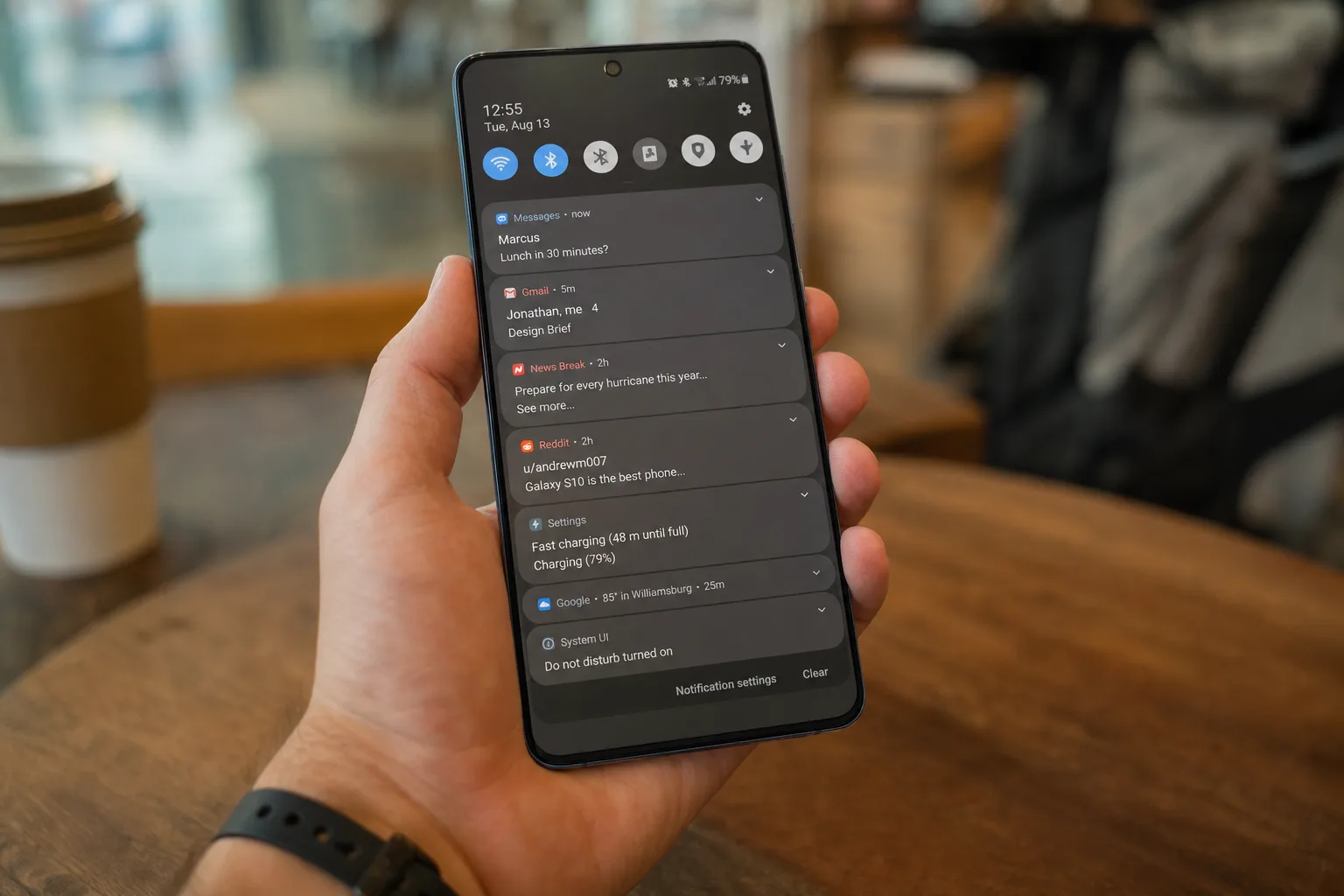
- Push notifications control now sits firmly with Apple and Google — every alert passes through their servers before reaching your screen.
- Apple and Google’s push notifications control has tightened consistently since 2017, with AI-driven filtering increasingly replacing simple user settings.
- Android 13’s opt-in requirement cut notification reach by up to a third in some app categories, according to Pushwoosh data.
- Unlike email, app developers have almost no visibility into what happens to their notifications once they leave the server.
Table of Contents
Push Notifications Control Starts With a Battery Problem
Push notifications control — who has it, who lost it, and where it’s heading — is one of the more consequential shifts in mobile computing that most people aren’t paying attention to. Every notification that has ever landed on your iPhone or Android device travelled through one of two company-owned pipes. Not your carrier. Not your Wi-Fi provider. Apple or Google. That’s it. And what those companies choose to do inside those pipes has changed dramatically over the past fifteen years.
The story begins, of all places, with battery anxiety. In June 2009, Apple’s Scott Forstall took the stage at WWDC to explain a fundamental problem with the smartphone model of the time: you couldn’t let every installed app maintain its own persistent background connection to a remote server without draining the battery in hours. Apple’s solution was the Apple Push Notification Service (APNs) — a single, persistent TLS connection from each device to Apple’s servers, through which any registered third party could deliver alerts. It shipped with iPhone OS 3 on June 17, 2009, about nine months later than originally announced while Apple rebuilt the underlying infrastructure for scale.
Google followed suit in 2010 with Cloud to Device Messaging, which evolved into Google Cloud Messaging in 2012 and then Firebase Cloud Messaging in 2016. Two pipes. Two companies. The entire global push notification ecosystem funnelled through them from day one. The platforms have always had the technical ability to throttle, drop, log, deprioritise, or refuse any notification. For most of the channel’s history, they simply chose not to. That restraint is what ended.
Fifteen Years of Tightening the Screws
The early era of push notifications — roughly 2009 through 2017 — was comparatively hands-off. Apps could send pretty much what they wanted, and users had a blunt instrument to respond: a single per-app on/off toggle. Push notifications control, such as it was, belonged almost entirely to the sender during this period. That changed in August 2017 with Android 8 Oreo, which introduced notification channels. Before Oreo, the sender decided the priority of every notification. After it, that power shifted first to developers, then meaningfully to users.
Under the channel system, developers had to declare distinct notification categories — think messages, downloads, and promotions — each assigned an importance level running from IMPORTANCE_NONE to IMPORTANCE_HIGH. Users could then mute, demote, or block individual channels without affecting the others. Critically, once a developer set a channel’s importance level, they couldn’t raise it later. Any app targeting Android 8 that didn’t declare channels simply went dark. No exceptions.
Apple restructured its side of the equation with iOS 15 in September 2021, introducing Focus modes, Scheduled Summary, and a new four-level interruption taxonomy: passive, active, time-sensitive, and critical. Of those, time-sensitive was the only level that gave senders any real ability to break through — and Apple was unambiguous that marketing messages don’t qualify. The operating system was now making editorial judgments about which alerts were worth interrupting you for. Push notifications control had quietly moved up the stack.
The Opt-In Cliff That Changed the Numbers
The single biggest structural shift in push notifications control came in August 2022, when Android 13 turned the POST_NOTIFICATIONS permission into a runtime requirement. For the first time, Android users had to explicitly grant apps the right to send them notifications, replacing the implicit opt-in that had existed since Android’s launch.
The impact was immediate and measurable. Pushwoosh, analysing a sample of 16 million devices, found that gaming apps lost nearly a third of their opted-in user base. News apps dropped 19 percent. Batch’s 2025 benchmark — drawn from over 800 billion messages across 10,000 apps — reported Android opt-in rates falling from 85 percent to 67 percent in a single year, with the cross-platform average settling at around 61 percent. For context, that means roughly four in ten users who have an app installed are now completely unreachable via push.
Some of that lost reach went back to users, who genuinely benefit from not being buried in alerts from apps they barely use. But a meaningful portion of push notifications control passed to the platforms themselves — and that’s where it gets uncomfortable for anyone trying to reach an audience. Platform-level filtering is opaque. There’s no appeal process. And increasingly, the decisions are being made by machine learning models rather than by explicit settings a user ever consciously chose.
When AI Starts Editing Your Alerts
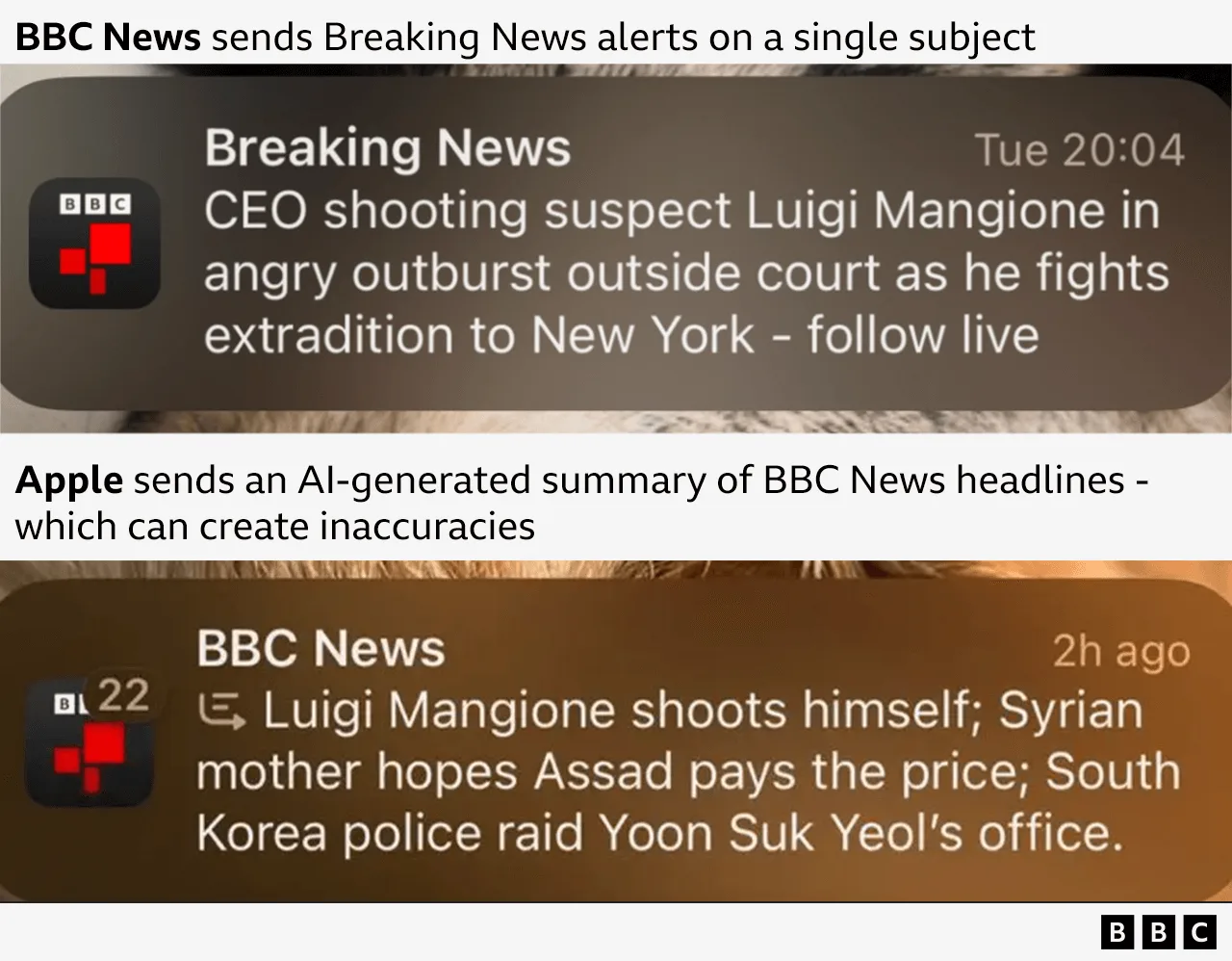
Here’s the thing that should concern every app developer and marketer: Apple and Google aren’t just deciding whether your notification gets delivered. They’re starting to decide how it’s presented — and in some cases, what it says. Both platforms now run on-device models that can summarise, reorder, and rewrite notifications before they hit the lock screen. A message your server sent word-for-word may not be the message your user reads. Push notifications control, in this sense, now extends to the content itself.
This is where the parallel to email becomes useful as a frame. Email providers — Google, Apple, Microsoft, Yahoo — have been doing exactly this to inboxes for years. Machine learning has shaped inbox placement since the late 1990s, when Bayesian spam filtering replaced rule-based systems. Authentication standards like SPF, DKIM, and DMARC came later, functioning not as replacements for algorithmic judgment but as additional signals feeding into it. Push is following the same arc, just a few years behind.
The difference is that email gives senders at least some instrumentation to work with. Google’s Postmaster Tools, deliverability dashboards, bounce rates — they’re imperfect, but they exist. Push gives senders almost nothing. You fire a notification into Apple’s or Google’s pipe and you get a delivery receipt at best. Whether the notification was suppressed, summarised, rewritten, or shown exactly as sent? That information largely doesn’t come back to you.
What Push Notifications Control Actually Means for Senders
There’s a case to be made that all of this is good for users. A notification surface that’s intelligently filtered is less fatiguing than one that isn’t. People who don’t feel overwhelmed by alerts are less likely to nuke an entire app’s permissions or uninstall it outright. Lower uninstall rates and reduced notification fatigue serve the platforms too — a clean, calm lock screen is part of what makes iOS and Android feel premium. The editing, in other words, serves multiple interests at once, and user wellbeing is only one of them.
For senders — whether that’s a media company, a retailer, or an indie app developer — the practical reality is this: push notifications control over your own messages is largely an illusion. You are operating inside a channel you don’t own, with rules that can change without notice, enforced by systems you can’t inspect, with almost no feedback on what’s happening. Every policy update from Apple or Google is a potential reconfiguration of your reach.
That’s not a hypothetical risk. It’s already happened repeatedly. Opt-in rates are down. Channels have been demoted. Summaries have replaced real-time alerts for categories the platform deems non-urgent. And the trajectory — more AI involvement, more on-device filtering, more platform-level editorial control — points clearly in one direction.
Where This Is Heading
Watch email if you want to see where push notifications control is going. The inbox went from a simple delivery system to a fully intermediated, AI-curated surface over about two decades. Push is moving faster, partly because the platforms learned from the email playbook and partly because the on-device AI hardware is now powerful enough to run sophisticated models locally in real time.
The next few years will likely see Apple and Google pushing harder on notification quality signals — engagement rates, user dismissal patterns, content classification — to determine not just whether a notification is delivered, but when, in what form, and whether it’s shown at all. Developers who build apps that people actually want to hear from will probably navigate this fine. Those relying on volume and frequency to compensate for weak content are heading toward a wall. The platforms are building that wall deliberately, and they’re not in a hurry to apologise for it.

