

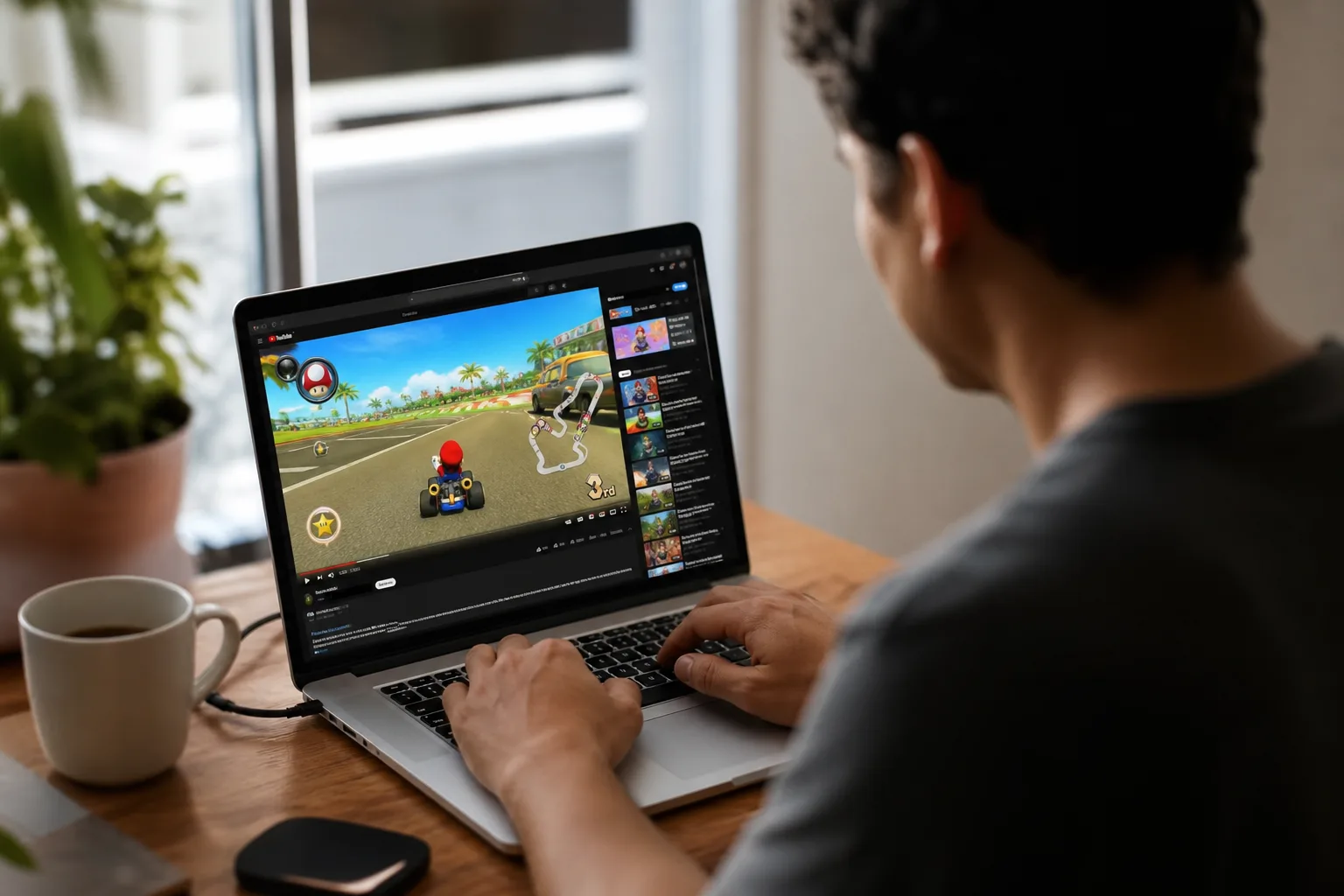
Nobody asked for Mario Kart on YouTube — and yet here we are, and it’s kind of brilliant. Two creators have pulled off one of the more inventive platform hacks in recent memory, turning Google’s video streaming giant into a surprisingly functional racing experience. It shouldn’t work. And yet it does.
- Mario Kart on YouTube is now playable thanks to creators Atlas Arcade and Animated Subtitles using 360-degree video.
- The Mario Kart on YouTube experience lets players choose from seven characters via the subtitle menu.
- Players can swerve left and right on Rainbow Road using keyboard controls in the one-minute interactive video.
- The project is a clever experiment in platform creativity, though it lacks items, opponents, and full gameplay depth.
Table of Contents
What Mario Kart on YouTube Actually Is
The project comes from YouTube creators Atlas Arcade and Animated Subtitles, who teamed up to build a fan-made interactive video that puts you behind the wheel on Rainbow Road — the iconic, nightmarish track that has haunted players since the original Super Nintendo days. On desktop, you steer left and right using keyboard controls, dodging obstacles as the course unfolds around you. It’s not the Nintendo Switch 2. It’s not even close. But it works, and that’s the impressive part.
The whole thing clocks in at about a minute long, which means you won’t be sinking hours into this. There are no power-up boxes to smash through, no blue shells flying at your face from behind, and no opponents to elbow off the track. What you do get is a single-player obstacle run that captures just enough of Rainbow Road’s visual identity to trigger that unmistakable Nintendo nostalgia.
The Clever Technical Trick Behind It
Here’s where it gets genuinely interesting. The creators didn’t build a browser game or embed anything external — they built this entirely within YouTube’s own native feature set. The secret ingredient is YouTube’s 360-degree spherical video format, a feature YouTube has supported since 2015 but that most creators use for virtual reality walkthroughs, concert footage, or the occasional gimmick travel vlog.
In a standard video, you’re locked into whatever frame the filmmaker chose. With 360-degree video, you can drag the perspective around — up, down, left, right. Atlas Arcade and Animated Subtitles realised that ‘left and right’ is basically all you need to simulate steering. By building the course geometry and obstacles into a spherical video environment, they transformed a passive viewing feature into an active control scheme. That’s genuinely smart design thinking.
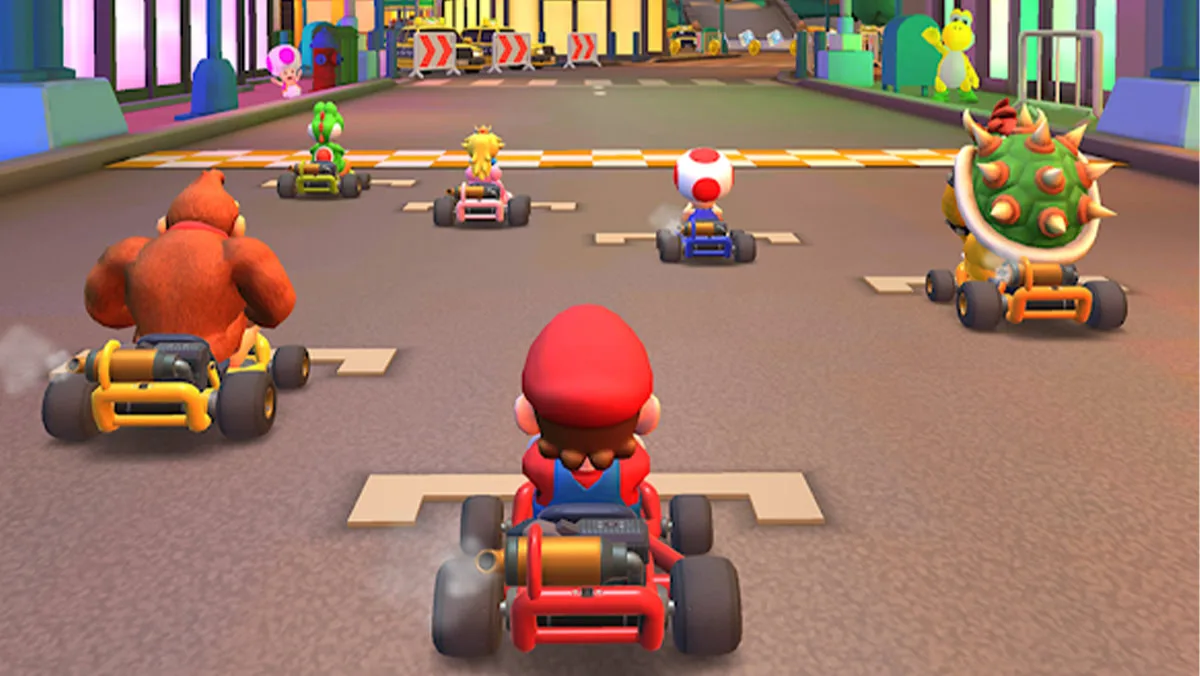
But the character selection system might be the cleverest part of playing Mario Kart on YouTube. Rather than building a separate UI — which YouTube wouldn’t allow anyway — they hijacked the platform’s subtitle menu. Switch your subtitle track, and you switch your character. You can race as Mario, Luigi, Princess Peach, Toad, Yoshi, Wario, or Bowser. Seven options, zero lines of custom code running outside YouTube’s existing infrastructure. It’s the kind of solution that makes you think: why didn’t anyone do this sooner?
Why This Kind of Platform Creativity Matters
Mario Kart on YouTube isn’t just a novelty. It sits within a longer tradition of creators finding the edges of what platforms are technically capable of and pushing past them in ways the platform engineers never intended. We’ve seen this with Twitch Plays Pokémon back in 2014, which turned a live chat into a collective game controller and drew over a million participants. We’ve seen it with interactive Netflix films like Bandersnatch, which used the streaming platform’s branching video architecture for choose-your-own-adventure storytelling. The difference here is that Atlas Arcade and Animated Subtitles built their experience using nothing but features already available to any YouTube creator with a 360-degree camera and a bit of lateral thinking.
That’s a lower barrier than most people realise. YouTube’s 360-degree video spec is open to any creator — you don’t need special access or a partner programme. Which raises a fair question: now that someone’s demonstrated this trick with Mario Kart on YouTube, how long before others start building their own interactive experiences on top of it? A dungeon crawler? A simple rhythm game? An escape room? The architecture is already there.
The Limits Are Real, But So Is the Achievement
To be clear about what this isn’t: Mario Kart on YouTube is not going to replace your Nintendo console. The interaction model is limited by the fact that YouTube’s 360-degree feature was designed for passive viewing, not real-time input. There’s noticeable latency in how the left-right panning responds compared to a native application. The course resets after roughly a minute. You can’t save progress, unlock anything, or play multiplayer. Nintendo’s IP lawyers presumably have eyes on this too, though fan-made experiences in this space tend to exist in a legal grey area as long as they’re not monetised.
What the project does achieve, though, is a proof-of-concept that interactive video has more potential than YouTube itself has probably explored commercially. YouTube has dabbled with interactive elements — shoppable videos, polls, end screens — but nothing this tactile. Meanwhile, platforms like TikTok are experimenting with live interactive features and game-adjacent formats. The competitive pressure to make video more engaging is only going one direction.
How to Try It Yourself
If you want to give the Mario Kart on YouTube experience a go, you’ll want to be on a desktop browser for the full keyboard-control version — the 360-degree interaction on mobile works differently and may not give you the same steering response. Once you’re in the video, use your keyboard’s left and right arrow keys (or click and drag) to steer around obstacles. Head into the subtitle settings before you start to pick your character. Given it’s only a minute long, there’s no real reason not to try it at least twice.
It won’t scratch the itch that a proper Mario Kart World session would. But as a demonstration of what two creative people can do with a video platform and some unconventional thinking, playing Mario Kart on YouTube is one of the more entertaining things to come out of the platform in a while. Sometimes the best creative work happens when someone ignores what a tool was built for and asks what else it could do.

