
- Google AI Pro will be free for one year to eligible US college students, including higher Gemini limits and 5TB storage.
- The Google AI Pro student offer turns premium Gemini features into a campus recruiting tool ahead of the fall semester.
- Google Search and Lens are adding guided problem solving, custom study materials, and practice quizzes for major standardized tests.
- Gemini Live will let students receive Deep Research reports later, then discuss the findings conversationally on their phones.
Table of Contents
Google AI Pro is becoming a campus freebie
College students have become the most fought-over users in consumer AI, and Google AI Pro is now Google’s clearest bid to win them. Eligible US college students can receive a year of the premium plan at no charge, a package Google values at $19.99 a month. That is a sizeable giveaway, particularly when the bundle includes 5TB of cloud storage and higher Gemini usage limits rather than a stripped-down trial built to expire before finals.
Google says the US plan includes Gemini Spark and four times the standard Gemini limits. Students outside the US are being offered Google AI Plus for a year instead, with Gemini Omni, 400GB of storage, and double the usual limits. The company is also pitching a student bundle combining its premium AI service and YouTube Premium at discounts of up to 70%.
Google is betting on habit, not a one-year sugar rush. A student who puts Gemini into their notes, research, calendar, files, and search habits may be less likely to leave after graduation. Google has the distribution advantage here: Gmail, Drive, Docs, Android, Chrome, and Search already surround much of a student’s daily digital life. The question is whether Gemini can earn trust as a learning tool rather than simply becoming another button people ignore.
Frankly, the storage may be as persuasive as the chatbot. Five terabytes is overkill for many undergraduates, but it makes Google AI Pro feel like a genuine account upgrade, not merely permission to generate more text. For students already paying for Google One or juggling years of lecture recordings, photos, and group-project files, that’s real money back in their pocket.
Google AI Pro arrives with a more ambitious study stack
The Google AI Pro subscription promotion would be much less interesting if Google were only handing out extra prompts. It is pairing the offer with a Student Hub intended to collect assignments, notes, deadlines, and study resources in one place. Google says its Study Notebooks will soon pull dates from a course syllabus into Google Calendar automatically, while also adding charts and other visual material to short lesson plans.
That sort of automation sounds mundane until you remember the first week of a semester: a dozen PDFs, three learning portals, conflicting deadlines, and a calendar that still thinks it is summer. If the system actually extracts dates accurately, it could remove some clerical pain. If it gets a midterm date wrong, it could create the sort of chaos that makes students swear off automation for a year. Accuracy matters more here than flashy demos.
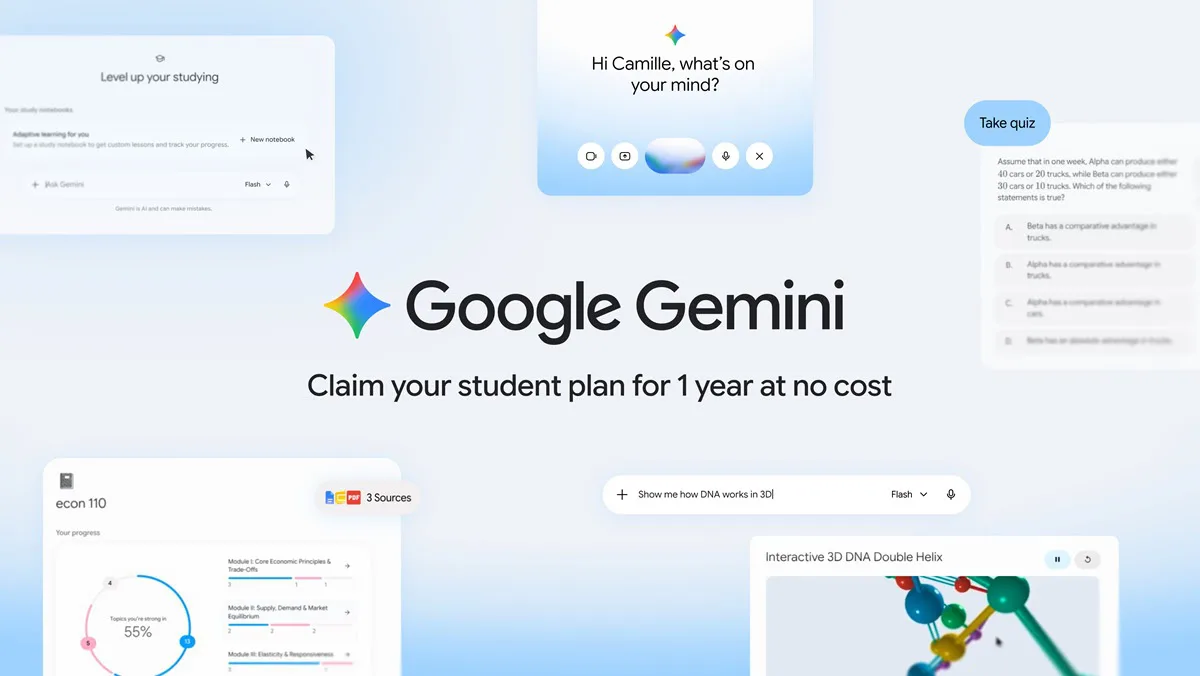
Google also plans to connect those notebooks to AI Mode in Search, allowing students to organize sources and examine reference material from the search interface. That is a strategic move. Google Search has long been where academic work begins, even when the final research ends up in a library database or a professor’s reading list. Keeping the notes and AI assistant in that same orbit gives Google a useful home-field advantage over ChatGPT.
Students who want a look at the company’s broader Gemini product lineup can also check Google’s official Gemini site. The fine print will matter, though. Eligibility requirements, regional availability, and university verification often turn a headline-grabbing student deal into a more complicated sign-up process than the marketing suggests.
Search and Lens are trying to teach, not merely answer
Google’s most consequential education update may be the one built into Search. The company is expanding custom practice quizzes beyond its existing SAT preparation work to cover the GRE, LSAT, and MCAT. It also says students will be able to turn lecture notes into a tailored study guide and create interactive simulations for difficult concepts.
There is a sensible idea underneath all this: an AI tutor should help a student work through a problem, not function as an answer vending machine. Google Lens is being positioned that way. Take a picture of a difficult question, and the system is supposed to coach the user through the concepts step by step instead of dropping the final answer on the screen.
That places Google closer to OpenAI’s recent ChatGPT for Teens approach, which emphasizes guardrails and learning-oriented prompts for younger users. But Google’s pitch to college students is more expansive. It is effectively saying that Google AI Pro can sit beside the student throughout an entire term, from the first assigned reading through test preparation and late-night revision.
I would not assume this solves the academic-integrity problem. Guided explanations can be valuable; they can also be a very polished route to outsourcing thought. Schools will have to decide where the line sits, and instructors will need assessment designs that do not collapse when every student has a capable conversational assistant in their pocket. We have been here before with calculators, search engines, and Wikipedia, although generative AI is a more slippery opponent because it can imitate understanding.
Deep Research could be Gemini’s strongest student feature
The other feature worth watching is coming to Gemini Live. Students will be able to send a multistep Deep Research request, put their phone away, and receive a notification when the report is ready. They can then discuss the results by voice. For Google AI Pro users, that turns a tedious research prompt into something closer to delegating a preliminary briefing to an always-available classmate.
Used responsibly, asynchronous research is genuinely useful. Ask for a map of competing arguments around a policy question, a plain-English explanation of an unfamiliar scientific paper, or a list of primary sources to investigate next. Then verify everything. AI-generated research reports are starting points, not citations, and students who treat them as finished work are taking a risk with both accuracy and plagiarism rules.
My read is that Google is not merely chasing subscriptions with this promotion. It is trying to make Gemini habitual before OpenAI, Anthropic, and others lock in the next generation of knowledge workers. A free year is an expensive invitation. Whether students accept it will come down to a tougher test: when the deadline is tomorrow and the material is confusing, does Gemini help them learn something, or does it just help them produce something that looks learned?