

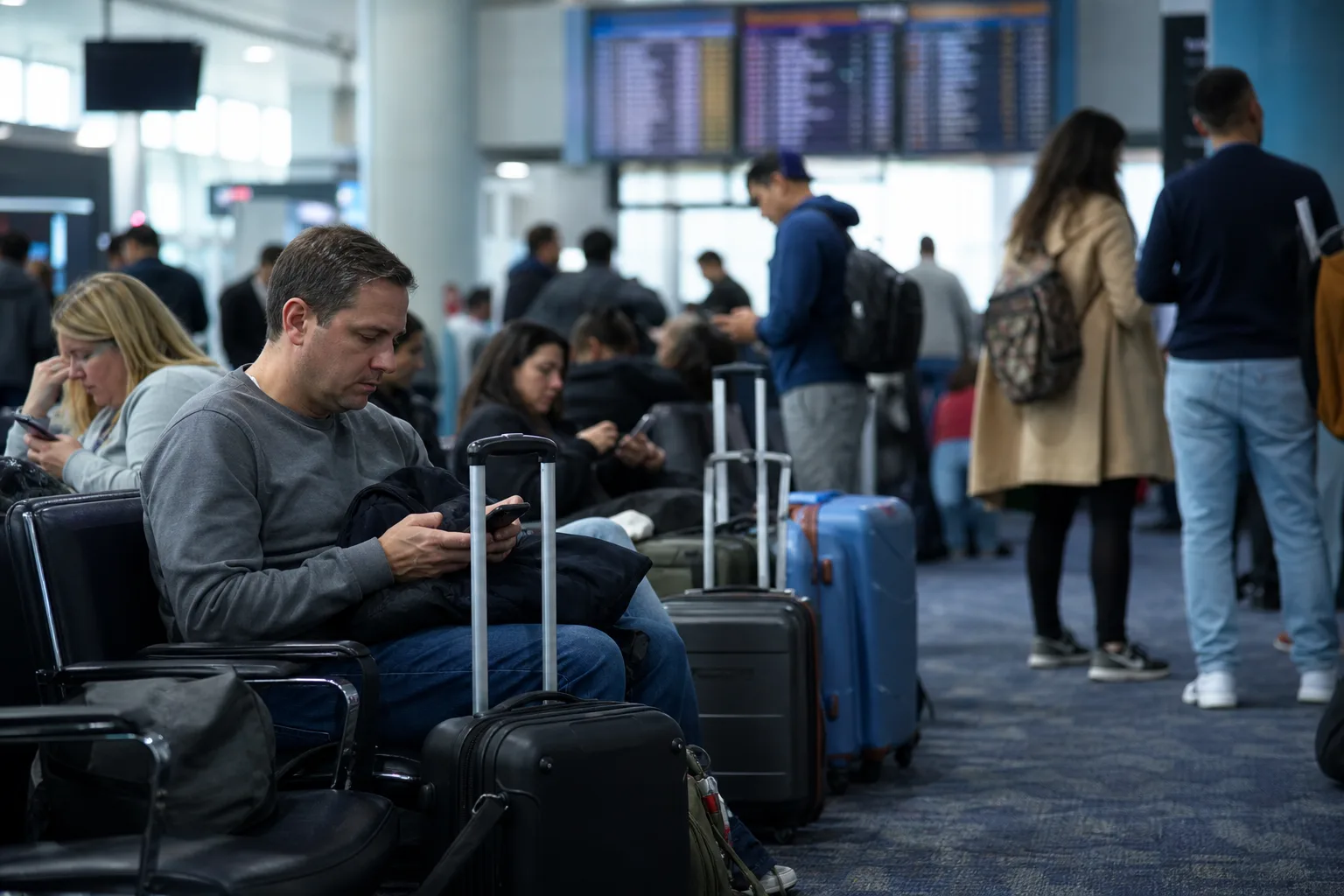
- The FAA ordered a national ground stop after a telecommunications problem affected every US Air Route Traffic Control Center.
- This national ground stop is only the third nationwide FAA shutdown, following September 11 and a 2023 system outage.
- Transportation Secretary Sean Duffy said FAA technicians were investigating the communications failure as airlines began canceling departures.
- Homeland Security Secretary Markwayne Mullin said officials saw no evidence that the outage resulted from a malicious attack.
Table of Contents
FAA halts departures across the country
Air travel in the United States came to a sudden standstill Friday when the Federal Aviation Administration ordered a national ground stop, preventing civilian flights from departing airports across the country. The cause, according to Transportation Secretary Sean Duffy, was a communications problem affecting every Air Route Traffic Control Center.
That phrasing matters. A delay at one busy airport is routine aviation life; weather, staffing, runway construction, and an airline’s own operational mess can produce those by the hour. But a failure touching the network of facilities that guides aircraft through US airspace is another category entirely. It is the difference between closing one freeway entrance and switching off the traffic lights across the state.
Duffy said in a post on X that FAA personnel were working to identify and resolve the issue. The agency had not immediately laid out which communications systems failed, how long they had been impaired, or when normal departure operations would resume. Those details will determine whether this becomes a bad Friday evening for travelers or an operational hangover that lasts deep into the weekend.
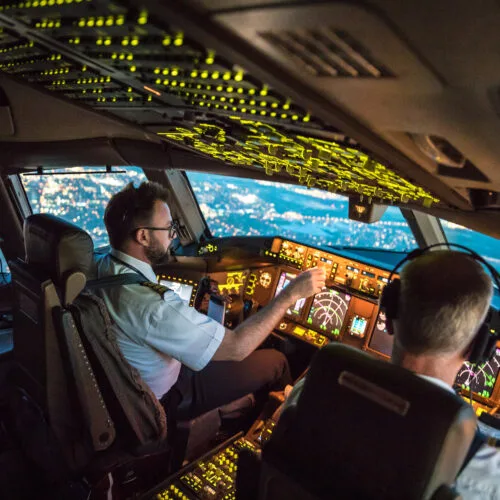
Airlines moved quickly to cancel later departures, with American Airlines warning customers to expect disruption through the rest of Friday. Even after a national ground stop is lifted, the recovery is rarely tidy: aircraft and crews are stranded in the wrong places, gates stay occupied, and passengers miss connections that were scheduled with little slack to spare. Anyone who has watched a thunderstorm paralyze a major hub knows the drill. This is that problem, except the trigger sits in the infrastructure layer beneath the entire system.
Why a national ground stop is so rare
The FAA has issued a national ground stop only twice before, which gives Friday’s order its proper scale. The first was September 11, 2001, when the agency stopped civilian departures and then directed aircraft already aloft to land. Commercial aviation did not resume until September 13, in an unprecedented response to the terrorist attacks.
The more relevant comparison is January 11, 2023. A fault in the FAA’s Notice to Air Missions system, known as NOTAM, halted departures nationwide for under two hours. NOTAM distributes safety information pilots and airlines need before a flight: runway closures, equipment outages, hazards, and temporary restrictions. The outage exposed an uncomfortable truth about aviation technology: the public sees sleek aircraft and sophisticated cockpit displays, but parts of the administrative plumbing are old, central, and difficult to replace without risk.
Friday’s incident appears distinct from the 2023 NOTAM failure. Officials have pointed instead to telecommunications affecting air traffic control centers, the facilities that coordinate aircraft across large chunks of US airspace. That suggests the FAA’s concern was less about preflight paperwork and more about whether controllers could reliably communicate and coordinate. When that confidence is missing, grounding new departures is the conservative call. Frankly, it is the only defensible call.
Readers can follow the FAA’s public operational updates through its official website, though airline apps and airport departure boards will usually provide the more immediate answer to the question passengers actually have: is my flight moving today?
No sign of an attack, but the questions will linger
Homeland Security Secretary Markwayne Mullin said the national ground stop was not imposed because of a security threat. “This is a telecommunications outage out of the FAA,” Mullin said. “Out of an abundance of caution, we have grounded all of the flights.” He added that there was no indication at that point of “a nefarious attack against us.”
That is reassuring, as far as it goes. A nationwide aviation interruption naturally raises the prospect of cyberattack or sabotage, especially when the underlying diagnosis is still incomplete. But an outage does not need an attacker to be serious. Complex legacy systems fail in mundane ways: a bad configuration, damaged circuit, failed hardware component, software update, or a dependency nobody notices until it breaks at the worst possible moment.
Mullin said incoming international flights would be handled individually. That distinction matters operationally. Aircraft already committed to an ocean crossing cannot simply wait for a cleaner network status, and US controllers still need to bring them into the country safely. Ground stops are designed to reduce the number of moving pieces while controllers and technical teams regain certainty about the systems supporting them.
The AI timing will invite scrutiny
The outage arrives days after the FAA expanded its use of an AI-based advisory tool intended to help manage air traffic congestion across US airspace. Nothing in the available information links that newer AI system to Friday’s communications failure. The timing, however, will invite questions.
Federal aviation technology is entering an awkward transition period. The agency wants better predictive tools because airspace is crowded, controller workloads are intense, and weather disruptions ripple faster than airlines can repair schedules. Yet introducing software intelligence on top of aging communications and data systems can create a strange public perception: officials are talking about AI while travelers are stuck because the phones, networks, or control links are down.
My read is that these are not competing priorities. Modernizing communications infrastructure and deploying decision-support software are both necessary. But the former comes first. An AI tool can suggest a clever reroute; it cannot rescue a system whose controllers lack dependable communications to execute it. The FAA will need to explain the architecture clearly once the immediate incident is over, including whether redundancy worked as intended and what failed over when it did not.
What travelers should expect next
For passengers, a national ground stop means the original itinerary should be treated as provisional until the airline says otherwise. A flight may still show as scheduled while its aircraft, crew, or inbound connection is delayed elsewhere. Rebooking early through an airline app can help, but travelers should avoid accepting a tight connection that only works if every part of the recovery runs perfectly. It won’t.
What matters next is the restart. The FAA and airlines must unwind a national ground stop without overwhelming airports that are already short on gates and crews during peak periods. If the outage is resolved quickly, the impact could resemble the 2023 NOTAM disruption: severe but contained. If it runs longer, cancellations will spread into the next day and the recovery becomes a logistical relay race.
Friday will show whether this was a contained telecommunications failure or another warning that America’s aviation system has too few graceful ways to fail. The planes may be modern. The question is whether the network coordinating them is ready for the next ordinary problem before it becomes an extraordinary one.