

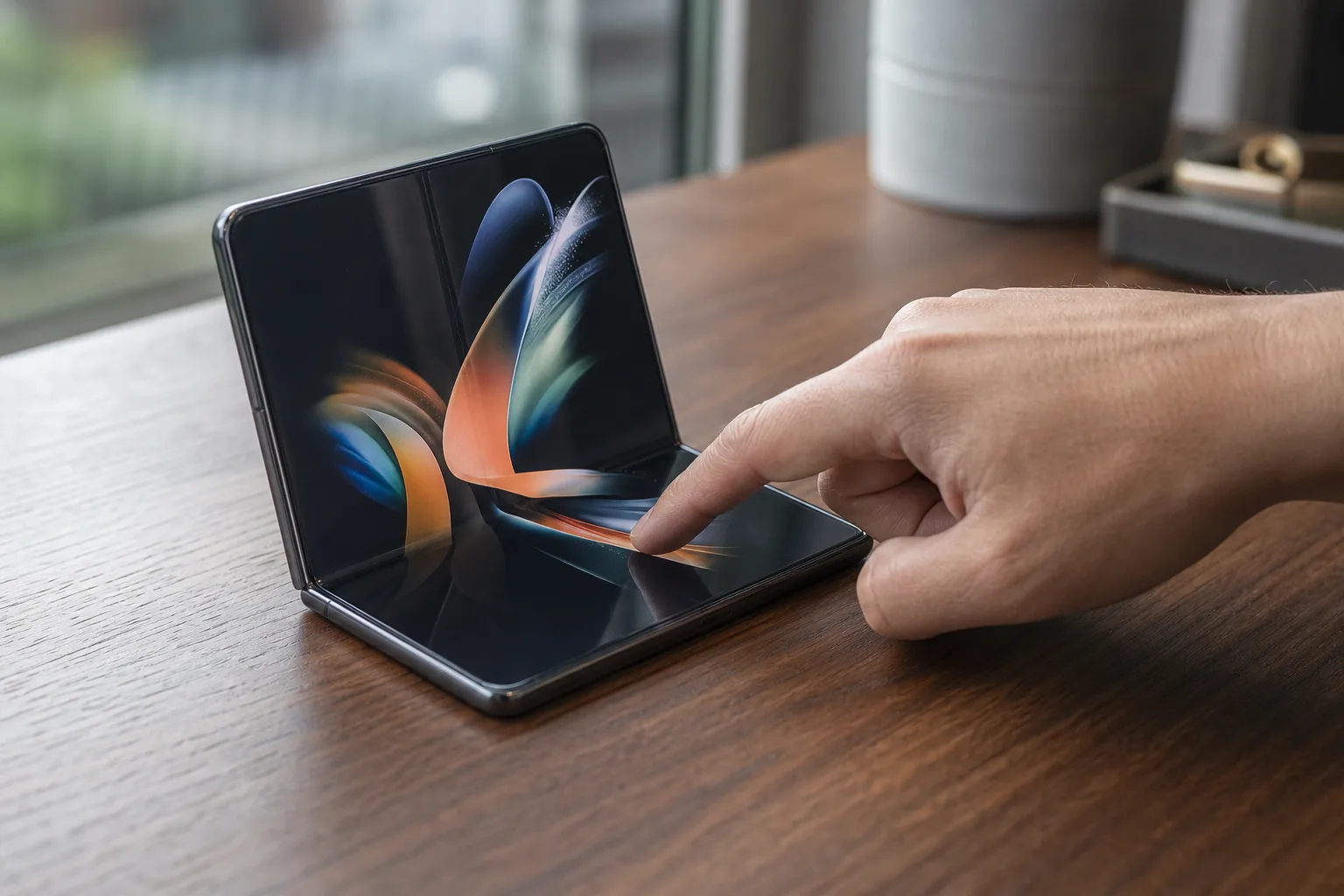
- Apple’s iPhone Duo survey asks early owners why they bought the foldable and which hardware compromises they can tolerate.
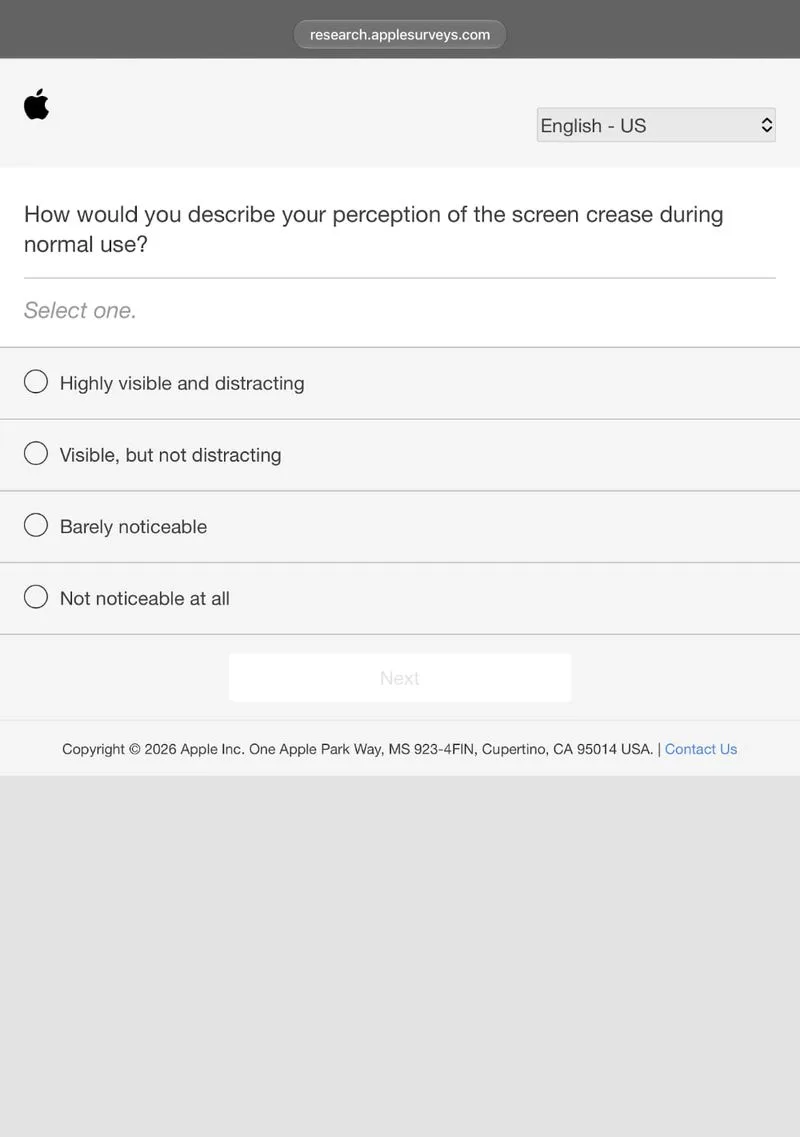
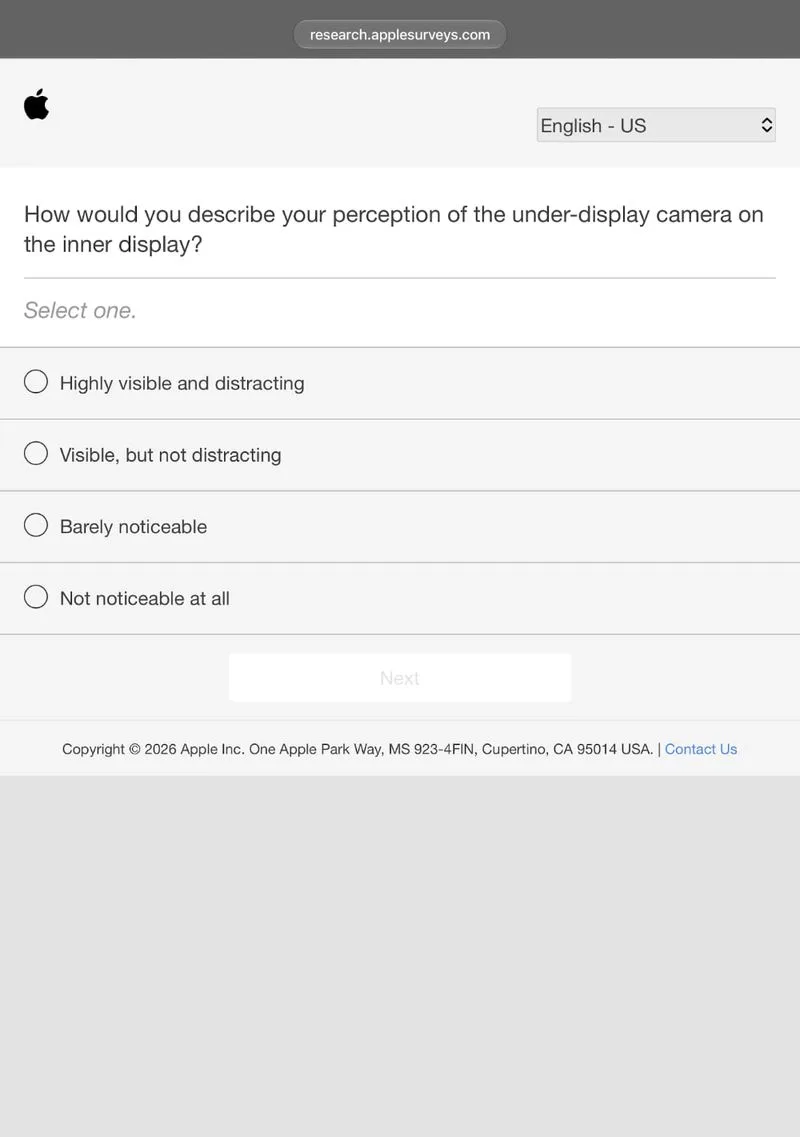
- The iPhone Duo survey zeroes in on the visible crease, outer display size, and the 4MP under-display camera.
- Apple appears to be gauging whether its first foldable’s design trade-offs are acceptable before deciding which changes deserve priority.
- Reported display cracking, Touch ID concerns, and poorly adapted apps appear absent from the current questionnaire.
Table of Contents
The iPhone Duo survey is Apple asking the awkward questions
Apple can see how many people bought its first foldable. What it can’t learn from sales data alone is whether they love it, tolerate it, or quietly regret it. That is the real purpose of the iPhone Duo survey now landing in some buyers’ inboxes: finding out where the company’s expensive new design crosses the line from compromise to annoyance.
According to reports from owners who received it, Apple begins with a revealing question: why buy the iPhone Duo now? Responses include wanting to try Apple’s first foldable, making an impulse purchase, and buying ahead of anticipated smartphone price increases. Those aren’t throwaway marketing questions. They suggest Apple wants to separate early-adopter curiosity from practical demand — a crucial distinction when a new product category is still looking for its normal customer.
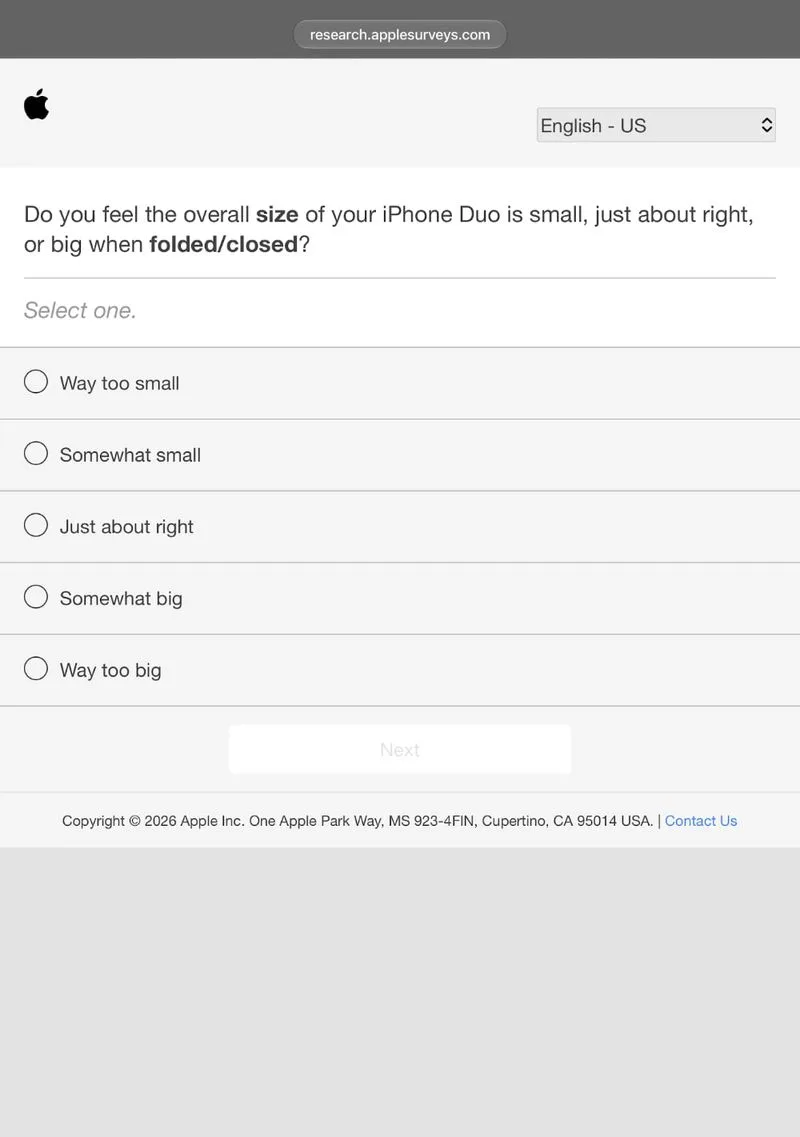
Then the questionnaire gets specific. In the iPhone Duo survey, buyers are asked about the size of the phone’s closed display, the visibility of its folding-screen crease, and whether its under-display camera gets in the way. Apple also asks about image quality from that camera, before finishing with an open text field for features owners would add or change.
That is a fairly direct admission that Apple knows exactly where the iPhone Duo’s rough edges are. Frankly, it would be stranger if the company didn’t.
Apple is testing the limits of foldable-phone compromise
The outer screen is perhaps the cleanest example. At 5.4 inches, the iPhone Duo’s closed display reportedly lands in roughly the same territory as Apple’s discontinued iPhone mini models. For some people, that’s a virtue. The mini had devoted fans because it could disappear into a pocket and be used one-handed. But a narrow outer screen is a very different proposition when it is the cover display on a premium foldable, expected to handle quick replies, directions, banking and the thousand tiny jobs phones do before breakfast.
The iPhone Duo survey is effectively asking whether buyers see that smaller screen as charmingly compact or merely cramped. Samsung, Google and other foldable-phone makers have spent years wrestling with this exact geometry problem: make the closed device narrow enough to hold comfortably, and it can feel like a remote control; make it broad enough to work like a normal phone, and the folded hardware becomes a brick.
Apple has a history of being willing to reject a spec-sheet arms race when it believes a design makes more sense. The original iPhone skipped a physical keyboard. The iPhone X killed the Home button. But foldables are less forgiving because their compromises are physical. You can patch a software quirk. You cannot remotely update a crease out of the center of a display.
Apple’s current mainstream iPhone lineup sets a very high camera baseline, while the Duo’s internal under-display camera is limited to 4 megapixels. Under-panel camera technology remains difficult because the screen has to let light pass through layers that were designed to emit it. The result, across the industry, has often been softness, haze, and inconsistent exposure. Apple’s own iPhone lineup has conditioned customers to expect cameras that simply work, so the Duo’s concession was always likely to attract scrutiny.
The questions Apple did not include may matter more
The reported iPhone Duo survey does not ask about every complaint circulating among early owners. There is no apparent question on Touch ID, app optimization, or reports of cracked displays. That omission does not prove Apple is ignoring those issues; companies commonly split research across multiple surveys, support data, repair records and internal diagnostics. Still, it is conspicuous.
Touch ID is particularly interesting because foldables have revived a debate Apple supposedly settled years ago. Face ID is elegant on a conventional iPhone, but a fingerprint reader mounted in a power button can be more immediately useful on a device that changes shape and orientation. Apple’s long-standing preference has been to avoid feature duplication where possible. Users, meanwhile, tend to care less about design purity when they are trying to unlock a folded phone at an odd angle in a checkout line.
Apps are the other large variable. A folding display can be brilliant with software built for it: maps expand, documents breathe, video previews become useful. An unoptimized app can look like it has been stretched across a dinner napkin. Apple has historically been better than Android at getting developers to adopt new screen sizes, but foldables pose a more complicated challenge than a new iPad dimension. The software needs to respond gracefully as a screen opens, closes and changes aspect ratio in real time.
Then there are display-crack reports. Any first-generation folding device will be judged harshly on durability because consumers remember the early Galaxy Fold fiasco, when review units failed after debris entered the hinge area or users removed a layer that looked removable. Apple knows that memory is still out there. If failures are isolated, its repair and warranty data will show it. If they are not, no customer survey wording will paper over a hardware problem.
Why this feedback matters before a second-generation model
The useful part of the iPhone Duo survey is not discovering that people prefer a less noticeable crease. Of course they do. Apple needs to know which compromise buyers would accept in exchange for fixing another one. Would customers live with the crease if the outer display were larger? Would they trade camera quality for a thinner device? Do purchasers actually unfold the phone often enough to justify its cost and bulk?
Those answers shape a second-generation product more than a review score ever could. Reviews identify flaws loudly, but the iPhone Duo survey can segment the audience: people who bought for novelty, people who needed a pocketable tablet, former iPhone mini owners, mobile photographers, and users who almost never open the device. That is how Apple decides which group is worth building around.
My read is that Apple is still testing whether the foldable’s central promise is strong enough to outweigh its list of caveats. The company entered this category late, as it often does, but lateness only works when the finished product feels meaningfully more considered than what came before. The iPhone Duo survey suggests Apple is now collecting the evidence for its next move. Whether it responds with a better cover screen, a cleaner camera solution, or a more durable panel will tell us what it learned — and what it is willing to spend to fix.