

The prospect of a Jensen Huang exit is rattling Nvidia for a simple reason: the company has spent three decades being built around one exceptionally visible, unusually hands-on founder. Reports from The Wall Street Journal say Nvidia’s board could move quickly to determine Huang’s future after allegations involving personal relationships, including one reportedly connected to a purported Chinese intelligence operative. Nvidia has not publicly detailed a board decision.
Shares reportedly fell about 8% in Wednesday after-hours trading and roughly 11% over five days. Markets hate uncertainty, sure, but this is more than a routine executive scandal. Nvidia is now one of the world’s most consequential technology companies, sitting at the center of the AI infrastructure spending spree. Removing its chief architect would be like changing a plane’s pilot mid-flight while every passenger is watching the fuel gauge.
- Reports of a Jensen Huang exit have pushed Nvidia shares down as its board reportedly weighs the chief executive’s future.
- A Jensen Huang exit would leave Nvidia facing a succession question that has remained unusually unresolved for a company of its scale.
- Huang’s tightly centralized management style could make an abrupt leadership change harder than investors initially expect.
- Nvidia’s AI-chip dominance gives any successor a formidable platform, but also leaves little room for operational mistakes.
Table of Contents
Why a Jensen Huang exit is different
Huang co-founded Nvidia and has led it through several distinct lives: PC graphics specialist, gaming powerhouse, data-center supplier and, now, the company whose GPUs have become the default picks for training many large AI models. Plenty of CEOs become synonymous with their companies. Huang is more intertwined than most.
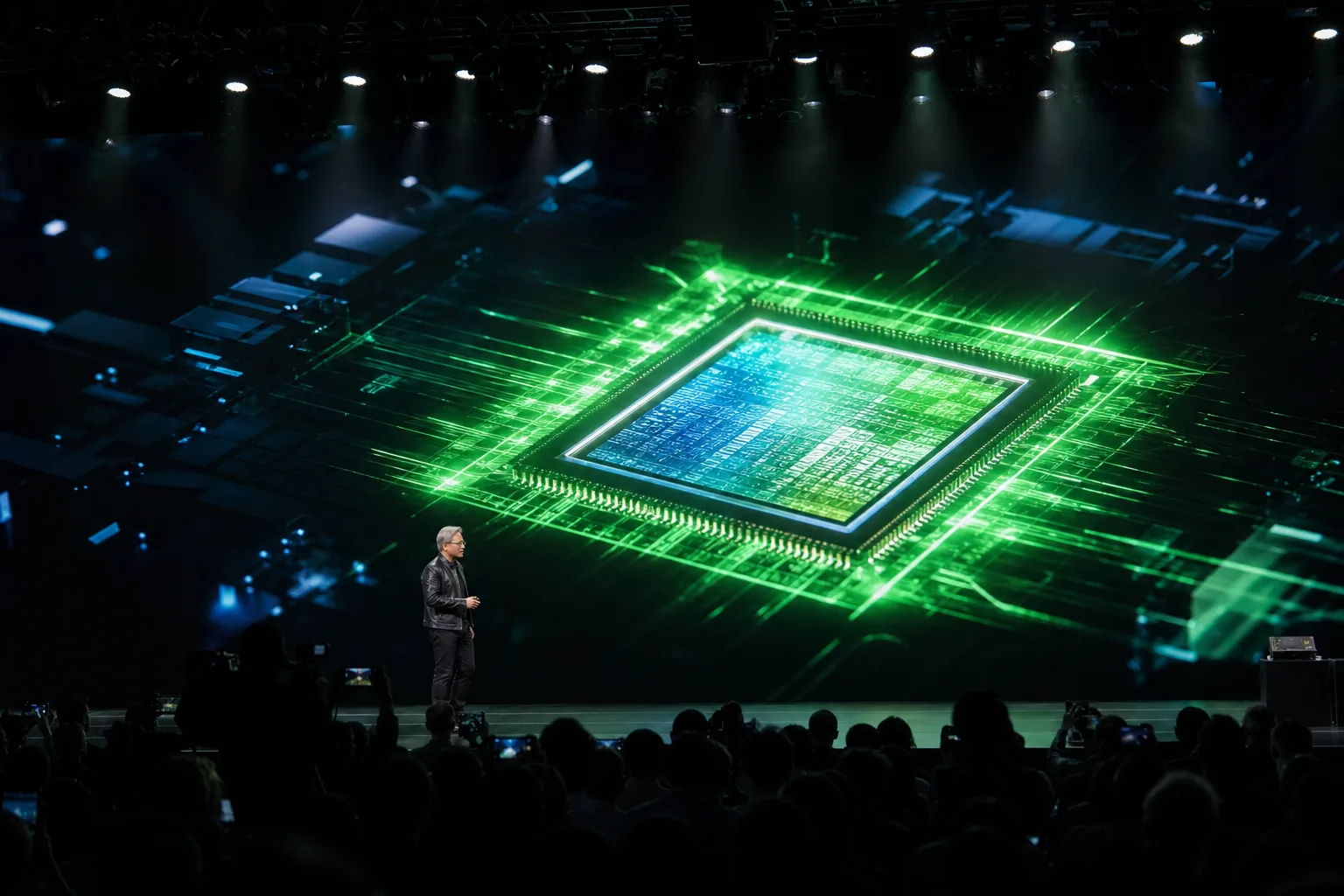
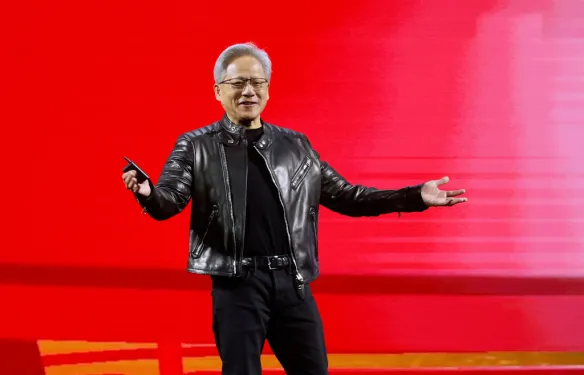
That concentration was partly a strength. His leather-jacket keynotes became an annual ritual for developers and investors, and Nvidia’s product cadence has been remarkably disciplined. The company’s investor materials make plain just how much of its recent growth has come from data-center demand, where customers are placing massive orders years ahead of deployment. Huang has been the salesman, product strategist and public face of that machine.

But founder centrality has a cost. Huang has said he has around 60 direct reports, an extraordinary number for the CEO of a company this large. That may keep information flowing directly to the top, but it also raises an uncomfortable question in any Jensen Huang exit scenario: who has been given enough authority to take over without months of internal jockeying?
Bloomberg reports Nvidia has turned to an outside firm to identify potential CEO candidates. If accurate, that detail is especially telling. Executive search firms are normal tools for boards, but bringing one in during a live crisis suggests the succession bench may not be as obvious as investors would like. A Jensen Huang exit without a clear internal successor would intensify those concerns. Companies can survive leadership transitions. They struggle when the transition reveals nobody had seriously planned for one.
The allegations and the board’s immediate problem
The reporting describes Huang acknowledging an extramarital relationship with a woman whom US intelligence reportedly considers a Chinese spy. The New York Times also reported an alleged relationship with an Nvidia executive who reported to him. Those are serious claims, and the second allegation cuts directly into corporate-governance territory: relationships between a CEO and a subordinate can create obvious concerns around power, workplace conduct and disclosure.
At this stage, readers should separate what has been reported from what Nvidia’s board ultimately establishes. A board investigation has its own fact-finding process, and neither a rapid meeting nor a stock sell-off tells us where that process ends. Still, boards rarely get the luxury of moving slowly when the CEO runs a company worth trillions of dollars and the allegations raise potential security and workplace issues at once.
For the Nvidia board, the task is brutally practical. It needs to protect employees, assess whether company policies or disclosure duties were breached, and communicate enough to prevent a vacuum of confidence. It also has to avoid appearing to treat a founder differently from everyone else. That last point matters. Silicon Valley has a long, not especially flattering history of boards discovering that founder worship is a poor governance framework.
Nvidia’s succession gap has become a market risk
The Jensen Huang exit reports land at a precarious moment. Nvidia remains dominant in AI accelerators, but the market around it is no longer sleepy. AMD is pushing its Instinct lineup, custom silicon from Google, Amazon and Microsoft is becoming more meaningful, and hyperscalers have every incentive to reduce their dependence on a single supplier.
Nvidia’s position will not evaporate tomorrow. Its advantage runs through hardware, software, developer tools and an ecosystem built around CUDA. That moat is real. Yet AI buyers are also impatient buyers. If an executive transition slows decisions on product roadmaps, supply commitments or relationships with the largest cloud companies, competitors will see an opening.
The near-term stock reaction therefore makes sense, even if it may be excessive. Investors are attempting to price something they cannot yet model: whether a Jensen Huang exit would be a brief governance disruption or the start of a broader strategic reset. The answer depends less on the boardroom drama than on who runs engineering, sales and operations the morning after any announcement.
The practical questions for employees, customers and investors
My read is that Nvidia’s underlying business is sturdier than its current headlines. Huang did not personally invent every chip architecture, write CUDA or negotiate every data-center contract. There are deep technical leaders inside the company, and its customers are unlikely to cancel infrastructure plans simply because the CEO changes.
Still, an orderly transition and an abrupt removal are very different events. The board’s first credible move, if a Jensen Huang exit becomes reality, would be naming an interim leader with genuine operating authority and explaining how product execution stays on track. Vague reassurances won’t cut it. Nvidia sells confidence as much as silicon, particularly when customers are committing billions of dollars to systems that take years to deploy.
For now, the central issue is not whether Nvidia can survive beyond Jensen Huang. Of course it can. The sharper question is whether its board prepared the company to prove that before a crisis forced the test. A well-managed Jensen Huang exit would test that preparation immediately. If these reports hold, the world’s most valuable AI supplier is about to find out.