

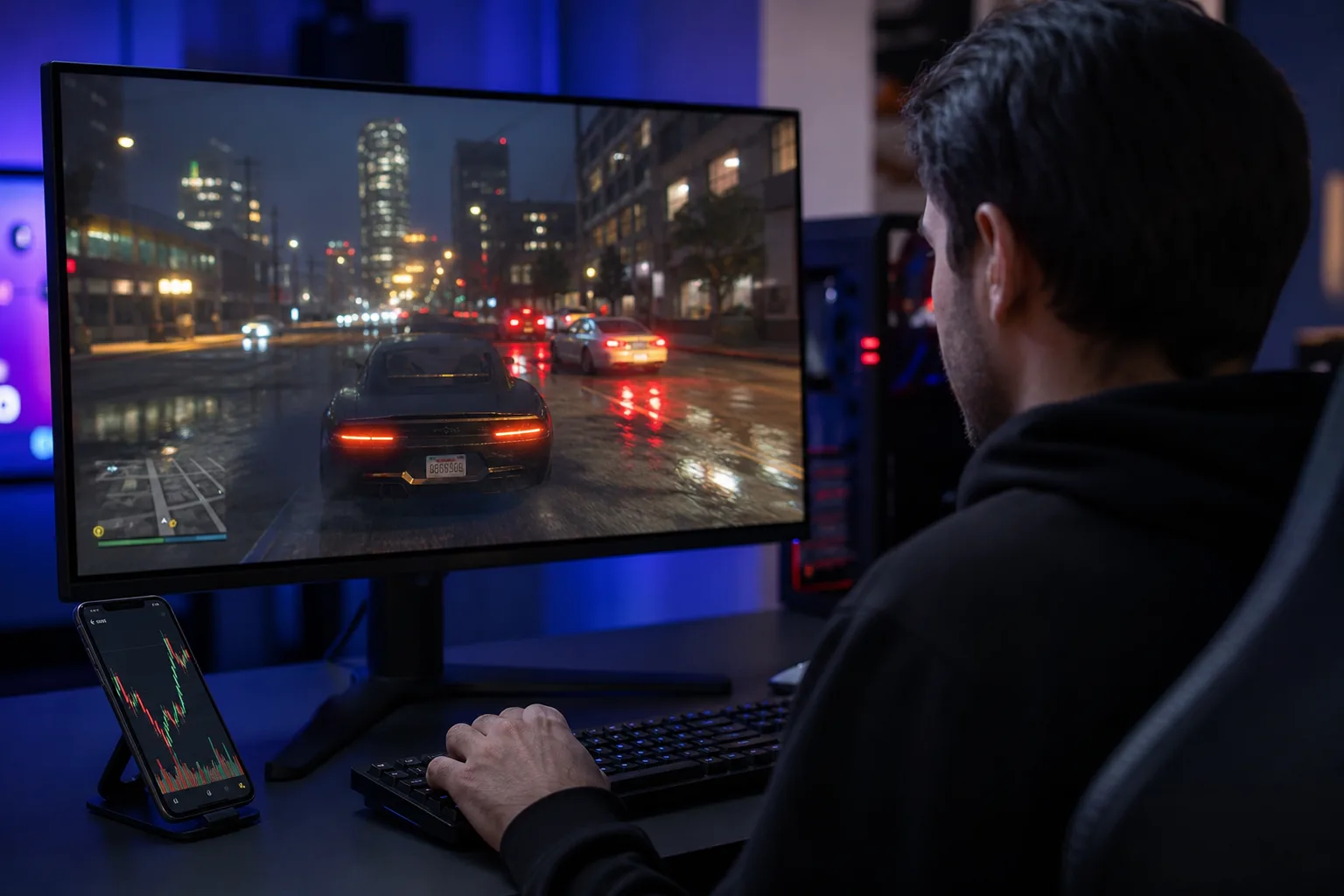
The DacityCoin token saga is crypto at its most familiar and least flattering: a few seconds of video game footage, a fictional brand name, competing Solana coins, and one early buyer who reportedly transformed about $307 into more than $202,000. It’s the sort of trade that will be screenshotted for months. For everyone arriving later, though, the picture has been considerably uglier.
When Grand Theft Auto 6 reached players around the world, traders tried to work out which unofficial token most closely resembled a coin apparently referenced in the game. That detail mattered enough to move millions of dollars in paper market value. It also revealed the central absurdity of the whole affair: neither coin is Rockstar’s product, and nobody buying one is gaining a stake in GTA 6.
- A DacityCoin token buyer reportedly turned roughly $307 into more than $202,000 by trading GTA 6 speculation early.
- The DacityCoin token fell sharply when gameplay clips drove traders toward a competing Solana coin using the DCTY ticker.
- Neither token has an official relationship with Rockstar Games, Grand Theft Auto 6, or any confirmed in-game cryptocurrency feature.
- The episode shows why fictional brands and viral clips are a precarious foundation for real-world crypto valuations.
Table of Contents
DacityCoin token hype collided with the ticker problem
The initial spark appears to have come from GTA 6 promotional material and leaked gameplay that pointed to a fictional crypto-themed venture called DacityCoin, associated with a company styled as AudaCity. One trailer showed the name on an aircraft; gameplay clips reportedly depicted protagonist Lucia participating in a publicity stunt intended to attract investment. Rockstar has not formally confirmed an in-game meme coin or any blockchain tie-in, but that didn’t slow the market down.
On Pump.fun, the Solana launchpad that has become a factory for fast-moving speculative tokens, a real-world DacityCoin token appeared shortly after the October trailer attention. It initially reached a market capitalization near $4.95 million before collapsing about 93% to roughly $344,000 as the chatter cooled. Then GTA 6 launch-day anticipation brought the crowd back, sending its reported market value as high as $10.8 million.
That peak was short-lived. Gameplay footage circulating from Brazilian streamer Combo Infinito appeared to show the fictional coin with the ticker DCTY. Traders then rushed toward another Solana token that they believed had the more accurate match of name and ticker. That alternate coin had reportedly been worth only about $54,000 at its prior high, then briefly ran above $12 million after the footage spread.
This is the kind of market where a four-letter abbreviation becomes a referendum on reality. But the reality is murky. The game material itself seems inconsistent: DacityCoin appears in one form in the trailer, while subtitles reportedly render it as two words, Dacity coin. AudaCity has also shown up as Auda City and Auda-City. Anyone calling this a clean confirmation is selling confidence that the evidence simply doesn’t support.
A $307 trade shows the upside — and the trap
Blockchain tracking cited by market watchers indicates one wallet bought around $307 of the original token soon after launch and later sold for approximately $202,278. That is nearly a 66,000% return, assuming the transactions and sale figures hold up. No normal investor should read that as a repeatable strategy. It’s a lottery-ticket outcome born from being early, getting attention, and finding enough later buyers willing to chase a narrative.
What happened after the confusion may matter more. The first DacityCoin token reportedly sank from its launch-day high to a market cap around $800,000, while the DCTY-branded rival held near $10 million. In meme-coin markets, capitalization figures are not cash sitting in a vault; they are a snapshot based on the latest trades and available liquidity. A holder can look wealthy on a chart and still struggle to exit without pushing the price down hard.
That distinction gets lost whenever a viral post says someone made six figures. They may have done exactly that. But a token’s headline value is closer to the estimated price of houses in a neighborhood than a guarantee that every house can sell at that number before lunch.
The community is selling identity, not ownership
Mike Lerro, described as the community takeover lead for the original coin, has argued that the ticker dispute misses the point. In messages shared with traders, he insisted: “DACITYCOIN AND AUDACITY ARE IN THE GAME. NOTHING ELSE MATTERS.” Asked about the chance that the ticker was wrong, Lerro’s answer was blunt: “It doesn’t matter.”
I’d argue that it matters quite a lot when the asset’s entire pitch is cultural proximity to a game. The community takeover argument is common in meme coins: even if the original creator disappears or sells, a committed group can keep the token alive. Sometimes that happens. Dogecoin, for all its weirdness, has endured multiple boom-and-bust cycles because it developed an identity beyond any one event. Most Pump.fun launches do not get that far. They’re more like pop-up Halloween stores: loud, temporary, and gone before you know whether the costume fit.
The DacityCoin token has no official license, endorsement, or technical connection to Rockstar Games. That point needs to be stated without euphemism. A fictional item appearing in a blockbuster game does not make a real token affiliated with the studio, and buying the token does not grant access to GTA 6 content, revenue, voting rights, or intellectual property. The Grand Theft Auto VI page is available here.
Gaming hype remains catnip for crypto speculators
This isn’t the first time crypto traders have tried to turn game culture into a tradable asset. Tokens tied loosely to Elon Musk posts, television characters, political candidates, and viral internet jokes have all followed the same cycle: attention arrives first, verification arrives later, and the late buyers discover that a community Telegram chat is not a business model.
Gaming has an especially potent pull because it comes with massive, highly online fan communities and a release calendar built around anticipation. GTA 6 may be the largest entertainment launch on the planet, so any stray reference can become fuel. Remember when every big game publisher was expected to cram NFTs into its roadmap? Players pushed back, publishers retreated, and the speculative layer mostly looked for new hosts. It has now found one in unofficial ticker matching.
The real test is whether the DacityCoin token can retain an audience once the first-week GTA 6 footage stops flooding social feeds. My read is that the market has already answered: traders are not valuing a durable project. They’re wagering on which spelling, ticker, screenshot, or influencer post will command attention for the next hour. That may make for a thrilling chart. It’s a lousy reason to treat a DacityCoin token as an investment.