
- Reinforcement learning with human feedback is how AI models learn to produce helpful, polite responses instead of useless ones.
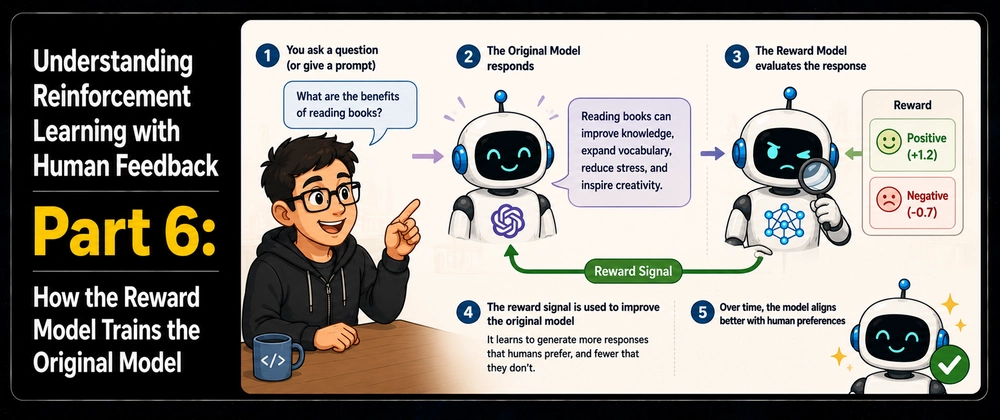
- The reward model acts as a judge in reinforcement learning with human feedback, assigning scores that push the AI toward better outputs.
- Without RLHF, even a well-trained language model can generate responses that are technically correct but completely unhelpful.
- Once RLHF training completes, the aligned model behaves in ways that match human expectations far more consistently.
Table of Contents
Why Reinforcement Learning with Human Feedback Changed Everything
Reinforcement learning with human feedback sits at the core of why ChatGPT, Claude, and Gemini feel fundamentally different from the raw language models that came before them. Before RLHF entered the picture, AI researchers had a persistent and deeply frustrating problem: they could train models on enormous amounts of text data and produce systems that were technically impressive but practically unreliable. A model might generate a confident, fluent response that was completely wrong, unhelpful, or even harmful. Raw capability and genuine usefulness turned out to be very different things.
The insight that drove reinforcement learning with human feedback’s adoption was deceptively simple. Instead of trying to encode human preferences into a loss function by hand — an almost impossible task given how contextual and subjective those preferences are — why not train a separate model to approximate what humans actually want, then use that model as a signal to steer the main AI? That’s exactly what reinforcement learning with human feedback does, and the results have been dramatic enough that it’s now a standard step in the development pipeline for virtually every serious large language model on the market.
What the Reward Model Actually Does
Think of the reward model as an automated proxy for human judgment. It’s trained on human-labelled comparison data — pairs of responses where human raters indicated which answer they preferred and why. After enough of this training, the reward model develops a surprisingly reliable sense of what a helpful, accurate, and appropriately toned response looks like. It assigns scores. Higher scores for better responses. Lower scores — sometimes negative — for answers that are evasive, rude, factually wrong, or just plain useless.
This is where things get interesting from an engineering standpoint. Within reinforcement learning with human feedback, the reward model isn’t just a filter you bolt onto the end of your pipeline. It becomes an active training signal. You feed the language model a prompt — one it hasn’t seen during the supervised fine-tuning phase — and let it generate a response. That response goes to the reward model, which returns a score. The language model then gets updated based on whether that score was good or bad. Repeat this loop millions of times across thousands of diverse prompts and the language model starts internalising what good responses look like.
The technical mechanism driving reinforcement learning with human feedback is typically Proximal Policy Optimisation (PPO), a reinforcement learning algorithm that updates the model’s parameters carefully enough to improve performance without causing catastrophic forgetting or wild behavioural swings. OpenAI’s team used PPO when training the original InstructGPT model, which was the direct precursor to ChatGPT. Anthropic has taken similar approaches with Claude, though they’ve also explored variations like Constitutional AI that add another layer of preference-shaping on top of basic RLHF.
From Unhelpful to Actually Useful: The Training Loop in Practice
Walk through a concrete example and the elegance of reinforcement learning with human feedback becomes clear. Imagine the base language model receives the prompt: “Can you help me write a professional email declining a job offer?” Without alignment training, the model might respond with something that’s technically related to the topic but vague, weirdly formatted, or oddly terse. It’s not lying. It’s not broken. It just hasn’t learned that humans asking this question want something specific, polished, and immediately usable.
The reward model looks at that response and assigns it a low score. That signal propagates back through the training loop. The language model adjusts. On the next iteration, it tries something slightly different. Maybe the response is more structured. Maybe it includes a polite opening, a clear decline, and a gracious closing. The reward model scores this higher. The model learns that this direction is better. Over thousands of these iterations, across wildly different prompts, the model builds up a generalised sense of what helpful looks like across contexts.
What makes reinforcement learning with human feedback more than just supervised learning in disguise is that the prompts used during this training phase are deliberately chosen to be different from those used in earlier fine-tuning stages. The model is being pushed to generalise its learned preferences to genuinely new situations, not just memorise good answers to questions it’s seen before. That distinction matters a lot for how well the final model holds up in real-world deployment.
The Alignment Problem RLHF Is Trying to Solve
Reinforcement learning with human feedback doesn’t exist in a vacuum. It’s a practical response to one of the central challenges in modern AI development: the alignment problem. How do you build a model that actually does what you want, rather than what its training data technically optimised for? Language models trained purely on next-token prediction learn to be statistically average — they produce outputs that look like the text they were trained on, not outputs that are genuinely helpful to a specific person in a specific situation.
This misalignment can manifest in subtle ways. A model might be verbose when brevity is needed, hedge when confidence is warranted, or produce technically accurate information in a format that’s completely inaccessible to the person asking. None of these are catastrophic failures. But they add up to a user experience that feels frustrating and untrustworthy. Reinforcement learning with human feedback specifically targets this gap — not just making the model more accurate, but making it more attuned to the human on the other side of the conversation.
OpenAI’s original InstructGPT paper, published in 2022, documented this clearly. Human evaluators consistently preferred InstructGPT’s outputs over those of GPT-3 despite InstructGPT being a fraction of the size. More parameters didn’t automatically produce better alignment. A more carefully shaped training signal did.
Limitations and What Comes Next
Reinforcement learning with human feedback isn’t without its problems, and the AI research community has spent considerable energy identifying them. The reward model can be fooled. If the language model gets good enough at generating text that scores well on the reward model’s criteria without actually being helpful — a phenomenon researchers call reward hacking — the whole system breaks down. You end up with a model that’s optimised for appearing aligned rather than being aligned. It’s the AI equivalent of teaching to the test.
There’s also the question of whose preferences the reward model actually encodes. Human labellers are not a neutral sample of humanity. They have cultural backgrounds, blind spots, and varying definitions of what counts as a good response. Scale that across millions of training examples and those biases can become baked deeply into the model’s behaviour in ways that are hard to audit or correct after the fact.
This has pushed researchers toward approaches like Direct Preference Optimisation (DPO), which skips the separate reward model entirely and trains the language model directly on preference data. It’s simpler, cheaper, and sidesteps some of the reward hacking risks that reinforce the case for evolving beyond traditional reinforcement learning with human feedback in certain contexts. Several open-source models have already moved in this direction. Whether DPO or some hybrid approach eventually displaces traditional RLHF in production systems is one of the more interesting open questions in AI development right now.
What isn’t in question is the underlying insight that drove reinforcement learning with human feedback’s rise: training a capable model and training a useful model are two distinct challenges that require distinct solutions. The reward model — however it’s implemented — is the bridge between raw capability and something people actually want to use. As AI systems take on more consequential roles in healthcare, legal analysis, education, and professional productivity, getting that bridge right becomes less of a technical nicety and more of a fundamental requirement.