

Table of Contents
Apple 3D printing has moved from experimental research into a serious manufacturing strategy inside Apple. For years, 3D printing existed mainly as a consumer hobby tool used for prototypes and small objects. Apple instead applied the process to large scale industrial manufacturing. The company spent more than a decade researching how additive manufacturing could replace traditional metal machining in certain parts of its hardware lineup.
That research now appears in production hardware. Apple confirms that titanium cases in devices such as the Apple Watch Series 11 and the Apple Watch Ultra 3 are manufactured using layered printing techniques rather than conventional cutting methods. This shift signals a change in how the company approaches materials, cost control, and environmental targets.
Additive manufacturing replaces traditional machining
The foundation of Apple 3D printing lies in additive manufacturing. Traditional device frames are produced through subtractive machining. In that method, factories carve a finished shape out of a solid metal block. The process removes large amounts of metal during production. Even though manufacturers recycle the leftover material, the approach still consumes extra energy and raw resources.
Additive manufacturing reverses that logic. Instead of carving metal away, the machine builds the structure layer by layer using powdered titanium. Apple engineers describe this process as extremely precise. Each Apple Watch casing requires roughly nine hundred microscopic layers of titanium powder. The powder particles measure about fifty microns in diameter. A laser then melts each layer while sensors monitor oxygen levels and temperature conditions.
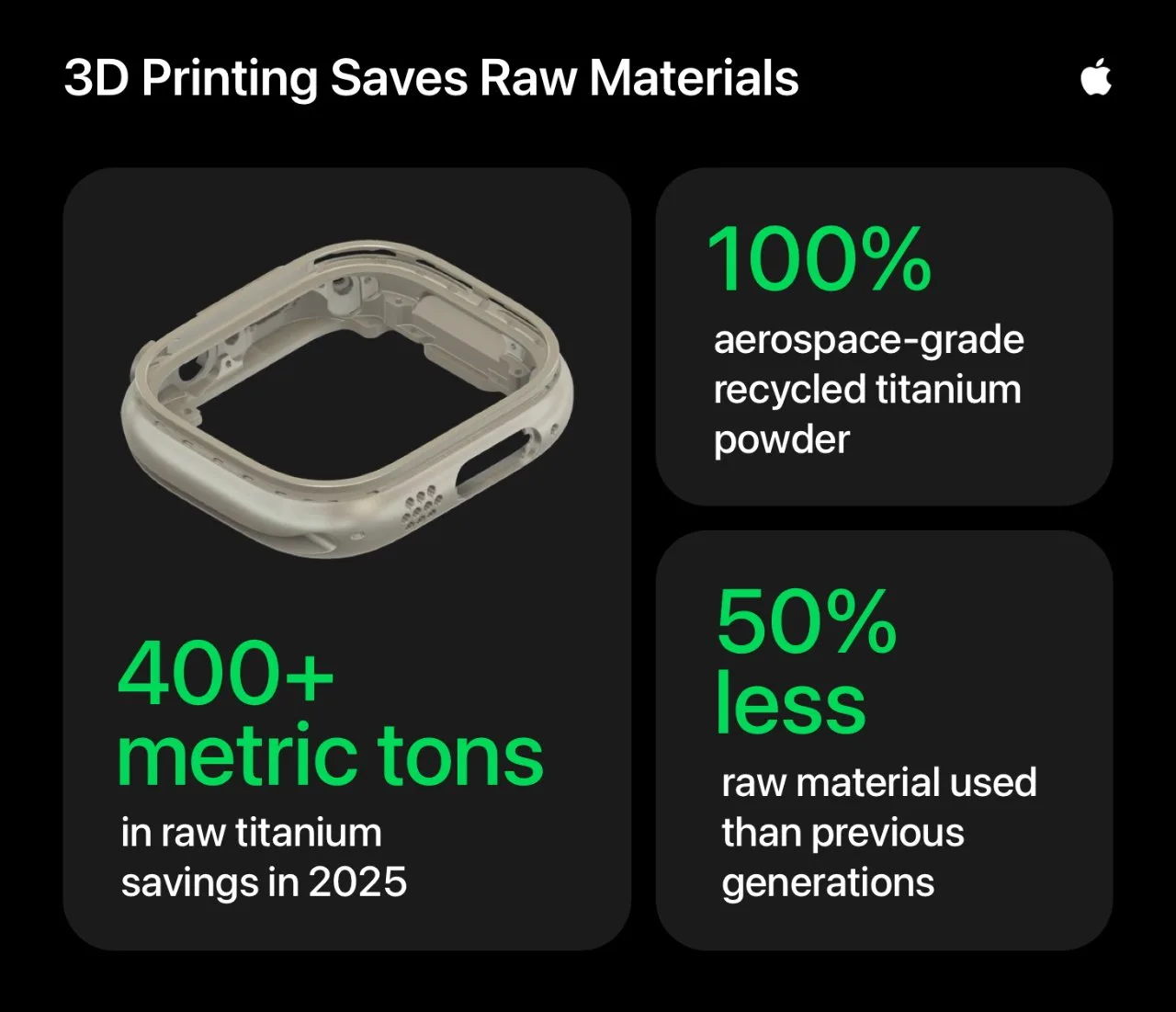
This method allows Apple to produce the same structure while using significantly less raw material. According to the company, titanium usage dropped by about fifty percent for certain watch cases. The change means that the same quantity of titanium can produce two watch enclosures instead of one.
| Manufacturing Method | Material Usage | Waste Output | Production Style |
|---|---|---|---|
| Traditional machining | High metal removal | Larger scrap volume | Carving from solid block |
| Additive manufacturing | Lower raw metal demand | Minimal leftover material | Layer by layer printing |
New hardware designs enabled by Apple 3D printing
The effect of Apple 3D printing extends beyond material savings. The process also enables device designs that were previously difficult to manufacture. Laser based printing can create fine textures and shapes that cutting tools cannot reach easily. These surface structures improve sealing and bonding in compact electronics.
This capability appears in another Apple product experiment. Engineers used additive manufacturing to build the enclosure for the USB C connector in the iPhone Air. From the outside the connector appears identical to standard ports. Internally the structure is thinner yet strong enough to handle repeated cable insertions. The new enclosure design helps Apple reduce internal space requirements while maintaining durability.
Apple links these manufacturing changes to its environmental goals. The company plans to reach carbon neutrality across its operations and products by 2030. Reducing raw material consumption plays a major role in that plan. Apple estimates that additive manufacturing helped avoid hundreds of metric tons of titanium use during 2025 alone.
From an editorial standpoint at SquaredTech.co, the rise of Apple 3D printing suggests that future devices may depend increasingly on additive manufacturing. The company will likely expand the technique to more components before attempting larger device frames. If the process scales successfully, it could influence the design and production strategy of future Apple Watch models and eventually reshape how iPhones themselves are manufactured
Stay Updated: Tech News

