

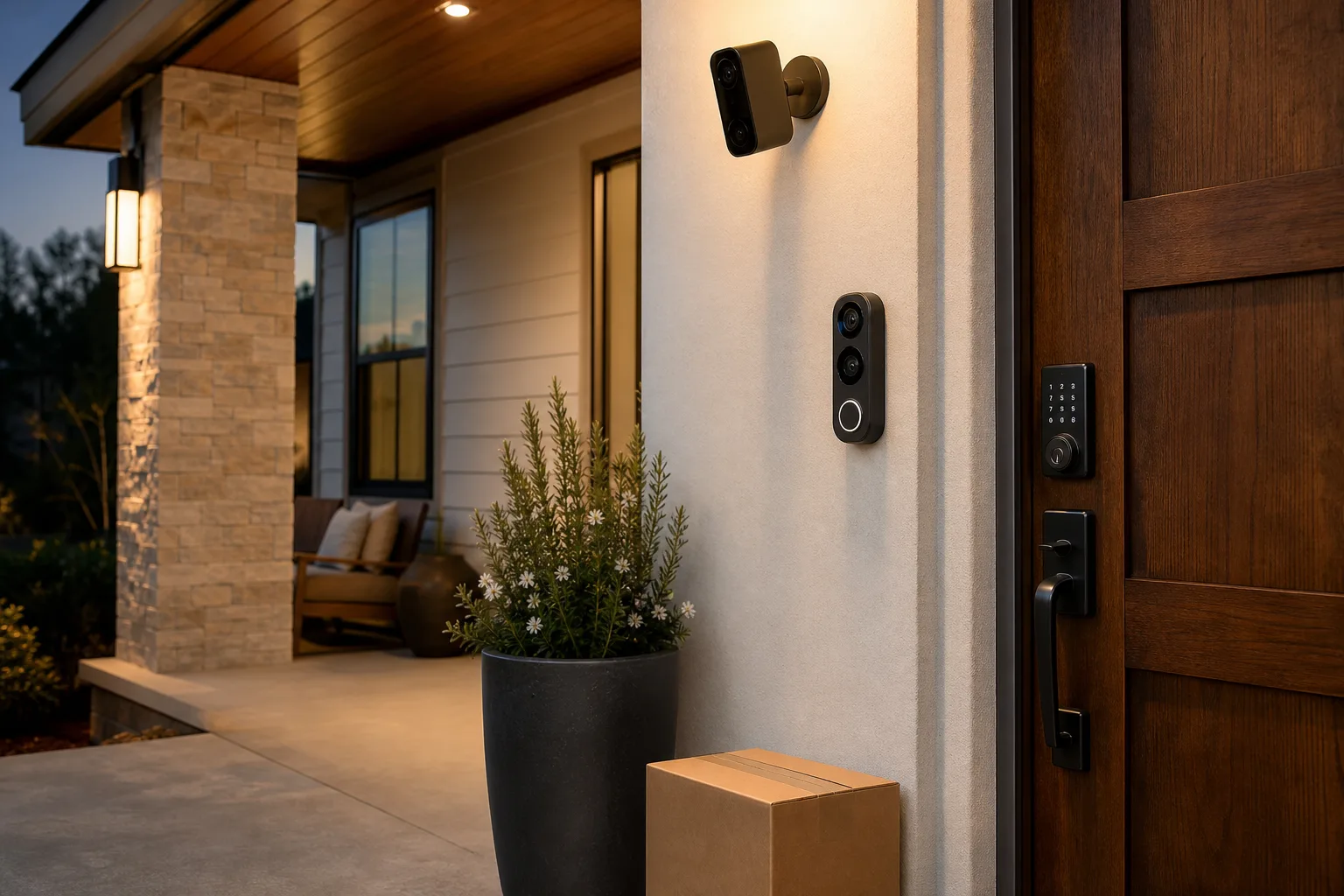
- The Apple Home Collection pairs Apple software with LG and Schneider Electric hardware across six connected-home products.
- Apple Home Collection devices range from $199 thermostats and cameras to a $399 floodlight-equipped outdoor security camera.
- LG’s new smart lock uses Apple Home Key and UWB for hands-free entry, while retaining PIN and physical-key access.
- HomeView gives Apple a dedicated smart display, putting Siri and Home controls in a more visible household role.
Table of Contents
Apple Home Collection puts hardware behind Apple’s smart-home ambitions
For years, Apple’s smart-home pitch has had an awkward gap at its center: the software was polished, but the hardware largely belonged to somebody else. The Apple Home Collection is the company’s clearest attempt yet to close that gap. It packages six new connected-home products — cameras, a video doorbell, a lock and thermostats — around Apple’s Home platform and its new HomeView display.
That doesn’t mean Apple suddenly wants to manufacture every appliance in your house. The devices were co-developed with LG Electronics and Schneider Electric, a pragmatic arrangement that gives Apple access to companies that already understand locks, cameras and climate controls. Apple, meanwhile, supplies the ecosystem glue: iPhone controls, Home Key, Matter compatibility and a Siri AI-enabled display intended to sit at the center of the home.
My read is that this is Apple responding to a problem Amazon and Google solved years ago, if imperfectly. You can buy a smart-home product with Alexa or Google Home support in virtually any big-box store. Apple Home support has often felt like a nice extra on the package rather than the reason a product exists. The Apple Home Collection reverses that hierarchy.

The front door gets most of the attention
The headline device may be LG’s $349 smart lock, which supports Apple Home Key and ultra-wideband technology. Approach the door with a compatible Apple device, and it can identify you and unlock the door hands-free. It’s a little bit like walking up to a newer car with its key in your pocket: no fumbling for credentials in the rain, no balancing a grocery bag while Face ID decides whether it recognizes you.
That convenience is only useful if the fallback options are sensible, and LG appears to have covered them. The lock also includes a keypad for PIN entry and a physical keyhole beneath it. Frankly, that last detail matters. Smart locks are terrific right up until a battery dies, a guest has the wrong phone, or your home Wi-Fi has picked exactly the wrong day to misbehave.
LG’s $249 video doorbell takes a similarly practical swing at the front-porch problem. Its two cameras can record at up to 2.5K resolution: one watches visitors, while the other looks down toward delivered packages. A motion-triggered light adds some deterrence after dark. Dual-camera doorbells aren’t a new idea — Eufy and other rivals have been working this angle for a while — but Apple’s involvement could make package monitoring feel more integrated for households already committed to HomeKit and iCloud.

Cameras and thermostats fill out the Apple Home Collection
A doorbell without a broader security setup is only half a system, so the Apple Home Collection also includes a $199 indoor camera and two wired outdoor models from LG. The indoor unit records in up to 2.5K and can automatically tilt up or down. Users can set it to point down when they return home, an important privacy gesture for a camera designed to live inside your house.
The outdoor camera comes in two versions: a $299 model without lighting and a $399 version with motion-activated floodlights. Their tubular form factors match the doorbell, which is hardly the biggest buying criterion, but it does suggest someone thought about what happens when these things are mounted around an actual home rather than shown individually on a product page.
Then there are the thermostats, perhaps the least glamorous products here and potentially the most consequential. LG’s round model and Schneider Electric’s square version both cost $199 and support Matter, the cross-platform standard backed by Apple, Google, Amazon and Samsung. The Apple Home Collection needs Matter because most homes are a messy mix of brands, old wiring and devices bought during different smart-home fads. Nobody wants to replace an otherwise functional sensor because one company changed platforms.
Matter does not magically make every product equally capable in every app — anyone who has wrestled with smart lighting settings knows the standard still has limits — but it lowers the odds that buyers are locking themselves into a cul-de-sac. Apple deserves credit for making interoperability part of the pitch rather than treating it as an afterthought. The company’s existing Home platform has long relied on certified third-party accessories; the new devices look like an effort to make that catalog feel coherent.
HomeView is the strategic piece that matters most
The hardware is interesting. HomeView may be the real story. Apple describes the Siri AI-enabled product as its first dedicated smart-home display, capable of controlling each device in the lineup alongside the iPhone and other Apple products. That puts it squarely in the territory occupied by Amazon’s Echo Show and Google’s Nest Hub — screens built for glancing at cameras, checking who rang the bell and adjusting the temperature without pulling out a phone.
Apple has been conspicuously absent from that category. An iPad can perform parts of the job, but it’s expensive, portable and usually belongs to one person. A household display has to be more like a shared kitchen calendar: always there, easy to use, and uninteresting enough that nobody carries it away to bed.
There’s also an AI question hanging over all of this. Siri has never been the assistant people praise for complex, conversational requests. If HomeView can understand plain-language commands and reliably connect them to the right room, person or device, the Apple Home Collection becomes much more appealing. If it merely wraps the same occasionally temperamental voice controls in prettier hardware, Apple will have built a polished dashboard for a familiar frustration.
Apple is selling confidence, not just connected gadgets
Prices place the Apple Home Collection toward the premium end of a very crowded market. A $199 indoor camera and $399 floodlight camera will be compared directly with Ring, Nest, Eufy and Arlo products, many of which offer sales, bundles and broader accessory catalogs. Apple’s advantage won’t be undercutting them. It will be asking buyers to pay for a system that feels more private, more unified and less likely to require three separate apps.
That’s a credible argument, especially for iPhone households. But this category punishes overpromising. A smart lock must open every time. A camera alert must arrive when it matters. A thermostat cannot decide that cloud maintenance is a good time to forget the heat. The Apple Home Collection has the ingredients to turn Apple Home from a background feature into a product family people actively choose. Now it has to prove it can handle the boring Tuesday-night reliability test — the one that actually decides whether a smart home feels smart.