

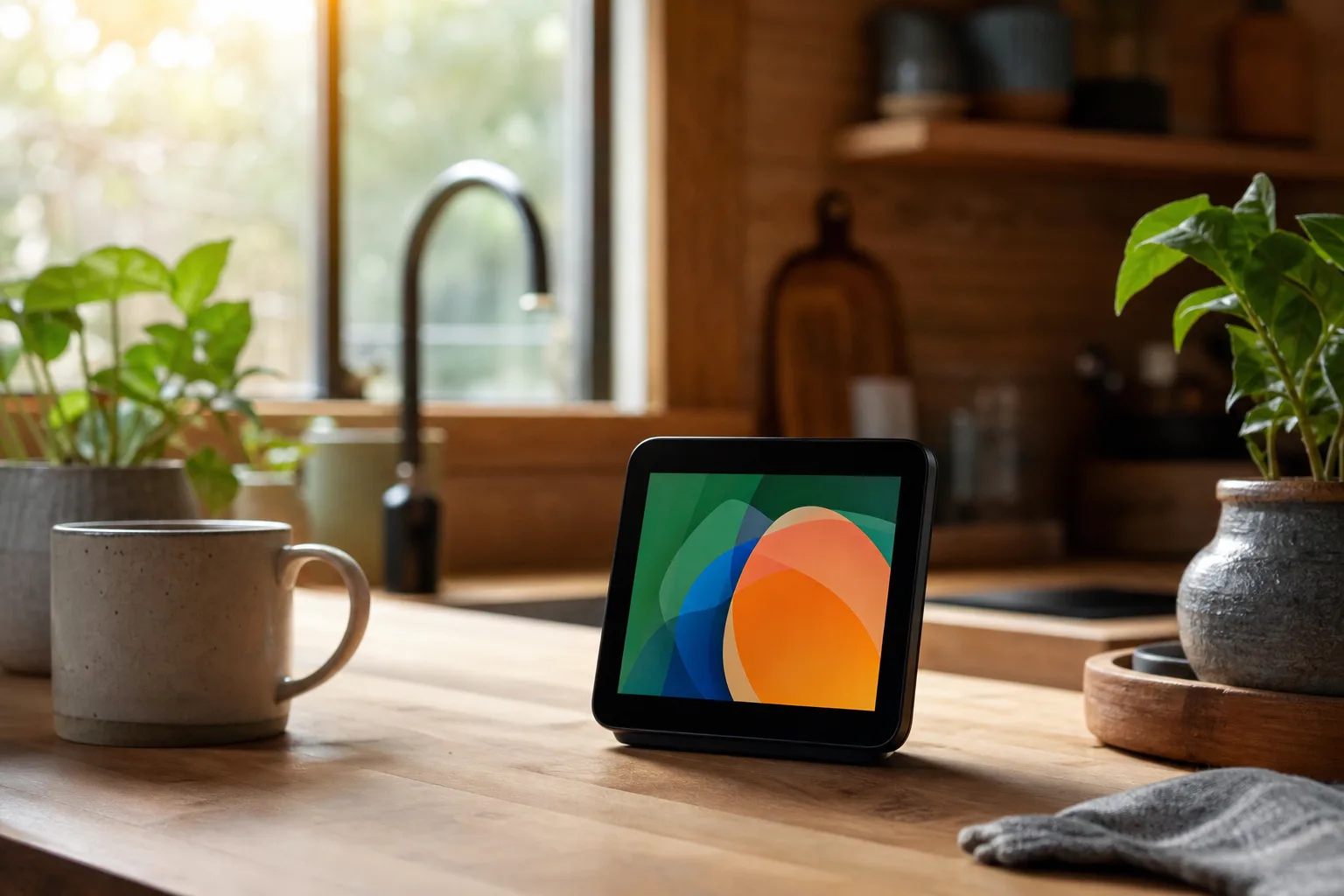
- Apple Home Hub is expected to arrive October 13 with a compact display built for shared rooms and household controls.
- The Apple Home Hub may combine smart-home management, FaceTime, music, photos, calendars and a new Siri AI interface.
- Apple reportedly plans tabletop and wall-mounted models, but third-party apps may be missing at launch.
- A focused household screen could finally give Apple’s fragmented smart-home strategy a clear physical center.
Table of Contents
Apple Home Hub could finally give Apple’s smart home a front door
Apple has spent years building the plumbing for a connected home, then left users staring at their iPhones to operate it. The Apple Home Hub reportedly set for an October 13 reveal could fix that awkward gap: a small, always-available screen for the kitchen counter, bedroom, or living room wall.
Reports point to a roughly 6-inch square display, a speaker-equipped tabletop base, and a separate wall-mounted option. Apple is expected to introduce the device during its “Welcome home” experience in New York, with a newsroom announcement likely timed around 9 a.m. Eastern. Invited media and creators are reportedly getting hands-on access, which suggests this is more than a quiet accessory refresh.
That matters because Apple’s Home ecosystem has had all the components of a decent smart-home platform without the obvious control panel. HomePods handle voice requests. Apple TV can act as a home hub. The Home app manages lights, locks, cameras and automations. But the experience is scattered across devices, and frankly, it has never had the simple visibility of an Amazon Echo Show sitting on the counter.
The expected Apple Home Hub sounds like Apple’s answer to that problem, though with a familiar Apple twist: less of a general-purpose tablet and more of a household appliance. Think thermostat, family calendar, intercom and photo frame rolled into one small screen.
What the Apple Home Hub is expected to do
The reported feature list covers the obvious bases, but that is exactly what a household screen needs. The device is expected to provide Apple Home controls, security camera views, music playback, digital photo displays, calendars, reminders, notes and FaceTime calls. Preinstalled apps may include Calendar, Camera, Apple Music, Apple Podcasts, Apple News, Reminders and Notes.
The interface may change depending on how close someone is. Reports say controls and information could change size as someone approaches or walks away. That sounds a lot like Google’s Nest Hub approach, where the display shifts its usefulness based on distance. From across a room, you want a readable clock, now-playing track or upcoming appointment. At arm’s length, you want camera controls and room-specific switches. It’s basic human-interface design, but it is exactly the sort of thing Apple tends to obsess over when it gets serious.

The Apple Home Hub is also expected to support multiple people in a household. That’s harder than it sounds. A family screen must know whether to show one person’s work calendar, another person’s medication reminder, or a shared grocery list without turning private information into living-room wallpaper. Apple’s existing Home architecture and emphasis on on-device processing could give it an advantage here, although the company will need to explain how identity recognition works and what data remains local.
FaceTime is another potentially smart inclusion. Video calls on a fixed household device can be genuinely useful for checking in with relatives or chatting while cooking, provided Apple solves the awkward camera-placement problem. Meta tried to make this category happen with Portal before abandoning it. Amazon has kept pushing Echo Show. Neither company has made the video-call screen essential. Apple has a stronger communications ecosystem, but that alone won’t make people want a camera watching the kitchen.
Siri AI is the real test
Under the hood, the Apple Home Hub is rumored to use an A18 chip or something newer, enough horsepower for Apple Intelligence features. That detail matters less for raw speed than for Apple’s apparent plan to make Siri the device’s main reason to exist.
A rebuilt Siri with conversational context could make a household hub much more useful than today’s voice assistants. Ask it to turn down the lights, pull up the front-door camera, tell you whether the garage was left open, add ingredients to a list, and remind the right family member about tomorrow’s appointment. Those aren’t exotic requests. They’re the messy little chores smart speakers promised to handle a decade ago and frequently botched.
Apple Intelligence could help make Siri more useful in a shared home. The company’s own Apple Intelligence overview lays out that privacy-first pitch. The question is whether the new Siri experience is ready for the most demanding setting possible: a shared home full of overlapping voices, routines and permissions.
My read is that Apple needs this product as much as consumers do. Siri has lost ground to chatbots and has become the punchline in too many smart-home setups. A dedicated display gives Apple a controlled place to prove that its assistant can finally understand context instead of merely recognizing commands.
homeOS may be deliberately limited at launch
The interface may run on a new platform called homeOS, with widgets and clock-face-style layouts. Apple could call the product Apple Home, HomeView, or something else entirely; rumor names are often just placeholders with good publicists. The bigger story may be the reported lack of an App Store at launch.
That restriction could frustrate anyone imagining an iPad nailed to the wall. But it may be the right call. The Apple Home Hub needs to be reliable, glanceable and painless for people who did not set it up. Letting every app developer colonize the screen on day one would risk turning it into another abandoned tablet charging beside the fruit bowl.
Apple’s first-party apps can cover a lot: household schedules, media, communications and security. Still, the company should not mistake control for a complete strategy. Smart-home platforms win when they accommodate weird real homes: a niche thermostat, a favorite recipe service, a particular energy monitor, a doorbell bought three years ago. Matter has helped make accessory compatibility less chaotic, and Apple supports the standard through Home, but software services are another matter entirely.
The hardware is easy; the habits are hard
The Apple Home Hub will enter a market that has already taught consumers to be skeptical. Google’s Nest Hub line remains useful but quiet. Amazon’s Echo Show family is widely available, though its screens can feel crowded with promotions and shopping prompts. Apple has an opening precisely because it can sell calm: fewer ads, more privacy, better hardware, tighter integration with iPhone and HomeKit accessories.
But a pleasant screen isn’t enough. Apple must answer why a household needs another display when phones, tablets, televisions and smart speakers are already everywhere. The strongest answer is shared context. Your phone knows about you. A household hub should know about the house: who is expected home, which door is unlocked, what is playing, whether the laundry timer is done, and what everyone needs to remember before leaving.
If the Apple Home Hub lands near an accessible price and Siri actually delivers on the intelligence Apple is promising, it could become the company’s most important new home device since the original HomePod. If it is merely a pretty control panel with a delayed assistant, it will join the long list of screens people admired in stores and ignored at home. October 13 should tell us which version Apple thinks it has built.

