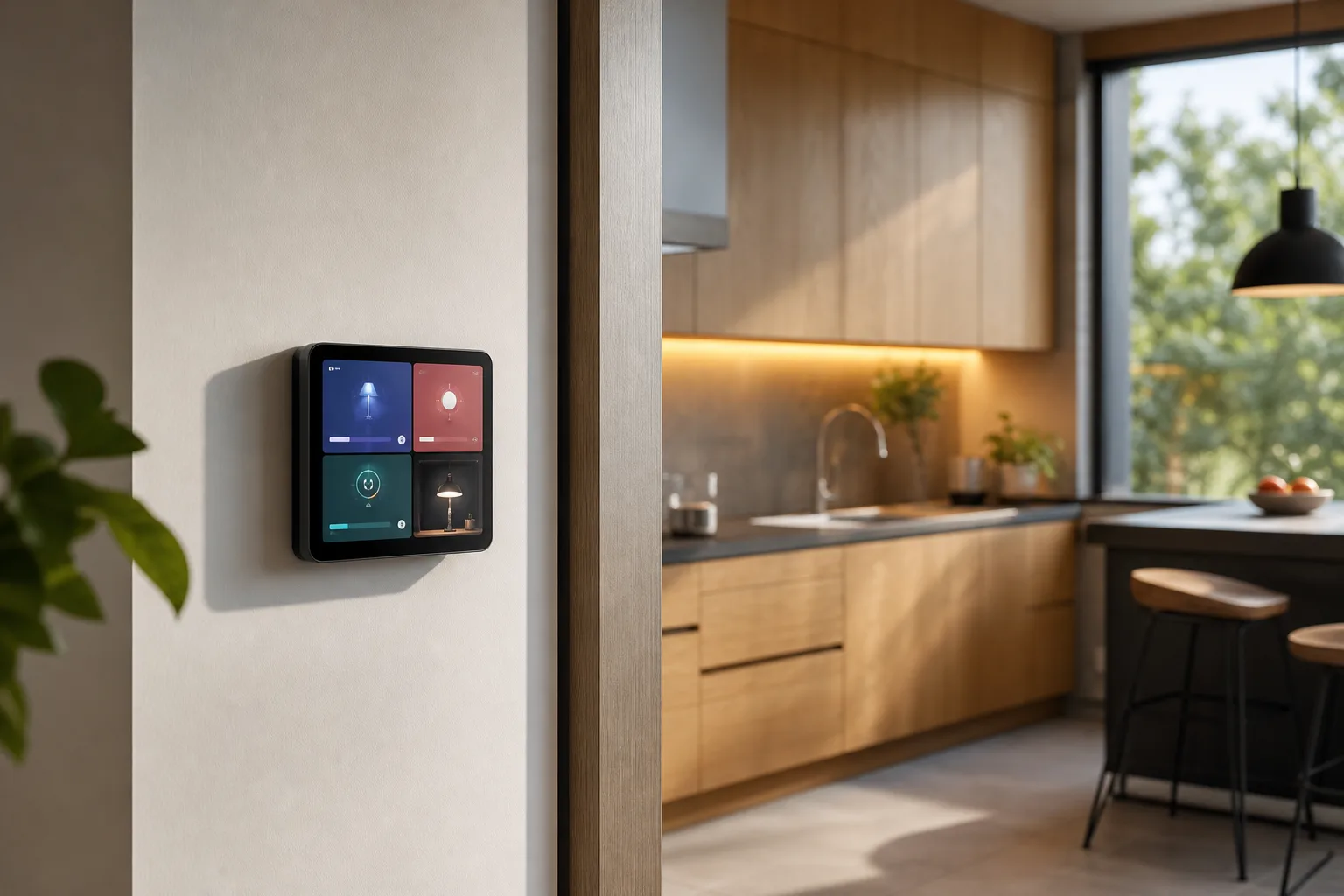
- The Apple smart home hub could bring a shared, display-first Siri interface to kitchens, hallways, and bedrooms for roughly $350.
- Apple smart home hub rumors point to wall-mounted and speaker-based versions, with presence sensing and personalized information for household members.
- A refreshed HomePod mini and Apple TV 4K may give Apple’s home ecosystem newer chips and improved wireless connectivity.
- Apple’s October 13 gathering in Tribeca suggests the company wants journalists to experience its long-delayed home strategy firsthand.
Table of Contents
Apple smart home hub could finally give HomeKit a front door
Apple has spent years building the plumbing for a connected home without giving people a compelling place to actually use it. That may change on October 13. The rumored Apple smart home hub is expected to headline a product launch, alongside updates to the Apple TV 4K and HomePod mini.
The timing matters. Apple Home has long been competent, private, and occasionally maddening. It works best when you already own an iPhone, an Apple TV, a HomePod, a pile of compatible lights, and enough patience to troubleshoot a device that has somehow become “No Response.” What it lacks is a visible center of gravity: a screen on the wall or countertop that makes the system feel like part of the home rather than another settings menu on a phone.
Reports point to a roughly six-inch square display that combines an iPad-like screen with HomePod-style audio. Apple is said to be considering both a wall-mounted model and a version attached to a half-dome speaker base, a silhouette that reportedly echoes the beloved iMac G4. If that sounds like Apple rediscovering the household computer, well, that may be exactly the point.
Apple has invited some media members to an “Apple Experience” in Tribeca at 9:00 a.m. Eastern on October 13. That phrasing leaves room for a simple online announcement, but an in-person hands-on session would make sense for products whose value depends heavily on how they feel in a room. A smart display is hard to judge from a spec sheet. You need to see it from across a kitchen, hear it over a dishwasher, and find out whether its camera makes visitors uncomfortable.
A shared screen, not another personal gadget
The most interesting claim around the Apple smart home hub is not its display size or rumored $350 price. It is the idea that Apple sees it as a multi-person device. Presence detection and a camera could identify someone entering the room, then shift the interface toward that person’s calendar, widgets, media, and smart-home controls.
That is an ambitious concept, and it comes with obvious privacy questions. Apple has spent years marketing privacy as a product feature, so a camera-equipped household screen would need unusually clear controls, visible indicators, and credible local processing. Nobody wants a cheerful weather widget that doubles as an opaque family surveillance terminal.
Still, the use case is real. Amazon’s Echo Show line and Google’s Nest Hub have already established the basic shape of the category: screens for timers, video calls, cameras, recipes, photos, and quick controls. But both companies have struggled with the line between useful ambient computing and a cluttered screen that keeps trying to sell you something. Apple’s chance is to make the interface quieter and more personal, provided Siri can carry its side of the bargain.
For an Apple smart home hub, voice would reportedly sit at the center of interaction while apps, video playback, FaceTime, news, weather, and calendar information fill out the experience. That approach sounds sensible. A display in a common space should be glanceable first and touchable second. You should be able to ask it to turn off the downstairs lights while carrying groceries, then tap a camera feed when somebody rings the bell.
Siri has to show up this time
Apple’s home ambitions are tied directly to its broader Siri AI effort. The new HomePod mini is expected to receive a faster S-series processor and Apple’s N1 networking chip, reportedly improving Wi-Fi and Bluetooth performance while preparing the speaker for more capable Siri features. New colors are also rumored, because Apple can rarely resist a color refresh when the underlying product has been around for a while.
For the Apple smart home hub, a more capable Siri is not a nice extra. It is the whole assignment. Basic commands such as “turn on the lights” have been table stakes for years. The useful version of an assistant needs to understand context: which room a person means, whether the kids are asleep, why the thermostat routine did not run, and how to answer without forcing someone into an app.
Apple has a particularly awkward gap to close here. It has enormous reach through the iPhone, but Siri’s reputation in the home has often lagged Alexa and Google Assistant on flexibility. Amazon, meanwhile, has retrenched after pouring money into Alexa, while Google has repeatedly changed its smart-home strategy. That instability gives Apple an opening. It also means the company cannot afford a half-finished experience dressed up in tasteful aluminum.
Apple’s own Home platform already supports Matter, the industry standard intended to reduce the compatibility mess across smart-home brands. The standard has not magically made setup painless, but it is meaningful progress. A dedicated Apple screen could make Matter’s promise more tangible by turning a scattered collection of devices into a household dashboard people might actually consult.
Apple TV 4K and HomePod mini may be the less flashy story
The companion updates may matter more than their billing suggests. The next Apple TV 4K is rumored to use an A19 or A19 Pro-class chip, more memory, the N1 wireless chip, and an updated Siri Remote. That may sound like a predictable specification bump, but Apple TV is already a key Home hub for many households. Better networking and more processing headroom could matter more than raw streaming performance.
The Apple smart home hub would be joining a broader lineup, not arriving as a solo experiment. Apple appears to be laying down a refreshed foundation: a screen for shared interactions, speakers for voice access, and a television box for media and home automation. That is a more coherent strategy than treating each product as a separate island.
That broader foundation could also make the Apple smart home hub feel less like an experimental accessory and more like the visible control point for Apple Home. The value will depend on whether those devices work together without demanding constant attention from the people using them.
There is also talk of an OLED iPad mini appearing around the same window. The prospect is intriguing, especially if Apple improves water resistance and updates its chip, but I would be cautious about assuming it belongs in a home-focused launch. An OLED iPad mini is a personal device with a very different audience, and Apple often uses compact product announcements to avoid turning one event into a grab bag.
The price is where Apple’s home plan gets real
A price near $350 would place the Apple smart home hub well above many Amazon and Google displays. Apple can justify that premium only if it delivers something those products do not: great sound, a genuinely useful display, strong privacy protections, dependable smart-home control, and an assistant that does not collapse the moment a request becomes slightly unusual.
Frankly, $350 is a lot for a device some people will install in multiple rooms. Apple reportedly imagines exactly that scenario, which means the economics could get steep fast. A family that wants one in the kitchen, one near the front door, and one in a bedroom is looking at a four-figure investment before buying a single light bulb. The wall-mounted version may help make that proposition feel more intentional, but it also raises installation questions Apple will need to answer.
My read is that Apple is not trying to win the bargain smart-display market. It is trying to make the home feel like the next surface for its ecosystem, much as the Apple Watch made notifications more immediate and AirPods made Siri more accessible. The Apple smart home hub could be a strong start, but only if it solves the boring problems: reliability, household sharing, setup, and voice control that works when you need it.
October 13 should tell us whether the launch is a confident declaration or a belated acknowledgment that Apple has left its own living room unattended for too long.