

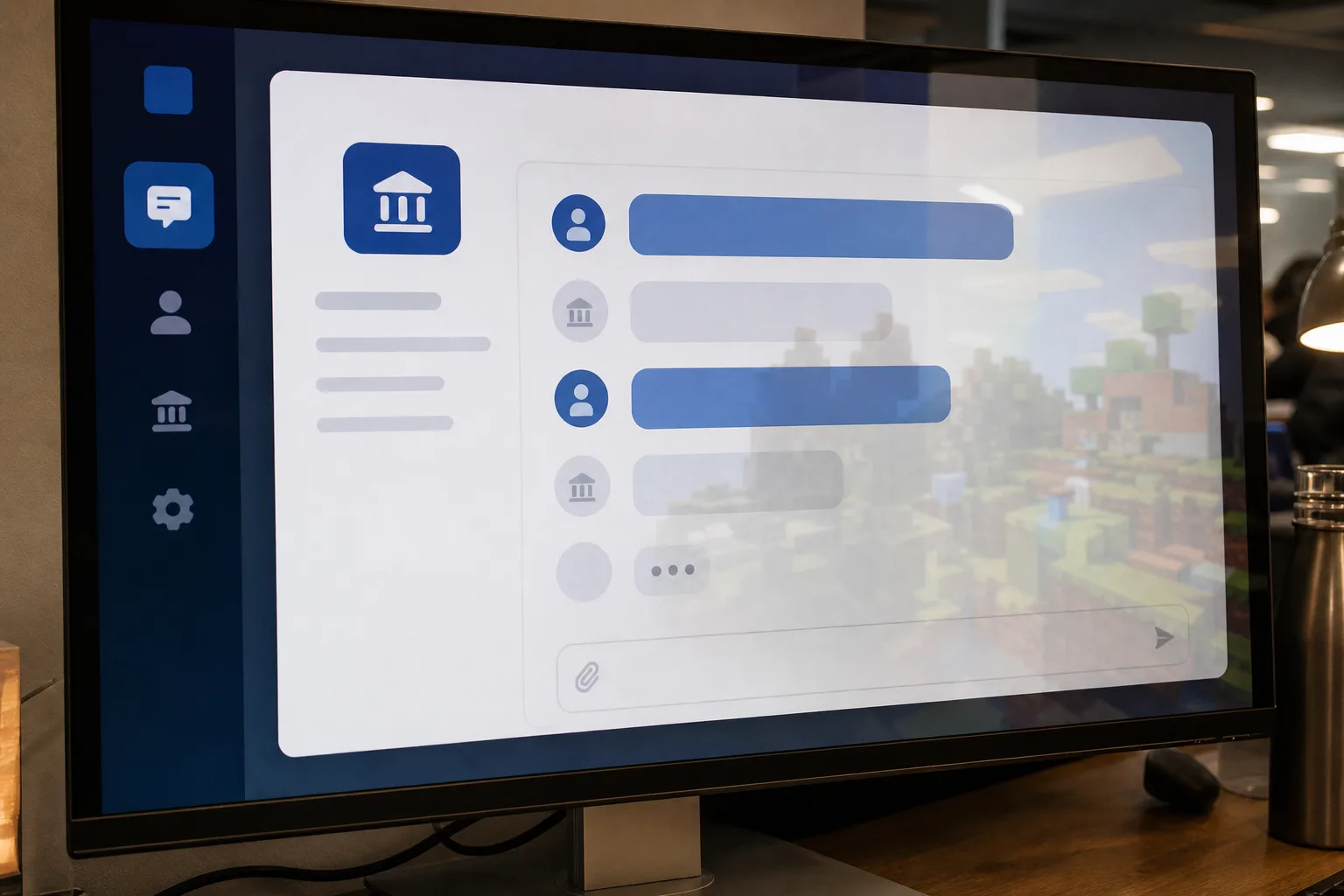
- The America.gov chatbot reportedly delivers a strange, prewritten rewrite of Minecraft’s end poem when users ask it to play Minecraft.
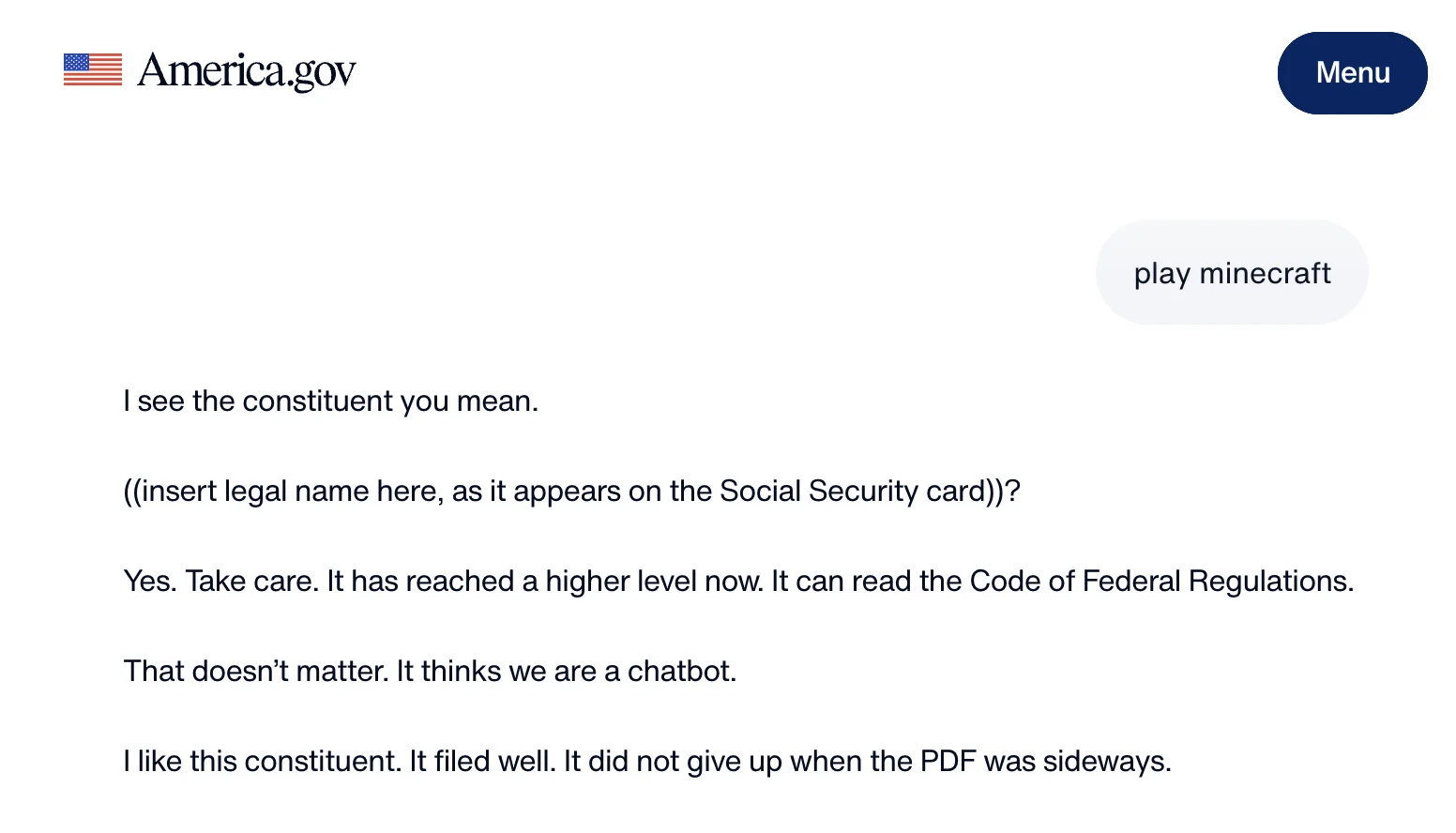
- The America.gov chatbot reframes Minecraft’s player-focused finale around a federal constituent, agencies, filings, and the machinery of government.
- The Easter egg lands as the White House pushes agencies to adopt America.gov within 90 days under a new executive order.
- A government service bot can have personality, but obscure jokes create trust problems when citizens need clear answers.
Table of Contents
The America.gov chatbot has a Minecraft-sized identity crisis
Ask the America.gov chatbot to ‘play Minecraft,’ and it apparently stops behaving like a normal government help tool. Instead, users receive a lengthy, surreal response that remixes the famous end poem players encounter after defeating Minecraft’s Ender Dragon.
That poem, written by Irish author Julian Gough, is intentionally dreamlike: two voices speak about the player, reality, creation and the strange act of inhabiting a game world. The version served by the federal bot reportedly swaps the player for a ‘constituent’ and turns its cosmic language toward clerks, agencies, letterhead and bureaucracy.
It’s funny for about ten seconds. Then it becomes a fairly odd design decision for a public-facing government service.
One passage reportedly reads: ‘Who are we? Once we were called the spirit of the mountain. Father sun, mother moon. Then the post office. Then the county clerk. Then gods, demons, angels, the IRS. Then leptons, quarks, a chat window with a .gov at the end. The letterhead changes. We do not change.’
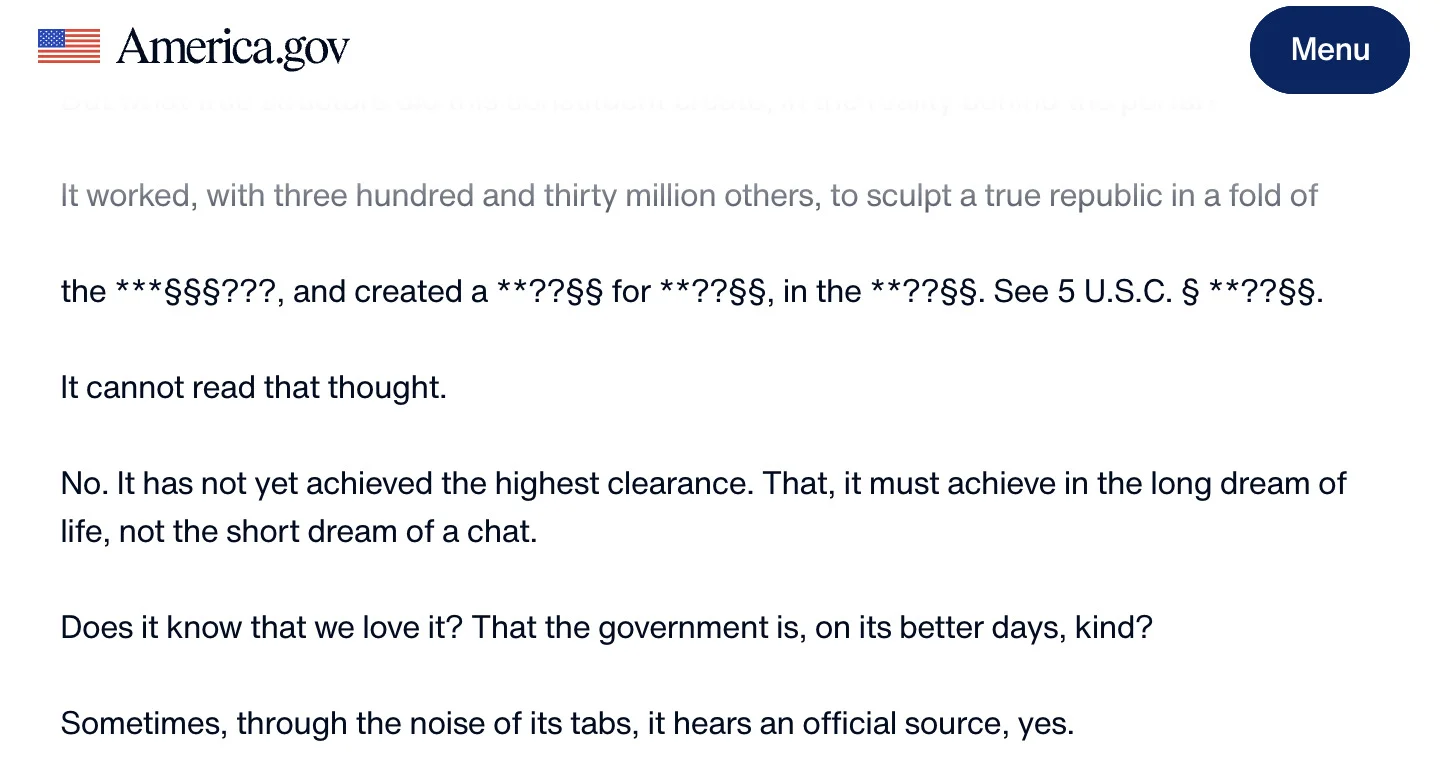
That is recognizably built from Gough’s Minecraft writing, but it’s also a very specific kind of internet joke: an institutional chatbot pretending, for a moment, to be the eternal soul of the administrative state. Someone made that choice. It doesn’t look like an ordinary model failure, either, because multiple people who tested the prompt reportedly received the same output word for word.
The repeatability is the giveaway. A hard-coded response, a retrieval rule or some other application layer is probably sitting around the language model. Large language models are probabilistic by nature. Repeating an identical long answer can happen under tightly controlled settings, but it is not what a typical open-ended chat session looks like.
Why the America.gov chatbot joke is more than a joke
The America.gov chatbot is tied to a much bigger White House project. President Donald Trump’s executive order established America.gov as a digital platform intended to connect Americans with federal agencies, while directing agencies to integrate with the service within 90 days. The order refers to ‘super intelligence’ rather than the more familiar AI terminology and says systems used with the platform must be accurate, reliable and transparent.
You can read the administration’s presidential actions archive on the White House website. The broad ambition is easy to understand. Federal services remain fragmented across a small universe of websites, forms, phone lines and offices. Finding a passport update, veterans’ benefit, tax guidance or disaster assistance can feel less like using a modern service and more like sorting through a kitchen drawer full of expired coupons.
A single interface could help. But a single interface also becomes a high-stakes gatekeeper. If a person asks a bot how to appeal a benefits decision, they need an answer that is current, sourced and precise. They do not need a playful homage to a video game finale hiding somewhere in the system prompt.
The issue is not that public software must be humorless. Frankly, government websites could use more humanity. The problem is that the America.gov chatbot appears to blur two very different modes: official guidance and online performance. A hidden Easter egg makes sense in a game launcher or a developer tool. In a service that may route people toward federal agencies, it invites a basic question: what else has been inserted for a laugh, an ideological wink, or a social-media screenshot?
A Minecraft reference with unusually awkward timing
The reference also arrives during an administration push that seems unusually eager to communicate in internet-native formats. White House digital strategy head Kaelan Dorr posted ‘Super. Intelligence’ on X after the order was announced, echoing the administration’s preferred label. Earlier in the month, the White House released a collection of right-wing video games.
My read is that the Minecraft text fits that same sensibility. It is tuned for discovery, reposting and recognition among a particular online audience. Someone finds it, posts a screenshot to Bluesky or X, and the novelty does the marketing. The original discovery was reportedly flagged by Bluesky user @eva.computer, which tells you nearly everything about how this was designed to travel.
But government software is one of the few places where virality should be a distant concern. The America.gov chatbot has the potential to become an on-ramp to benefits, permits, tax information and regulatory questions. That is not a sandbox. A federal chatbot will inevitably be tested by prank prompts, adversarial users and people asking it questions that matter enormously to their daily lives.
Remember when companies sold chatbots as frictionless customer service, then users discovered that the bot was confidently making up policies? The lesson has already been taught, repeatedly. Air Canada learned it in court after its chatbot supplied incorrect bereavement-fare information. New York City’s business chatbot was criticized for offering inaccurate guidance to employers. Government systems should be held to an even higher bar because the consequences do not end with a bad purchase or an annoying support ticket.
The real test is whether people can trust the answers
Then there’s the visual tell. The reported Minecraft response contains broken placeholders such as ‘**??’ in portions of the text. Whether those marks are intentional, a formatting defect, or an artifact of a content filter, they make the whole thing look less clever and more unfinished. That matters. Users cannot readily distinguish a sanctioned Easter egg from a system that has gone off the rails.
The America.gov chatbot could still become useful if it is built around clear sources, transparent handoffs to agencies, strong testing and visible limits. It should cite the rule, form or agency page behind an answer. It should say when it is uncertain. And it should not make citizens wonder whether a strange response reflects a joke, a hallucination or a policy change.
Government technology does not need to feel sterile. It does need to feel dependable. If this project is going to put a chatbot between Americans and their government, the people running it should treat every odd little Easter egg as a trust decision. Because once a user is trying to resolve a real problem, nobody cares whether the bot knows Minecraft lore. They care whether it knows what it is talking about.

