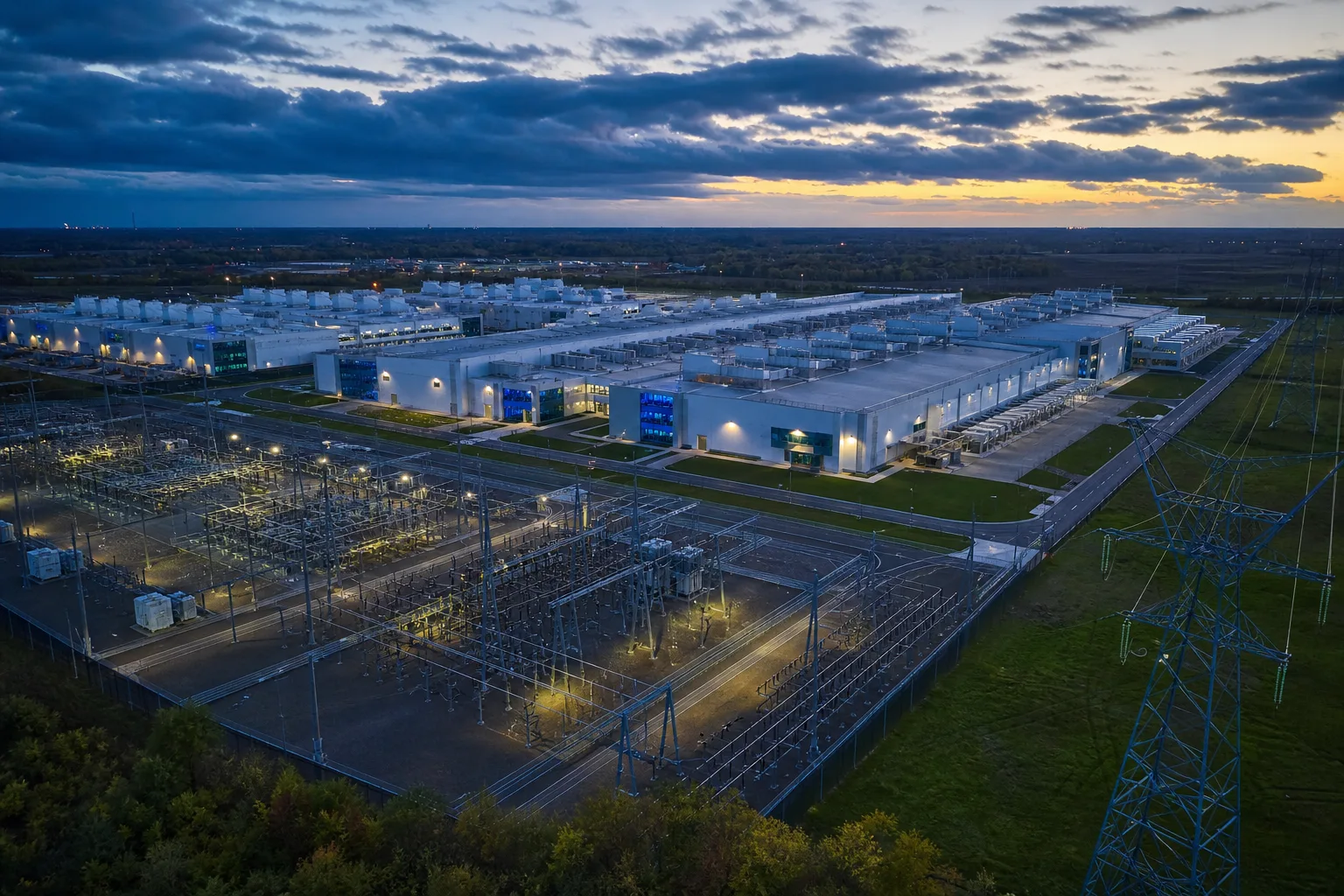
- AI infrastructure spending by Amazon, Alphabet, Microsoft, Meta and Oracle could reach $1.2 trillion in 2027, Goldman Sachs projects.
- Goldman’s AI infrastructure spending forecast sits above Wall Street expectations and would mark an investment cycle rarely seen outside historic industrial buildouts.
- The five companies may need roughly $300 billion in annual AI revenue to earn a credible return on their expanding data-center commitments.
- Power availability, construction labor, memory supply and debt financing could all restrain the pace of the AI data-center race.
Table of Contents
AI infrastructure spending has left the forecast phase
AI infrastructure spending is rapidly becoming the real story behind the generative AI boom. Chatbots and image generators get the public attention, but the money is being poured into the decidedly less glamorous machinery underneath: data centers, power contracts, networking gear, GPUs, cooling systems and the buildings needed to house them.
Goldman Sachs now expects Amazon, Alphabet, Microsoft, Oracle and Meta to spend a combined $1.2 trillion on that machinery in 2027, according to a Bloomberg report citing Goldman strategist Ryan Hammond. That would be more than 50% above the roughly $800 billion expected this year, and above the Wall Street consensus of about $1.1 trillion.
Take a moment to absorb that number. A trillion dollars used to be a figure reserved for national budgets, bank rescues and the occasional geopolitical headache. Now five technology companies may direct that kind of money toward computing capacity in a single year. My read is that Silicon Valley has collectively decided the risk of not having enough AI capacity looks worse than the risk of building too much of it.
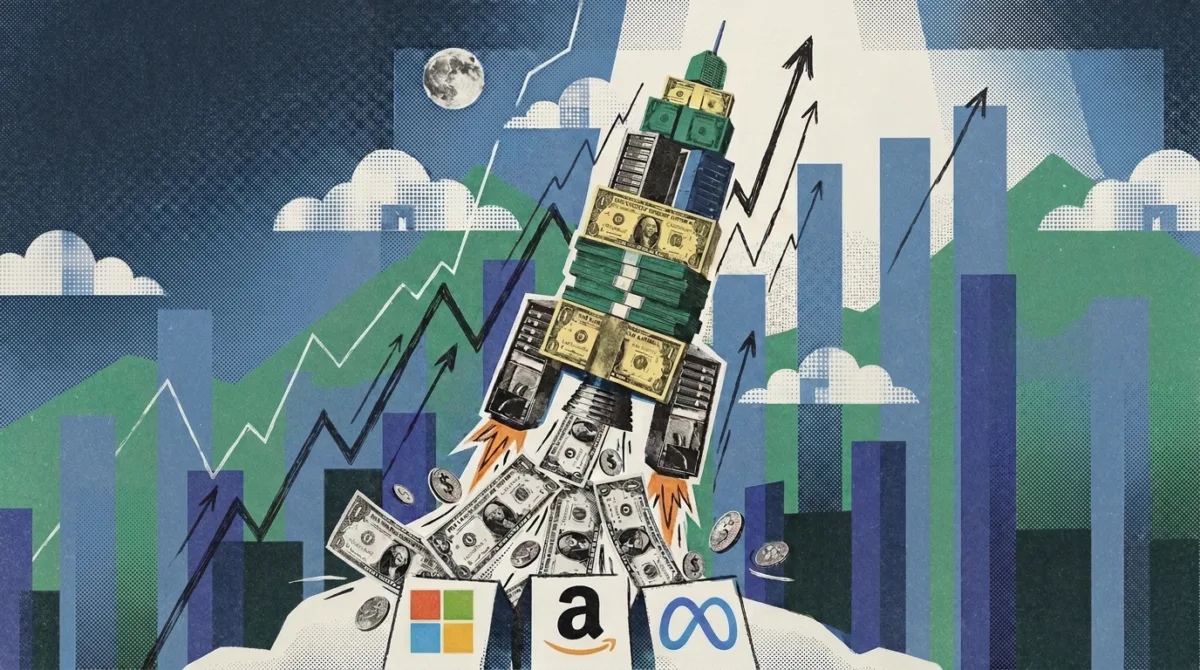
That is a rational instinct if AI becomes as central to software and business operations as its champions claim. It is also how industries create spectacular overcapacity when reality fails to cooperate. Remember the telecom fiber binge around the dot-com crash? The cable stayed in the ground; the companies that financed it did not always survive to enjoy the eventual demand.
Why the $1.2 trillion forecast matters
Goldman’s projection frames AI infrastructure spending as one of the largest private investment waves in modern American economic history. The firm reportedly compares its scale relative to GDP with the railroad construction era of the 19th century. The comparison is dramatic, but not absurd. Railroads rearranged commerce by connecting places; AI data centers aim to rearrange how knowledge work, software and media are produced.
For investors, AI infrastructure spending is increasingly a test of whether Big Tech can convert massive capital outlays into durable new revenue streams.
There is one big difference, though. Railroads had visible customers waiting at stations. The AI buildout is being financed against a messier premise: that businesses, consumers and governments will keep paying materially more for AI tools every year.
Microsoft can point to Azure growth and its deep ties to OpenAI. Amazon has AWS and a growing stack of AI services. Alphabet has Gemini and Google Cloud. Meta is spending heavily on models, recommendation systems and open-weight AI, while Oracle has become an unexpectedly prominent landlord for AI workloads. These are not speculative startups with a PowerPoint and a leased office. They are some of the most profitable companies on Earth.
Even so, profitability does not make the arithmetic disappear. Goldman estimates the group would need around $300 billion a year in AI revenue to support the outlays. Cloud revenue growth has accelerated, rising from 25% in 2024 to 48% in the second quarter of 2026, according to the figures cited in the report. That is encouraging, and it explains the market’s patience. But growing cloud sales are not the same thing as proving that AI services will produce durable returns after chips, electricity and depreciation are paid for.
The AI infrastructure spending slowdown may be the key detail
The headline number is enormous, yet Goldman’s own trajectory suggests the frenzy cannot keep accelerating forever. Its model has growth in AI infrastructure spending slowing from nearly 100% in 2026 to 54% in 2027, then just 12% in 2028. The spending mountain may keep rising, but the steepest part of the climb could be happening now.
That matters for Nvidia, memory suppliers, server makers, construction firms and every company that has attached itself to the AI supply chain. Markets tend to treat a lower growth rate as bad news even when the absolute dollar amount remains huge. If spending moves from doubling to merely rising, some businesses built for permanent hypergrowth could get a harsh lesson in basic math.
For the five buyers, a slower rate might actually be healthy. Data centers are not smartphone apps. They take years to permit, build, connect to the grid and fill with equipment. Capacity constraints can limit the ability to meet AI demand, while infrastructure availability is now a competitive weapon. Alphabet’s investor disclosures, like those of its peers, show just how central capital expenditure has become to the companies’ plans.
Frankly, the more revealing question is not whether these firms can afford the next cluster of data centers. They can. The question is whether they can turn a capital-intensive utility business into the sort of fat-margin software business investors have come to expect.
AI labs are carrying a lot of the expectations
A major chunk of the AI infrastructure spending thesis rests on demand from AI labs, particularly OpenAI and Anthropic. Both are central to the idea that frontier models will keep requiring vastly more training and inference capacity, and that enough paying users will eventually cover the bill.
The signs are encouraging. Enterprises are buying coding assistants, customer-service automation and AI analysis tools. Consumers have embraced chat interfaces more quickly than many people expected. But enthusiasm is not the same as repeatable, high-margin revenue. Many companies are still in pilot mode, testing tools with a small group before committing to organization-wide contracts.
The labs face their own awkward challenge: they need access to extraordinary computing resources before their future revenue has fully arrived. That helps explain the increasingly elaborate financing arrangements around AI capacity, cloud partnerships and long-term chip commitments. Goldman’s warning that spending is beginning to exceed cash generated from ongoing operations is significant here. More debt may be required, which makes this cycle less like a routine cloud expansion and more like a serious industrial financing project.
Power, people and memory chips can still spoil the plan
Money is not the only constraint on AI infrastructure spending. Power is the bluntest one. You cannot deploy a state-of-the-art GPU cluster on a wish and a press release; it needs electricity, transmission connections, water or alternative cooling arrangements, and local approval. In several markets, data-center operators are already competing for grid capacity with manufacturers and households.
Then there is labor. Building data centers requires electricians, engineers, construction crews and specialized technicians, many of whom are in short supply. High-bandwidth memory is another pressure point. AI accelerators are only useful when paired with enough fast memory, and supply bottlenecks there can limit shipments even when chip demand remains ravenous.
This is why the race may become more geographically uneven than the glossy AI demos suggest. The winners will not simply be the companies with the best model. They will be the ones that secured land, power and supply contracts years ahead of everyone else. That is a far less romantic contest, but it is probably the decisive one.
The bill will eventually demand an answer
For users, this AI infrastructure spending wave should mean better models, lower latency and more AI features woven into services they already use. It may also mean more subscription tiers, usage caps and pressure to move everyday work into cloud ecosystems. Somebody has to pay for those data centers.
Ultimately, AI infrastructure spending will be judged not by the size of the buildout, but by whether customers generate enough lasting demand to justify it.
Goldman’s $1.2 trillion estimate should not be read as a prediction that AI has already earned its place in the economy. It is a bet that the companies with the deepest pockets believe it will. If that bet pays off, today’s spending will look prescient. If demand plateaus, Big Tech will be left holding a very expensive collection of warehouses full of rapidly depreciating silicon. We will find out whether the AI era is built on a durable utility—or a very elaborate capacity reservation.