

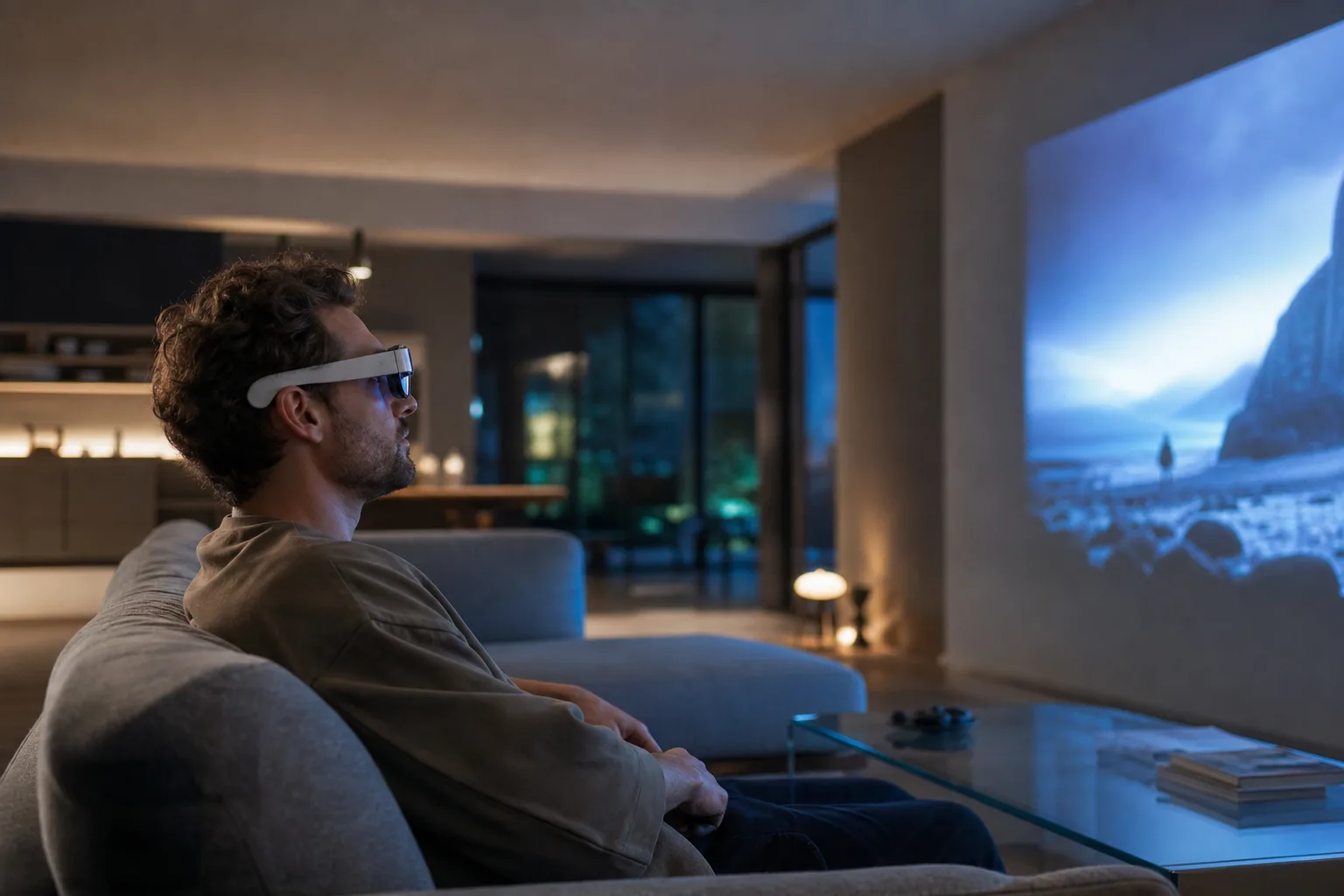
- Meta VR Glasses reportedly pair a substantially lower price with IMAX entertainment and lifelike remote-call features aimed at Apple Vision Pro.
- The Meta VR Glasses pitch hinges on comfort, an area where even impressive mixed-reality hardware can lose ordinary users quickly.
- Apple has established a premium benchmark, but Vision Pro remains far beyond the price most consumers will tolerate.
- Meta still needs software developers and reliable everyday use cases, not merely impressive demos, to make lighter hardware matter.
Table of Contents
Meta VR Glasses are chasing the problem Apple has not solved
The most interesting claim around Meta VR Glasses is not IMAX viewing or holographic calls. It is the suggestion that Meta can get near Apple Vision Pro territory while charging less than half of the Vision Pro’s price. For Meta VR Glasses, that price gap is central to the entire argument. At that level, Meta would still be selling an expensive piece of personal computing hardware. But it would no longer be asking buyers to spend laptop-and-a-half money on a device many people will use mostly on the sofa.
That is the point. Apple’s Vision Pro is a startlingly capable machine, with superb displays, excellent hand and eye tracking, and a pass-through video system that made mixed reality feel less like a science-fiction demo. Yet it is also heavy, conspicuous and wildly costly. The first question most normal people ask is not whether Vision Pro is technically impressive. It is whether they would actually wear it for two hours on a Tuesday.
Meta appears to understand that the answer is often no.
Reports describe a featherweight headset-style product built around premium entertainment, immersive shared communication and a much lower price than Apple’s flagship. Meta has spent years iterating toward this moment through its Quest line, while Apple arrived with a polished but extremely premium first-generation computer. Neither approach has cracked the mass market. Still, Meta’s path gives it an important advantage: it has already learned, repeatedly and sometimes painfully, where people stop tolerating friction.
Comfort is not a footnote in this category. It may be the whole story.
Why Meta VR Glasses need to feel more like glasses
Virtual and mixed reality makers have a hardware paradox. To produce sharp visuals and convincing spatial experiences, they need displays, cameras, sensors, chips, cooling and batteries. Put all of that on someone’s face, and the device becomes the technological equivalent of carrying a small melon around on your forehead.
Meta’s Quest 3 and Apple Vision Pro differ in weight and configuration. Those differences do not tell the entire story; balance, strap design and where the battery sits matter a great deal. But anyone who has used a headset knows the practical truth: weight can become very noticeable when the pressure lands on your cheeks and forehead.
This is why the featherweight framing around Meta VR Glasses matters more than the usual spec-sheet theater. A lighter device could make movies, work sessions and long-distance calls plausible as habits instead of occasional experiments. If Meta has managed to remove enough bulk without turning image quality into a compromise, it would be taking aim at the category’s largest unsolved consumer complaint.
There is a caveat, though. A lighter headset does not necessarily mean a better one. Battery life, display brightness, field of view, camera quality and heat all have to come from somewhere. Meta may use a separate computing puck or battery arrangement, as other wearable makers have explored, but that introduces another object to charge and carry. There are no free lunches in physics, even at a product launch with dramatic lighting.
IMAX and holographic calls are a smarter pitch than another virtual office
The reported entertainment angle makes sense. Meta has long promoted giant virtual screens for streaming video and gaming, but IMAX branding gives the idea an easier explanation. People already understand why they might want a cinema-sized screen at home, in a hotel room or on a flight. They do not need to be sold on the metaphysics of a virtual workspace.
For Meta VR Glasses, access to IMAX-style content could help turn a technical feature into a reason to buy. That clarity could give Meta VR Glasses a more immediate consumer appeal than another promise of virtual productivity. The company’s previous hardware has often had decent capabilities hidden behind a confusing library of apps, stores and experimental social spaces. A premium movie experience is clean and legible: put the headset on, sit somewhere comfortable, watch something big.
The tougher question is catalog depth. IMAX is a potent brand, but it does not automatically guarantee a steady stream of films formatted for immersive viewing. Apple has faced a similar issue with Apple Immersive Video. The clips that do exist can look spectacular, yet spectacular demos do not form a weekly entertainment habit. Netflix, YouTube, Disney and the rest still control the ordinary viewing routines that matter.
Holographic calls may be the more ambitious part of the pitch. Meta has invested heavily in avatars, face tracking and its long-running vision of embodied communication. A believable spatial call could be genuinely useful for families, remote teams and friends separated by distance. Video conferencing flattened work into grids of exhausted faces; a sense of presence is an understandable antidote.
But calling it holographic does not make it intimate. The system will live or die on whether people look natural, whether setup is painless, and whether the other person needs costly hardware too. We have all watched a video-call product demo where everyone appears delighted to be in a virtual room. Real life involves bad Wi-Fi, reluctant coworkers and someone joining from a phone while walking a dog.
Apple set the ceiling, but Meta has a clearer shot at the floor
Apple’s Vision Pro showed the industry what a no-expense-spared spatial computer can do. It also showed the commercial limits of that strategy. Apple has not publicly released Vision Pro sales figures, and estimates vary, but there is little evidence that the headset has become a broad consumer product. A high entry price was always going to restrict the audience, regardless of how refined the eye tracking might be.
Meta, by contrast, has traditionally competed on access. Quest devices have brought the platform closer to console pricing. A lower price for Meta VR Glasses would represent a large jump from those devices, but it would also position the product as a premium option that enthusiasts can at least contemplate.
That middle ground could decide whether the product gets a real audience. Meta cannot beat Apple by copying its price, and it does not need to. The company needs to persuade buyers that its hardware delivers enough of the spatial-computing promise without demanding a luxury purchase. Think of it less as replacing a television and more as buying an excellent home projector that happens to travel with you.
Meta also faces an uncomfortable reality: sooner or later, it has to prove that this is more than an expensive corporate conviction.
Meta’s official Quest lineup gives it a foundation of users and developers that Apple is still building. Yet a new premium device could fragment that audience if its apps do not work well across hardware tiers. Developers follow customers, customers follow apps, and this category has been stuck in that circular argument for a decade.
The real test is whether anyone reaches for it after week two
There is a tempting story here: Meta produces elegant lightweight hardware, undercuts Apple dramatically, adds cinematic video and makes remote calls feel human again. That story could be true. It is also exactly the sort of story that mixed reality companies have been telling since before Google Glass became a cautionary tale.
The difference now is that the technology is genuinely getting closer. Displays are better. Chips are more capable. Cameras and tracking have improved. And AI may help make voice controls, translation and contextual interfaces less awkward than the gesture-heavy experiments of the past. Still, Meta VR Glasses will need to earn their place in a household through boring excellence: quick startup, a comfortable fit, dependable content, sensible privacy controls and a battery that does not turn movie night into a charging ritual.
My read is that Meta has a better chance than Apple of making premium mixed reality feel financially reachable. But reachable is not the same as necessary. The company’s next challenge is not proving that it can make a lighter headset. It is giving people a reason to miss it when it is not within arm’s reach.

