
- Gemini model limits will reportedly move free app users to Flash-Lite only beginning October 9, cutting access to Flash and Pro.
- Google’s Gemini model limits also remove Pro access from AI Plus, sharpening the practical divide between its $4.99 and $19.99 plans.
- AI Pro subscribers are set to gain Deep Think, a parallel reasoning option previously reserved for Google’s most expensive AI tiers.
- New low, medium, and high effort controls could make Gemini usage clearer, but heavier reasoning will consume allowances more quickly.
Table of Contents
Gemini model limits turn a free AI app into a clear funnel
Google is reportedly drawing a much harder line around Gemini model limits. Starting October 9, people using the Gemini app without a paid Google AI subscription will reportedly be restricted to Gemini 3.5 Flash-Lite. Access to Gemini 3.6 Flash and Gemini 3.1 Pro is expected to disappear from the free tier.
That sounds like a technical reshuffle. In practice, it changes the character of the free Gemini experience. Flash-Lite is built for speed and low-cost tasks: quick rewrites, basic questions, short summaries, and the sort of everyday assistant work that doesn’t require the model to spend much time thinking. It is not the model most people will want for difficult research, multi-step planning, careful coding help, or a messy document they genuinely need analyzed.
Google has already been moving toward compute-based limits rather than the old, simpler idea that a model was simply available or unavailable. These Gemini model limits make the hierarchy far more legible: free users get the economical model, low-cost subscribers get a somewhat stronger model, and serious reasoning becomes a paid privilege. Frankly, that was probably inevitable. Running frontier-grade AI for millions of free users was never going to remain a permanent charitable exercise.
Still, there’s a difference between limiting the number of high-end prompts and removing a model altogether. The new Gemini model limits risk making the free app feel less like a useful preview of Google’s AI work and more like a checkout counter with a chatbot attached. That may be commercially sensible. It is also a far less compelling pitch against rivals that continue to rotate stronger models into free offerings, even with tight daily caps.
The $4.99 plan is losing its most useful upgrade
The squeeze is not confined to non-paying users. Google AI Plus subscribers, who pay $4.99 per month, are reportedly being limited to Flash-Lite and Flash. Gemini 3.1 Pro will no longer be part of that tier, with Google planning to email affected customers about the timetable.
For AI Plus customers, these Gemini model limits are especially awkward. A budget subscription works when it removes friction without making customers feel like they bought a seat in the waiting room. Pro access was a tangible reason to pay: it suggested better answers for questions where the cheap, fast model might rush or miss context. Once that goes away, AI Plus becomes a plan for people who want more Flash usage, not necessarily better AI.
That distinction matters because consumers are getting savvier about model branding. They may not know the parameter count or benchmark score, but they do notice when an assistant handles a spreadsheet poorly, loses the thread halfway through a travel plan, or confidently produces nonsense. Google can call Flash a premium benefit, but users will judge it by whether it solves a job that Flash-Lite cannot.
My read is that the Gemini model limits are designed to make the $19.99-per-month Google AI Pro tier feel like the actual starting point for anyone who uses Gemini as more than a novelty. It’s a familiar software subscription maneuver: keep an inexpensive entry plan, but remove enough of its value that the middle tier becomes the obvious answer.
Google is hardly alone here. OpenAI, Anthropic, Microsoft, and xAI all ration their strongest systems through subscriptions, prompt caps, or both. But Google’s consumer advantage has long been distribution. Gemini is woven into Android, Search-adjacent experiences, Workspace, and Google’s enormous account ecosystem. If the free product becomes too constrained, that distribution may still keep people using it — just not necessarily trusting it for work that matters.
Deep Think gives AI Pro a reason to exist
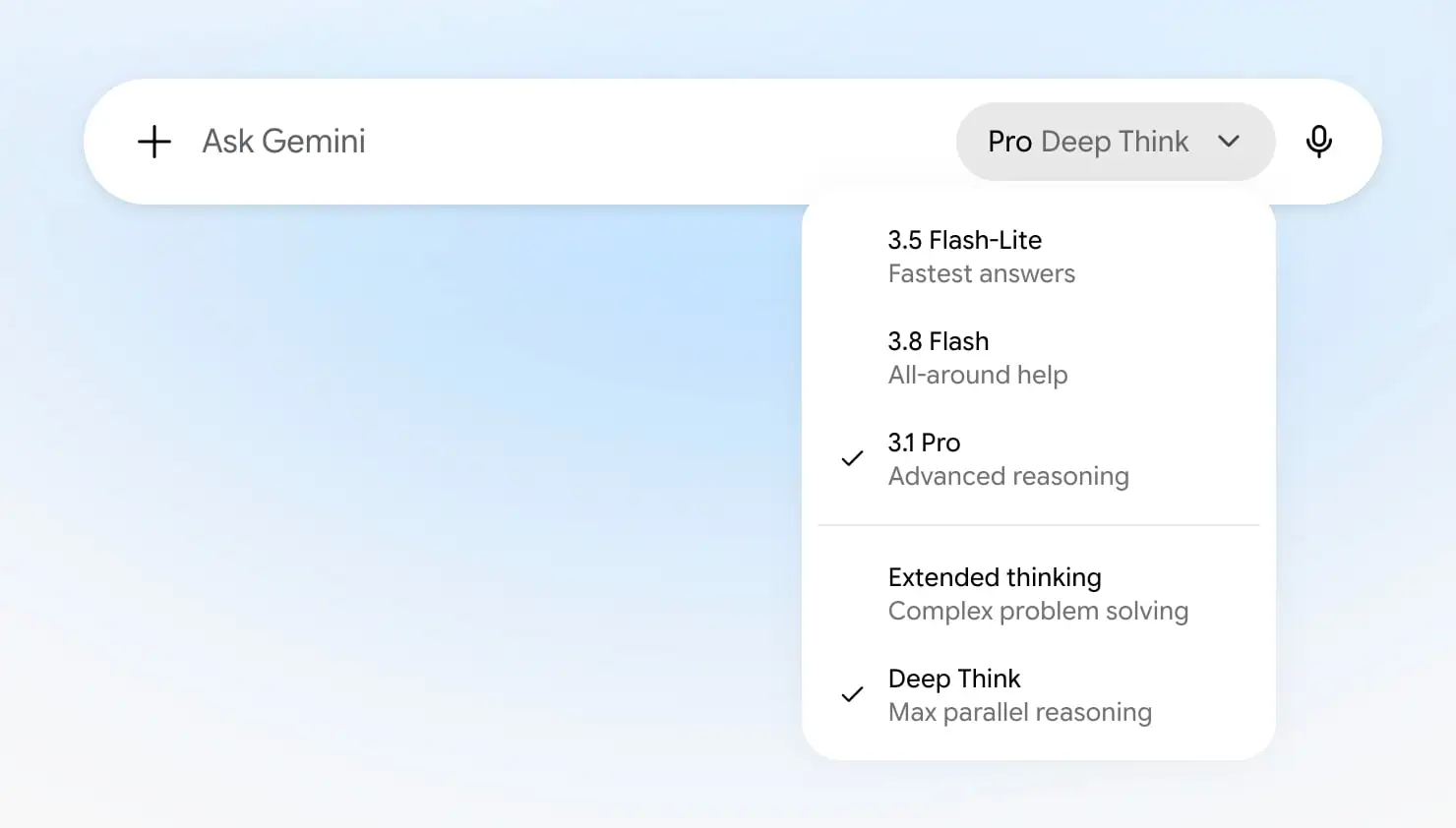
There is one meaningful upside for people already paying $19.99 per month. Google AI Pro is expected to receive Deep Think, the company’s option for what it calls maximum parallel reasoning. Until now, that capability has been associated with the considerably pricier AI Ultra plans, which run from $99.99 to $199.99 per month.
The phrase sounds a bit like a keynote slide designed by committee, but the underlying idea is straightforward. Instead of generating the first plausible response and moving on, a reasoning mode can explore multiple paths through a problem, compare approaches, and spend more compute reaching an answer. That can help with math, programming, planning, and tasks where a polished wrong answer is worse than a slower response.
Google’s Gemini support documentation has increasingly reflected this pay-for-compute reality: access is no longer only about which model name appears in a picker. The Gemini model limits are also about how much reasoning a user can ask for before hitting usage limits.
Giving Deep Think to AI Pro could be a smart correction. The $20 tier needs a feature that feels qualitatively different, not merely a bigger bucket of prompts. If Deep Think performs well, it could provide exactly that. But there’s an obvious caveat: Google has to explain when to use it. Most people don’t wake up wanting maximum parallel reasoning. They want help deciding whether a contract clause is risky, debugging an error, or comparing two laptops without getting a bland listicle back.
Effort controls could make the trade-off more honest
Google also appears to be preparing low, medium, and high effort settings for each available Gemini model. The controls would mirror options already seen in Google AI Studio and Antigravity, replacing today’s blunter extended-thinking switch with a clearer choice about how much work Gemini should put into a response.
This is arguably the most user-friendly part of the reported update. AI companies have spent years teaching people to treat a chatbot answer as instantaneous magic, then quietly imposing caps when the expensive requests pile up. An effort selector tells the truth: a one-line grammar check and a detailed analysis of a financial model should not cost the same amount of compute.
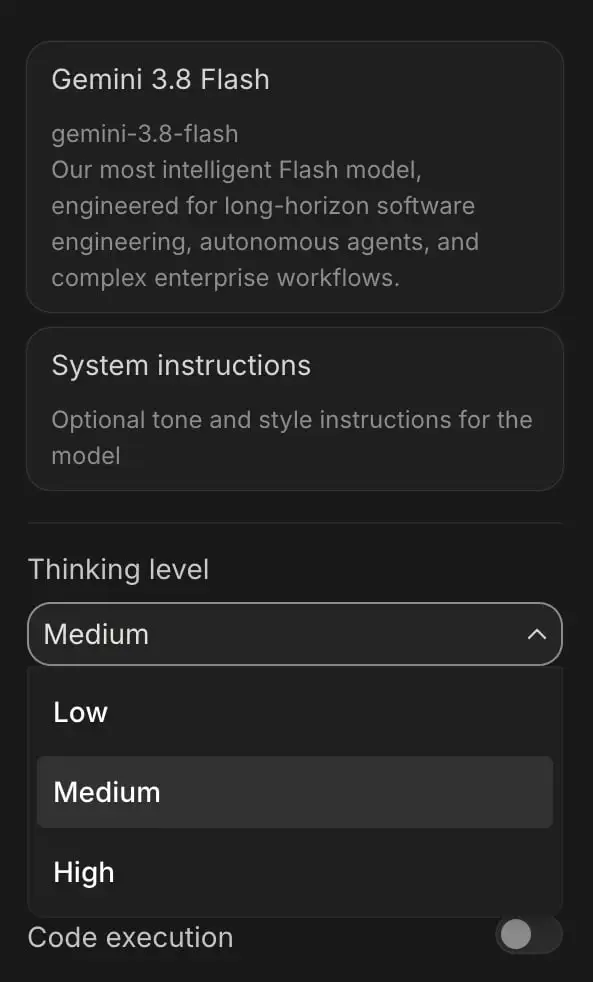
The catch is that the bill still arrives in another form. Higher effort will consume more of a user’s allowance, so the settings could also become a constant reminder of scarcity. These Gemini model limits would be easier to accept if the trade-off were visible before a request is sent, rather than surprising users after they have burned through their useful prompts for the day.
One question still hangs over these Gemini model limits: Gemini 4 Argon. Google has said the new frontier model will first reach AI Ultra subscribers, but it has not clearly said whether Argon will eventually be treated as a Pro-class model or placed in a separate, still more expensive category. That ambiguity is telling. Model names are becoming less important than the permission slip attached to them.
Google is building a ladder where every rung is measured in compute. The risk is that it climbs so steeply that free users stop looking up.