

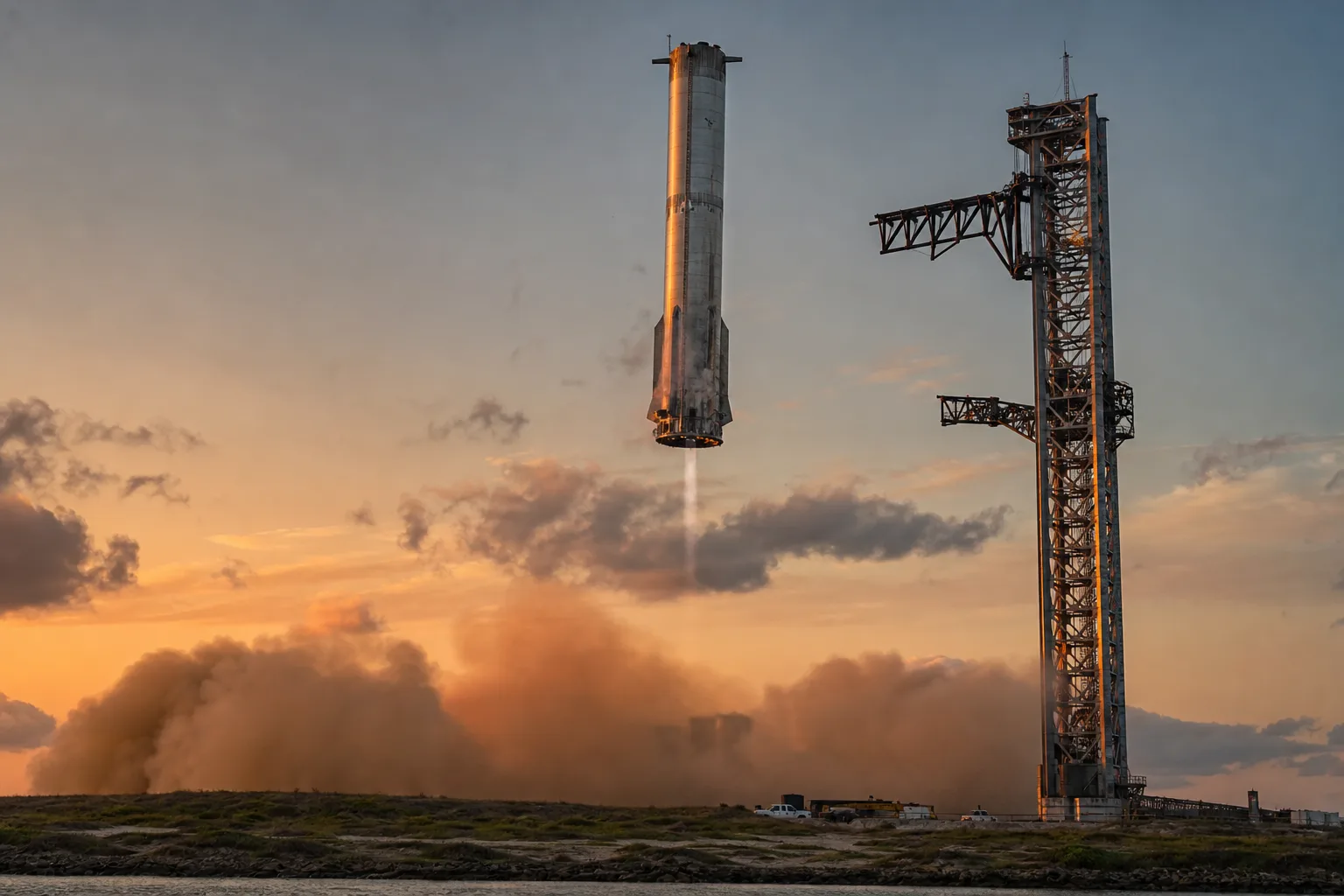
SpaceX has finally caught a returning Starship upper stage at its Texas launch tower, and Elon Musk is already looking past it. Starship V4, the next planned iteration of the company’s giant launch system, is supposed to be longer, heavier on propellant and fitted with more vacuum-optimized engines than the vehicle that just made that catch possible.
- Starship V4 could stand close to 500 feet tall, with a longer upper stage carrying substantially more propellant.
- SpaceX plans to give Starship V4 nine engines, including three additional Raptor Vacuum engines for orbital missions.
- The first upper-stage tower catch marks a serious step toward SpaceX’s goal of rapid, full vehicle reuse.
- Musk’s schedule points to a 2027 debut, though Starship timelines have repeatedly moved as testing exposes new problems.
Table of Contents
Starship V4 is getting much bigger
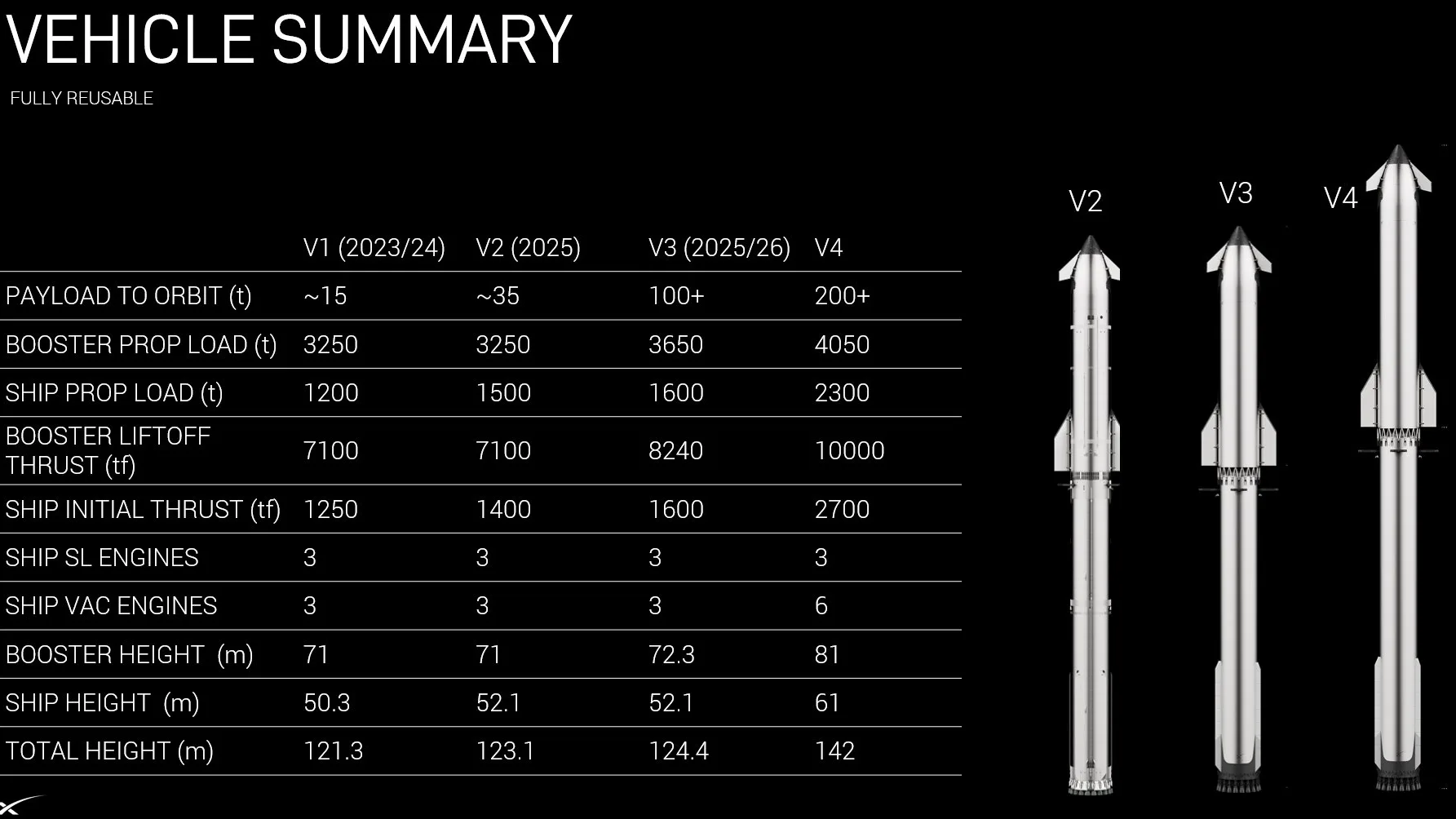
Musk said on X that Starship V4 will be roughly 70 meters, or 230 feet, long as an upper stage. That is a striking jump from the current V3 Ship, which stands about 52 meters tall. His estimate puts the new Ship around 40% longer, with capacity for more than 60% additional propellant.
That extra tank volume matters more than the headline-grabbing height. Rockets are, brutally speaking, flying fuel tanks with engines attached. More propellant can translate into more payload to orbit, more margin for difficult reentry missions, or a more credible path toward the tanker flights SpaceX says it needs for lunar and Mars operations.
The full stack could reach close to 150 meters, or nearly 500 feet, according to Musk’s latest comments. For scale, the upper stage alone would approach the height of a fully assembled Falcon 9, while being considerably wider. Falcon 9’s payload fairing is about 5.2 meters across; Starship’s diameter is 9 meters. It’s less like upgrading a delivery van than replacing it with a cargo ship.
SpaceX has published broad version-to-version concepts before, and Musk had previously suggested a 2027 debut for V4. Treat that date as an ambition, not a launch appointment. Starship’s development program has made enormous progress, but it has also repeatedly shown why building a reusable super-heavy rocket is not a normal hardware roadmap.
The engine plan is as consequential as the added height
Starship V4 is expected to use nine engines, up from six on the present Ship, including three additional Raptor Vacuum engines. Those vacuum engines have enlarged nozzles designed to work efficiently in the near-vacuum of space, where atmospheric pressure no longer fights the exhaust plume.
Those three added vacuum engines would join the current vehicle’s configuration, and Musk says they will be higher-thrust V4 Raptors. That detail could alter the economics of Starship far more than another dramatic visual comparison. Payload performance determines how many Starlink satellites can fly at once, how much NASA hardware SpaceX can haul toward the Moon, and how many tanker launches are needed to refill a spacecraft in orbit.
But higher thrust is never free. It puts new demands on plumbing, thermal protection, tank structure and the launch pad environment. The Raptor program has improved rapidly from its early, visibly rough test years, yet its job remains unforgiving: burn methane and liquid oxygen efficiently, survive reuse, and operate reliably in clusters. A rocket with more engines offers more muscle, but also more opportunities for a single malfunction to complicate a mission.
The Super Heavy booster remains part of the equation too. The V3 booster uses 33 Raptors, making the complete stack the most powerful rocket system SpaceX has flown. Starship V4 will only deliver on its promise if the booster, ship, launch infrastructure and ground teams can all turn around at a tempo closer to aviation than traditional spaceflight.
The upper-stage catch was the missing test
The immediate backdrop is Flight 15, where SpaceX recovered the Ship upper stage using the launch tower’s mechanical arms, often called chopsticks. Super Heavy catches had already occurred, impressive as they are. Catching the Ship after an orbital trip was a different class of problem: it had to survive the heat and speed of atmospheric reentry, make a controlled descent, and arrive precisely enough for a tower-based recovery.
SpaceX spokesperson Dan Huot put the company’s view plainly during the landing webcast: “We caught a Starship, and now everything changes.” That’s an understandable reaction. Recovering an orbital upper stage at the pad is the piece that makes the company’s reusability pitch feel less theoretical.
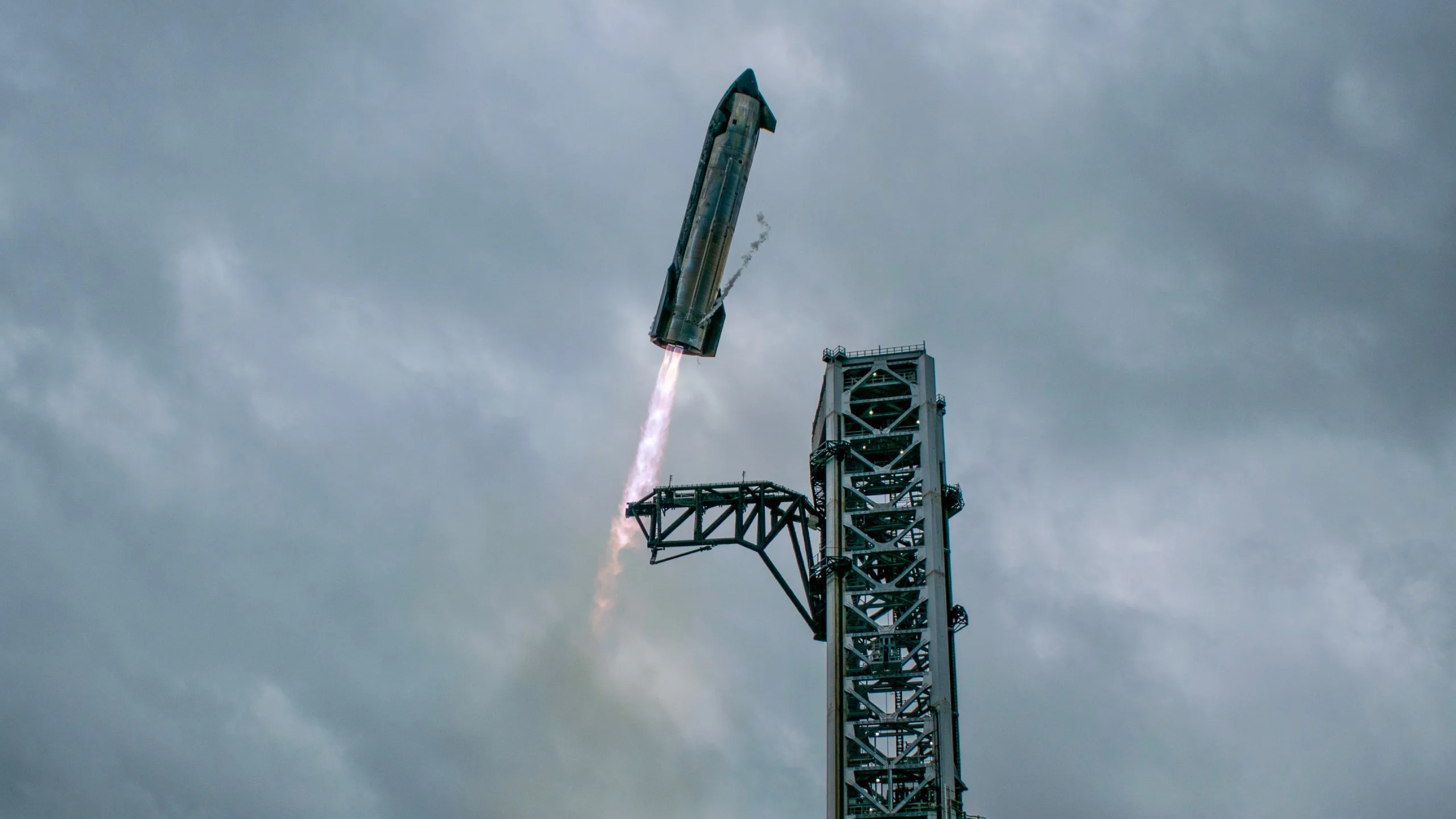
Flight 15 had originally been designed as a double recovery, with Super Heavy returning to the tower minutes after liftoff and the Ship coming home after roughly 22.5 hours in space. The booster instead diverted to a Gulf of Mexico splashdown after a low-fuel alarm, while the Ship completed its mission and deployed Starlink V3 satellites.
Frankly, that split outcome is a better illustration of SpaceX’s position than a flawless flight would have been. The company can do things no other launch provider is attempting, and it is still one sensor reading or propellant-margin concern away from changing the plan in real time. That is what experimental flight testing looks like when the experiment happens to be larger than the Saturn V.
Why SpaceX needs a bigger Starship V4
SpaceX’s case for Starship V4 is not simply that it likes building the largest possible rocket. The company needs a vehicle with enough performance and reuse capability to launch its next-generation Starlink constellation cheaply and often. Those larger satellites are a natural payload for Starship, and Starlink revenue is increasingly central to funding SpaceX’s broader ambitions.
NASA has its own reasons to care. SpaceX is developing a Starship-based Human Landing System for Artemis lunar missions, a plan that relies on multiple propellant-transfer launches before a lunar landing attempt. More capable Ships could reduce the number of launches required, though NASA and SpaceX still have a mountain of demonstrations to complete before anyone should call that problem solved.
There is also the competitive reality. Blue Origin’s New Glenn has entered the heavy-lift conversation, while China is pursuing reusable launch vehicles of its own. Nobody is currently matching SpaceX’s attempt to recover both stages of a vehicle this large at the launch site, but spaceflight has a habit of humbling companies that confuse a technology lead with a finished product.
My read is that Starship V4 is less a final design than a declaration of direction. SpaceX is trying to turn a prototype-heavy test campaign into an industrial transport system. The recent catch shows that goal is no longer science fiction. Whether the company can make it routine, affordable and safe enough for the Moon is the question that matters.
For now, SpaceX has caught the hardest piece of its reusable-rocket puzzle once. The next challenge is proving it can do it again, then do it often enough that a 500-foot rocket stops feeling like a spectacle and starts functioning like infrastructure. Readers can follow the company’s official Starship program overview, but the real evidence will arrive in the flight data, not the renderings.