

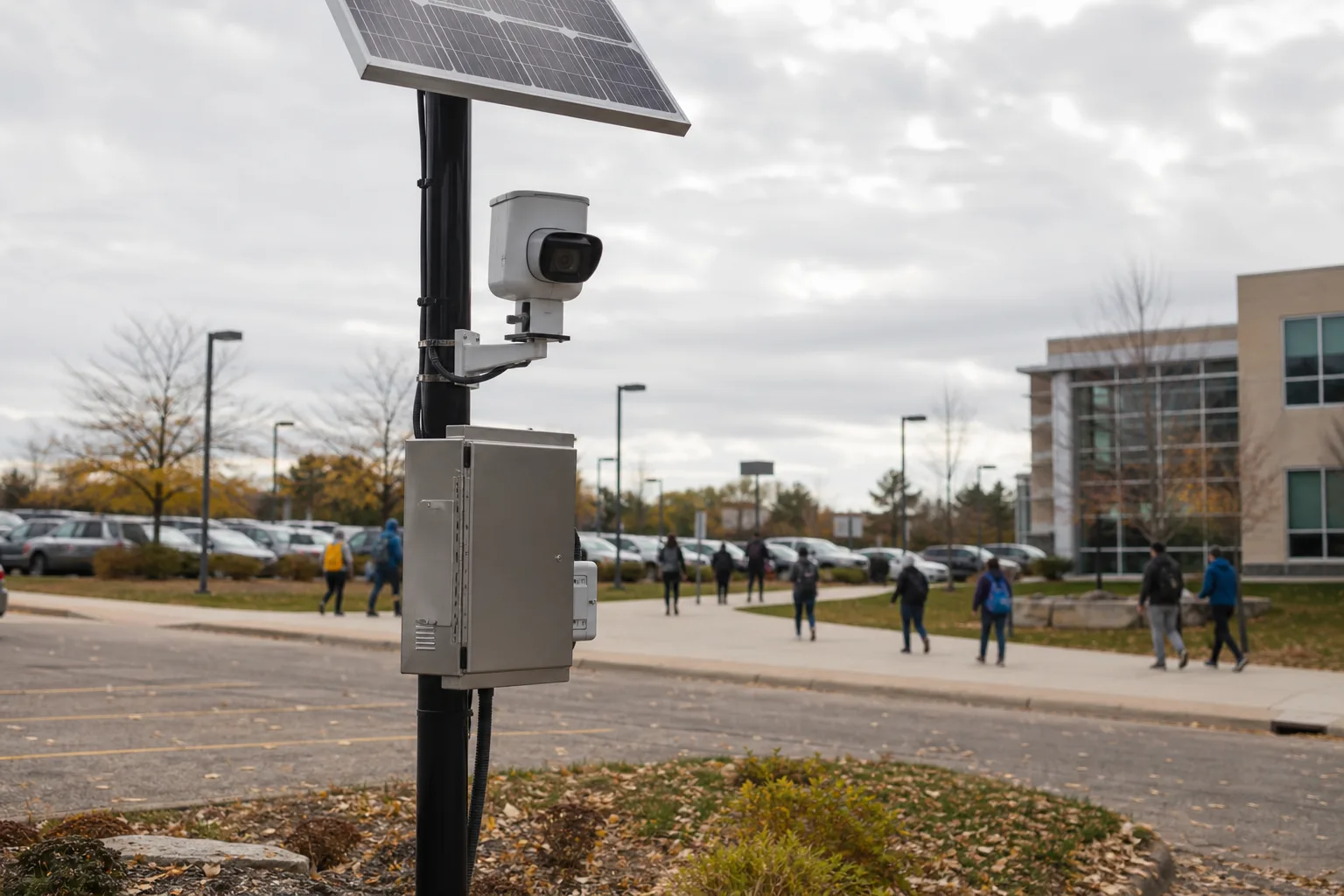
- Elgin Community College says Flock Safety cameras remained installed after it sought early removal and offered to pay the contract balance.
- Staff covered Flock Safety cameras with trash bags, then said workers repeatedly removed the coverings during service visits.
- The dispute reflects growing alarm over who can access automated license plate reader data and how vendors control physical equipment.
- The cameras were ultimately removed after Elgin Community College’s contract expired in April 2026.
Table of Contents
Flock Safety cameras became a campus standoff
Six cameras. Black trash bags. Zip ties. And a college that says it could not get a surveillance vendor to take its hardware off campus. The fight over Flock Safety cameras at Elgin Community College, outside Chicago, sounds almost comically petty at first. It isn’t. It exposes a hard question that public institutions are only beginning to confront: when a school pays for networked surveillance, who actually controls the cameras?
Elgin Community College installed six Flock Safety cameras in April 2025, presenting them as a way to improve student security. By September, though, the administration had developed serious reservations about the company’s data practices, the security of camera feeds, and reports of misuse by law enforcement agencies and Flock employees.
According to reporting by the Chicago Sun-Times, Heinrich said the company declined, arguing it had not breached the agreement. The college tried again in December, offering to pay the final five months of the contract while still requesting the cameras come down. Heinrich said the school received no response.
That’s when the dispute moved from procurement paperwork to something more visual: employees covered the cameras with black garbage bags secured by zip ties. Heinrich said people in an unmarked vehicle, whom she believed were Flock workers, would remove the bags during maintenance visits. “We were kind of in a back and forth for a bit where we’d cover, and then when they’d come to service, they’d remove,” Heinrich said. “Then we’d cover and then they’d remove.”
The contract expired in April 2026, and the cameras were removed. But the awkward ending matters well beyond one Illinois campus.
The contract question is bigger than six poles
Flock Safety cameras have an easy-to-understand pitch. Their solar-powered camera network can identify vehicle characteristics, read license plates, and help police search for a car connected to a crime or emergency. For a campus security director staring at theft reports, vehicle break-ins, and pressure to show they’re doing something, that can sound like a straightforward purchase.
But Flock Safety cameras do not operate like a row of ordinary security cameras feeding a locked office monitor. They are part of a cloud-connected system, and the value proposition is rooted in search, retention, sharing, and connections among participating agencies. That architecture is also precisely why civil-liberties advocates worry about them.
A camera pointed at a parking-lot entrance can document a single event. A searchable network can help reconstruct where a vehicle has traveled. Those are very different things, even if the box on the pole looks the same. Think of it as the gap between keeping a paper receipt in a drawer and handing every purchase to a database that can be queried across town.
Questions about privacy protections, data security, access controls, and audit logs are relevant to the debate; Flock maintains a privacy page. The stakes are real on both sides. Stolen cars, missing-person cases, and violent crimes are not abstract concerns for a college community.
Still, the Elgin case highlights the part vendors rarely put in giant type on a sales slide: a customer may discover that the operational and reputational cost of a surveillance system has changed after the equipment goes live.
Why data-sharing worries changed the calculation
Elgin’s concern reportedly included Flock data being available to Customs and Border Protection. That lands in a particularly fraught moment. Immigration enforcement has become a major source of anxiety for colleges, local governments, and communities that may want no role in helping federal agencies identify or track residents.
The issue is not that every search conducted by a federal agency is inherently unlawful. It’s that policy choices about sharing surveillance data can carry consequences far beyond the institution that installed a camera. A college may buy Flock Safety cameras to monitor its own lots, while the data environment around those cameras raises concerns about students, employees, visitors, and families far from any campus incident.
There have also been repeated national reports of law enforcement personnel improperly accessing license plate reader systems for personal reasons. Any large database with lots of authorized users eventually attracts bad behavior; that’s less a hot take than an old lesson from every corporate breach and police misconduct scandal. Logs can identify misuse after the fact, but they do not erase the privacy harm once someone has searched a former partner, a neighbor, or a political opponent.
My read is that institutions are finally catching up to the fact that surveillance procurement is data-governance procurement. The camera hardware is the easy part. The hard part is deciding who can search the information, under what rules, how long it stays available, and whether a customer can shut the system down when trust breaks.

A cancellation clause should mean cancellation
Flock may have been within the letter of its agreement with Elgin Community College; the company’s apparent position was that it had not violated the contract. We have not seen the complete contract terms in the reporting, and that distinction matters. It is possible the deal did not grant the college a convenient early-termination right.
But legal compliance and sensible customer practice are not the same thing. If an institution offers to pay the rest of its contract and asks that active Flock Safety cameras be removed from its property, a vendor refusing that request is courting a very public trust problem. Frankly, it’s hard to imagine a better advertisement for tougher exit clauses.
Schools, cities, homeowners’ associations, and businesses considering Flock Safety cameras should ask more pointed questions before signing. Can the customer deactivate or cover equipment immediately? Who physically owns the hardware? What happens if policy concerns emerge midway through a term? Can data sharing settings be restricted by the buyer? Is removal guaranteed upon written request, or only when the subscription ends?
Those aren’t fussy legal details. They determine whether a customer retains meaningful control over surveillance on its own property. Remember when companies treated cloud contracts as a harmless monthly software expense? Then outages, price hikes, and lock-in taught everyone to read the fine print. Surveillance systems deserve at least that level of skepticism.
The next campus camera debate will be about control
Elgin Community College’s experience could become a cautionary tale for public buyers. The school didn’t merely change its mind about a security product. It found itself in a months-long struggle over whether it could stop cameras from collecting footage while they remained physically installed on campus.
That’s an uncomfortable outcome for a product sold under the banner of safety. Security tools need public legitimacy to work, especially at educational institutions where trust is already fragile. If buyers believe Flock Safety cameras can be difficult to turn off or remove once installed, procurement committees may start demanding more control before approving them.
The real test for Flock and its rivals is not whether they can sell another camera network. It’s whether they can convince communities that the off switch belongs to the people who invited the cameras in.