

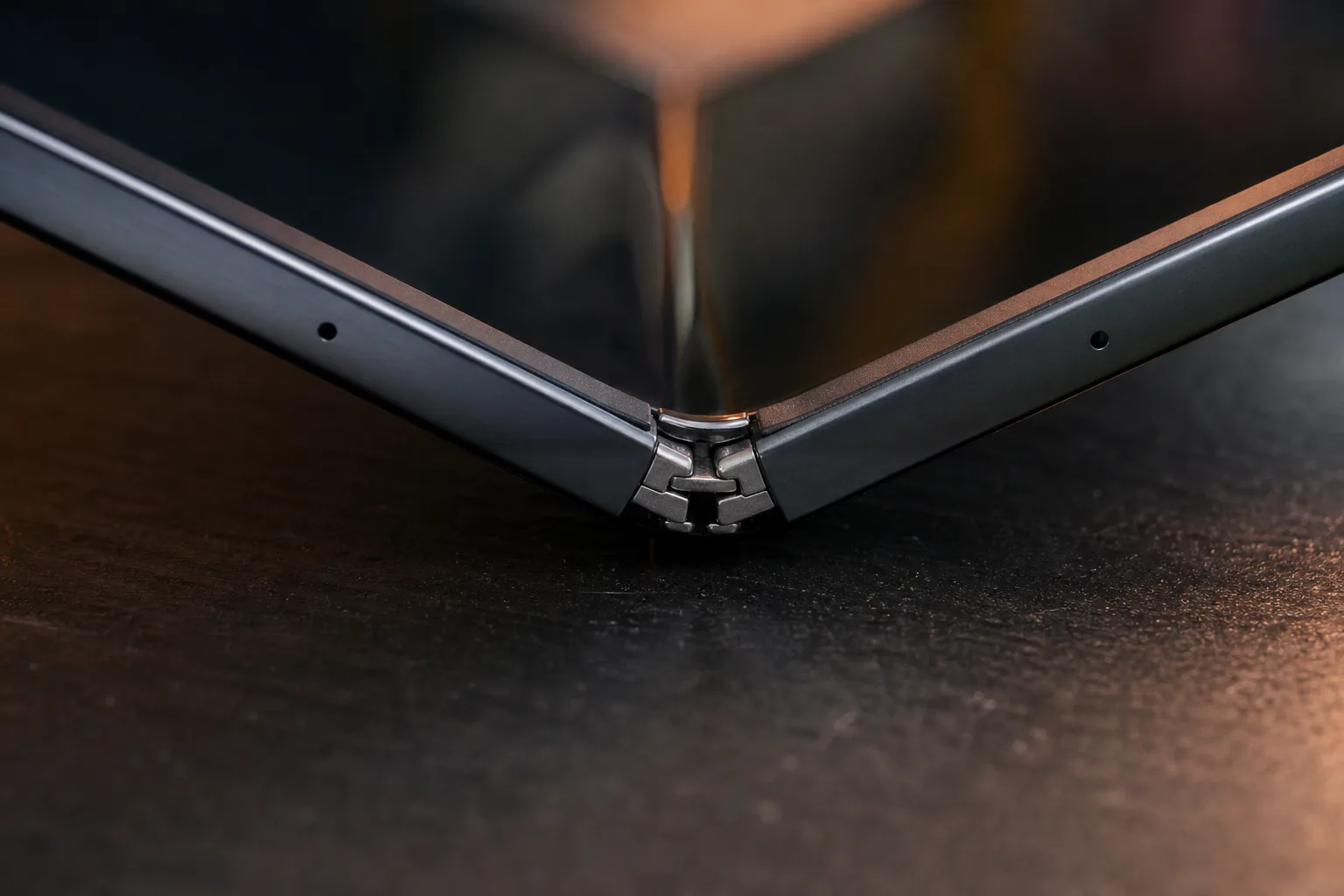
- Foldable hinge cooling could spread heat through a phone’s most underused structural component instead of trapping it in two thin halves.
- The reported iPhone Duo approach may give foldable hinge cooling a practical advantage over Android designs that isolate the hinge mechanically.
- Thermal headroom matters because foldables run powerful chips, large displays, cameras, and demanding multitasking workloads in constrained space.
- Samsung, Google, and Chinese foldable makers may need better heat architecture before pursuing even thinner designs.
Table of Contents
The hinge is no longer just a hinge
Foldable hinge cooling sounds like the sort of engineering detail that belongs in a patent filing and nowhere else. But it may be one of the more consequential ideas attached to Apple’s widely rumored foldable iPhone, sometimes referred to in reports as the iPhone Duo. If Apple can use the hinge to move heat through the phone rather than merely connect its two halves, it will have addressed a problem Android foldables have spent years politely pretending is manageable.
Heat is the boring antagonist of modern mobile hardware. Nobody walks into a store asking about thermal pathways. They ask whether the phone is thin, whether the screen crease is visible, and whether the camera is any good. Yet a device that gets uncomfortably warm while filming video, gaming, charging, or running split-screen apps eventually has to slow itself down. That means dimmer displays, reduced performance, shorter bursts of camera recording, and a generally less premium experience.
On a conventional smartphone, engineers have a relatively forgiving flat canvas. They can spread graphite sheets, vapor chambers, copper components, and battery-adjacent materials across one continuous body. A book-style foldable is more like trying to cool a desktop PC that has been cut in half and connected by an elaborate door hinge. Each side has its own constraints, and the joint between them is typically occupied by moving parts, cables, seals, and precious little else.
Why foldable hinge cooling matters
The core idea behind foldable hinge cooling is straightforward: make the hinge assembly part of the thermal system. A conductive structure could carry heat away from the processor side of a foldable and distribute it across more of the device’s surface area. Think of it as opening an interior door on a hot day so air can circulate between rooms. The heat does not vanish, but it has more places to go.
That matters for book-style hardware such as Samsung’s Galaxy Z Fold line, Google’s Pixel Fold family, OnePlus Open-style designs, and the many Chinese foldables that have pushed aggressively toward thinner bodies. These phones increasingly promise tablet-like productivity in a pocketable shape. They also run flagship-class silicon, bright OLED panels, sophisticated camera processing, 5G radios, and often desktop-like multitasking. The workload is real, even if the chassis looks almost impossibly slim.
Most current designs use familiar thermal tools inside each half: graphite, copper foil, thermal pads, and in some cases vapor chambers. Those methods work, but the hinge often remains largely separate from the heat-dissipation stack. That makes sense from a reliability perspective. Hinges must survive hundreds of thousands of folds, resist dust, avoid adding bulk, and accommodate flexible display cables. Foldable hinge cooling is not an easy win when the moving mechanism is already a mechanical headache wearing a thermal-engineering hat.
Still, the payoff could be substantial. Foldable hinge cooling would let manufacturers use more of the phone’s physical volume and exterior area for heat spreading. It may also reduce hot spots, where one side of a device becomes noticeably warmer than the other. Anyone who has used a foldable as a hotspot during a train journey or recorded extended 4K video on a sunny afternoon knows the sensation: one half of the phone becomes a tiny hand warmer, and not in a charming way.
Apple’s possible advantage is architectural, not magical
Apple has not announced a foldable iPhone, and the iPhone Duo name is not official. That caveat matters. The company’s foldable ambitions have been the subject of years of supply-chain reporting, analyst speculation, and patent archaeology. Until Apple puts a product on a stage, this remains an informed view of where its engineering may be headed, not a confirmed feature list.
But the reported hinge-based thermal approach fits Apple’s usual hardware playbook. The company tends to obsess over the less-visible parts of a product when they determine whether the visible experience feels polished. The iPhone’s thermal behavior, antenna layout, haptic hardware, and internal packaging all benefit from this mentality. Apple is not immune to heat problems, of course. No company can repeal physics. Its advantage, if this report is accurate, would come from treating the foldable as one connected thermal object from the start rather than attaching a hinge to two independently cooled slabs. That is the architectural promise of foldable hinge cooling.
Thinness is the other reason this matters. Better thermals can support slimmer hardware, and thinness remains a fixation across the industry. The catch is that ultra-thin foldables have less room for battery capacity and cooling material. That trade-off is already visible in devices that look stunning on a spec sheet but become less compelling under sustained load. A more conductive hinge could give designers extra room to chase thinness without asking the processor to spend half its day throttling.
Android phone makers should not assume they can copy the broad concept overnight. The details matter: the metals used, contact points, hinge geometry, flexible cables, display stress, water resistance, manufacturing tolerances, and intellectual property all complicate the picture. A hinge that moves heat well but adds weight, weakens dust resistance, or becomes painful to hold has not solved much.
Android makers have a reason to move quickly
The timing is awkward for Android manufacturers because the performance demands on foldables are climbing faster than the available room inside them. Qualcomm’s top-tier chips are powerful, displays are brighter, and on-device AI workloads are beginning to consume more sustained compute time. Android foldables typically do not use the hinge for thermal dissipation. But software adaptation is a safety net, not a substitute for moving heat somewhere useful.
Foldable hinge cooling could matter even more once foldables stop being a luxury curiosity. Samsung has done the hard work of making the category familiar, while Google and several Chinese brands have made a credible case that a folding phone can be a daily driver. The next phase cannot be only about a barely thinner profile or a slightly less visible crease. Those are useful improvements, yet users will remember whether the device stays responsive during a long work call and whether it can handle a weekend of travel without behaving like it needs a lie-down.
My read is that Android companies should investigate this approach even if Apple never ships it exactly as reported. The industry has spent plenty of energy refining how foldables open and close. Now it needs to treat the space in between as functional hardware. The company that turns the hinge from a necessary compromise into a thermal asset may have found the next genuinely useful foldable upgrade, and foldable hinge cooling may be the most practical route there.
Frequently Asked Questions
What is foldable hinge cooling?
Foldable hinge cooling is a phone thermal design that uses the hinge area to help move and disperse heat between both sides of a foldable device. Rather than treating the hinge solely as a mechanical joint, manufacturers could make it part of the device’s heat-management system.
Why do foldable phones get hot?
Foldables pack flagship processors, two displays, cameras, batteries, antennas, and complex hinge hardware into a body with very little uninterrupted internal space. Heat from the processor and charging system is harder to spread than in a conventional slab phone with one large chassis.
Would hinge cooling make a foldable phone faster?
Potentially, yes. Better heat dissipation can give a processor more time at higher performance before it reduces clock speeds to protect itself. It would not change the chip’s peak specification, but it could improve sustained gaming, multitasking, video recording, and wireless hotspot use.