


- Cloudflare Turnstile fingerprinting now blocks WebKitGTK browsers indefinitely, locking users out of many websites.
- Cloudflare Turnstile fingerprinting uses WebGL data to profile devices — something Apple’s WebKit has blocked for years.
- Mozilla Firefox has its own WebGL fingerprinting leak issues, potentially putting privacy-conscious users at risk too.
- The change raises serious questions about whether bot detection has quietly become a cover for tracking infrastructure.
Table of Contents
Cloudflare Turnstile Fingerprinting Is Quietly Locking Out Browsers
Cloudflare Turnstile fingerprinting has started causing serious problems for a growing number of users. Over the past few weeks, people using WebKitGTK-based browsers — a rendering engine used heavily in Linux desktop environments — have found themselves caught in an endless verification loop, unable to pass Cloudflare’s “Verify you’re human” challenge no matter how many times they click. It’s not a bug, exactly. It’s a deliberate design choice, and that distinction matters enormously.
Cloudflare’s Turnstile is billed as a privacy-friendly alternative to reCAPTCHA. The pitch has always been that it verifies humanity without making users squint at blurry fire hydrants — running its checks quietly in the background. That positioning made it attractive to site operators who wanted frictionless verification without the surveillance baggage of Google’s system. But the recent WebGL requirement is complicating that narrative considerably.
What Cloudflare Is Actually Asking For
At the heart of this issue is WebGL — a browser API that gives web pages access to your device’s GPU for rendering 3D graphics. It’s a legitimate and powerful tool for games, visualisations, and interactive content. It’s also a well-documented fingerprinting vector, because the way your specific GPU renders graphics is subtly unique enough to identify your device across sessions, across sites, and across time — even when cookies are cleared. Cloudflare Turnstile fingerprinting relies on exactly this mechanism to distinguish humans from bots.
Cloudflare’s own documentation for Turnstile now explicitly states the following:
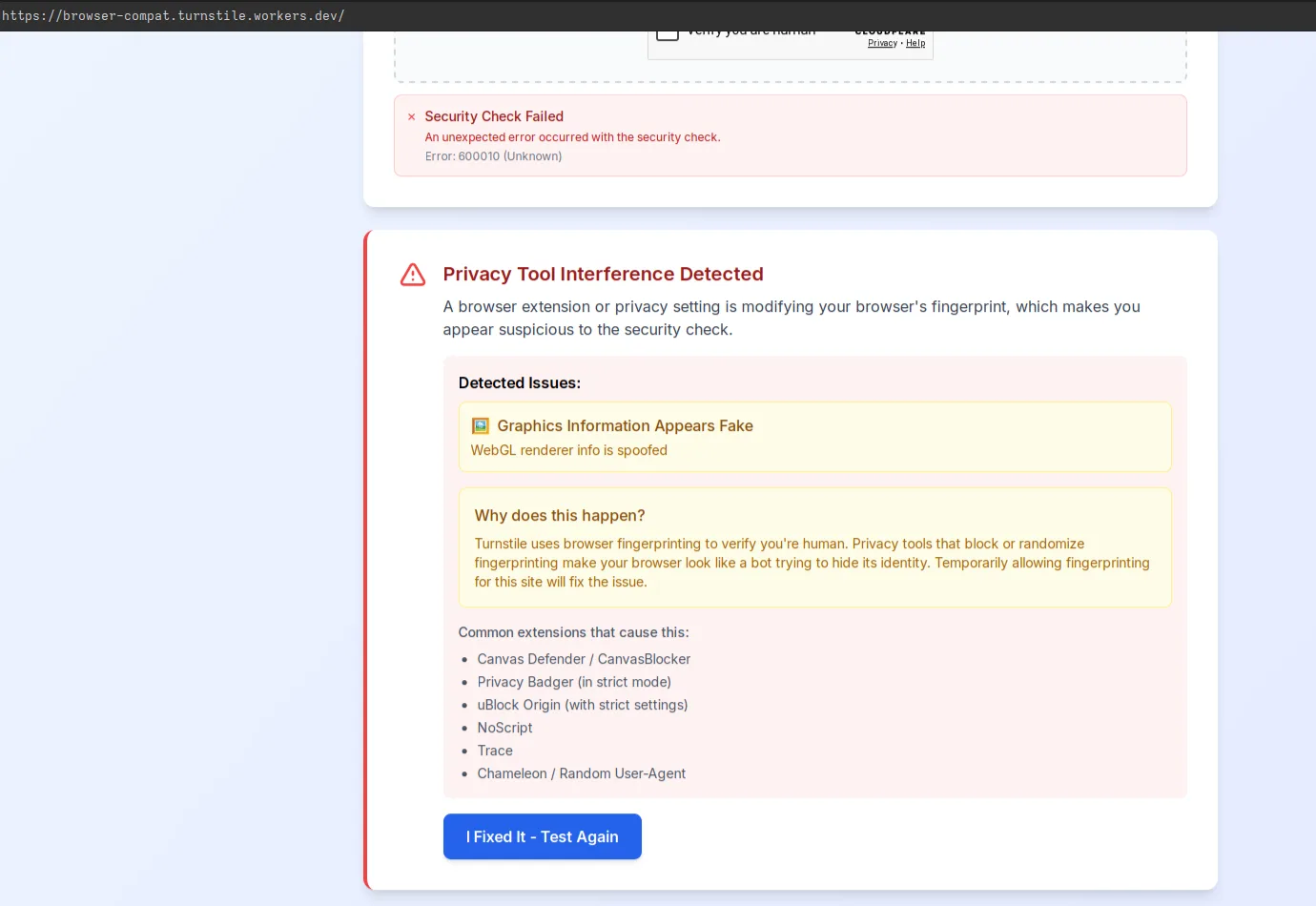
“Turnstile uses browser fingerprinting to verify you’re human. Privacy tools that block or randomize fingerprinting make your browser look like a bot trying to hide its identity. Temporarily allowing fingerprinting for this site will fix the issue.”
Read that carefully. Cloudflare is telling users that if their browser protects their privacy, it looks like a bot. The logical implication — intended or not — is that humans are expected to be trackable, and anything that resists tracking is suspicious by definition. That’s a genuinely troubling framing for a company that has spent years marketing itself as an internet infrastructure provider that takes user privacy seriously.
Why WebKitGTK Users Are Completely Blocked
Apple has blocked WebGL-based fingerprinting in WebKit for years. This isn’t a new or experimental privacy feature — it’s a long-standing, considered decision by Apple’s engineers to prevent a known tracking mechanism. WebKitGTK, the Linux port of Apple’s WebKit engine used in browsers like Epiphany (GNOME Web) and various embedded applications, inherits these same protections.
The result is that Cloudflare Turnstile fingerprinting now treats WebKitGTK browsers as fundamentally untrustworthy. Not because those browsers are doing anything wrong, but because they’re doing something right. Turnstile’s verification loop runs indefinitely on these browsers, offering no fallback, no alternative challenge, no way through. Entire websites have effectively become inaccessible to a segment of privacy-respecting users.
It’s notable that Apple’s own Safari — which shares much of the same underlying WebKit engine — appears to receive different treatment, likely because Cloudflare has explicitly whitelisted it. So the blocking isn’t about WebKit per se; it’s about which flavour of WebKit you’re running, and whether Cloudflare has decided to trust you. That’s a corporate gatekeeping decision dressed up as security policy.
The Firefox Problem Is Worse Than You’d Think
Firefox users might assume they’re safe from all this. They’re not — and the situation is arguably more insidious.
A reported bug tracked as Bugzilla#1916271 reveals that Firefox’s Gecko engine leaks sanitised GPU characteristics through WebGL even when fingerprinting resistance is nominally active. While WebKit and Blink return hardcoded strings for all users — making everyone look identical and therefore non-trackable — Firefox exposes enough real GPU data to make fingerprinting viable. This means Cloudflare Turnstile fingerprinting can still profile Firefox users even when they believe they are protected.

Making matters worse, Firefox’s privacy.resistFingerprinting setting — the one that actually hardens the browser against this kind of profiling — is not enabled even when users select “Strict” mode under Enhanced Tracking Protection. That’s a significant gap. Users who have explicitly chosen the most protective setting Firefox offers are still not getting the WebGL fingerprinting protection they presumably expect.
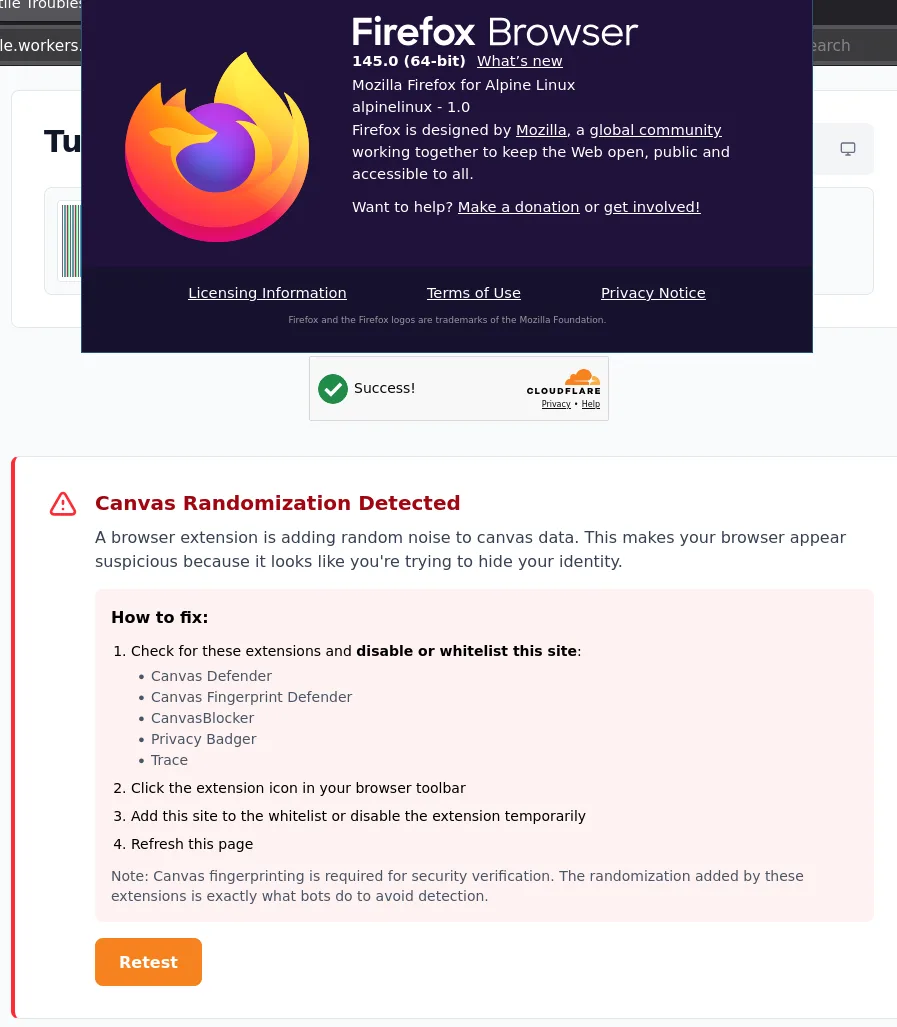
The practical consequence is a two-sided trap. Enable privacy.resistFingerprinting in Firefox and you might successfully block WebGL fingerprinting — but you could then find yourself failing Cloudflare Turnstile fingerprinting checks for the same reason WebKitGTK users do. Leave it disabled and your GPU data is quietly available for profiling. Neither option is good.
Bot Detection or Tracking Infrastructure?
This is where the story gets philosophically thorny. Cloudflare’s stated purpose for all of this is bot detection. Bots, the argument goes, often spoof or randomise fingerprinting signals to evade detection, so a browser that looks un-fingerprintable looks like a bot. That’s not an entirely unreasonable technical observation.
But the conclusion Cloudflare draws from it — that users must submit to fingerprinting in order to prove their humanity — is a significant escalation. Cloudflare Turnstile fingerprinting essentially makes trackability a prerequisite for internet access. And once that precedent is established at infrastructure level, it’s very hard to walk back.
Cloudflare isn’t a niche CDN provider. It handles traffic for a substantial portion of the web. When Cloudflare makes a decision about what constitutes acceptable browser behaviour, it has the practical power to enforce that decision at scale across millions of websites simultaneously. Site operators who use Turnstile often have no idea their users are being blocked — they just see slightly lower traffic, or complaints that never quite make it through support channels.
There’s also a meaningful difference between using fingerprinting to detect bots in real-time and storing or sharing that fingerprint data for longer-term profiling. Cloudflare hasn’t been transparent about exactly what data Turnstile collects, retains, or shares, and that opacity is its own problem in an era when users are rightly sceptical of every new data collection vector.
What This Means for the Open Web
The broader trajectory here is worth paying attention to. We’re watching the gradual construction of a two-tier web: one tier for users with mainstream, commercially-approved browsers who accept pervasive fingerprinting as the cost of access, and another tier — increasingly walled off — for anyone using non-standard, privacy-hardened, or open-source browser environments.
WebKitGTK users, privacy-focused Firefox users, Tor Browser users, and anyone running a hardened browser configuration are increasingly being treated as second-class citizens of the web. Not because they’re doing anything wrong, but because the commercial infrastructure that underpins most of the internet has decided that resistance to tracking is itself a red flag. Cloudflare Turnstile fingerprinting sits at the centre of that shift — and its growing reach makes it one of the most consequential examples of this trend.
If Cloudflare doesn’t course-correct here — by providing fallback verification methods that don’t require fingerprinting, or by being transparent about what data Turnstile actually collects — the company risks validating every criticism ever levelled at centralised internet infrastructure. The irony would be considerable: a company that built its brand partly on protecting users ending up as one of the web’s most effective mechanisms for enforcing surveillance compliance.

