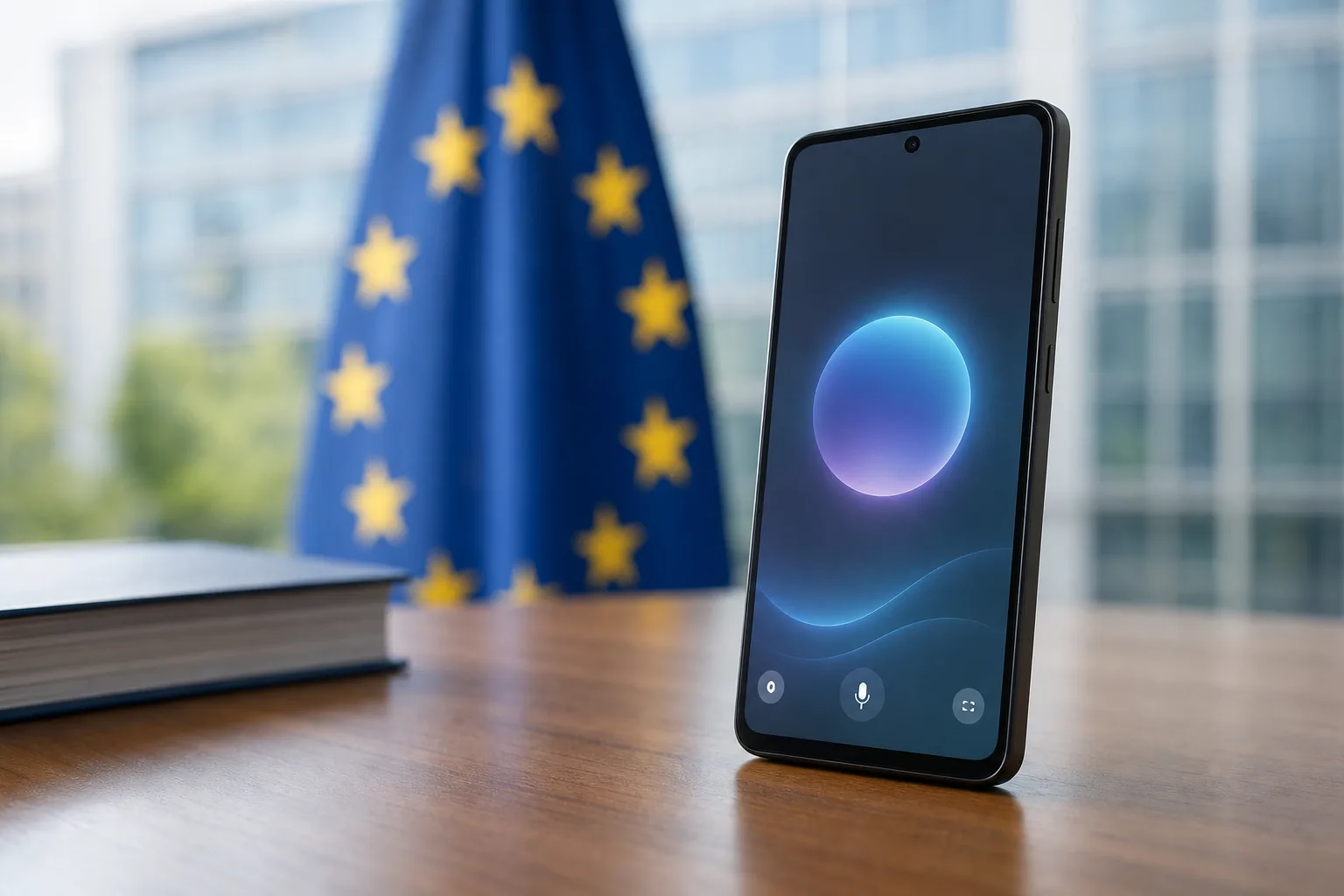
- The Google DMA ruling requires Google to give rival assistants deeper access to Android features available to Gemini.
- Under the Google DMA ruling, Google must begin sharing certain Search data with competitors by January 2027.
- Brussels says the remedies could create room for alternative search engines and AI chatbots across the European Union.
- Google argues the requirements could introduce privacy and security risks, while regulators say safeguards will apply.
Table of Contents
The Google DMA ruling takes aim at Google’s home turf
Google has spent years turning Android into the world’s most widely distributed mobile operating system while keeping the most valuable controls close to home. The Google DMA ruling from the European Commission now presses directly on that advantage: Google must give rival AI assistants and search providers access that is comparable to what its own services receive.
Brussels is not handing Alphabet another fine to pay, dispute, and largely absorb. It is asking for operational changes to two products that sit near the center of Google’s business: Android and Search. That matters because the AI race is increasingly about where an assistant lives, what it can see, and whether it can actually do things on a user’s behalf.
For years, Android’s openness has been real but qualified. Phone makers can customize it, app developers can distribute outside Google Play, and users can change plenty of defaults. Yet Google Assistant, and now Gemini, have enjoyed a privileged route into system functions, voice activation, app interactions, and device hardware. The Commission’s view is that competitors need a meaningful shot at those same capabilities if user choice is to mean much.
The Android portion of the Google DMA ruling gives Google until July 2027 to put those changes in place. Its Search-related obligations begin earlier, in January 2027. Both stem from the EU’s Digital Markets Act, the regulation designed to stop designated platform gatekeepers from using control of an ecosystem to freeze out rivals.
Android assistants could finally compete on the same floor
Picture the practical difference. Today, an AI app such as ChatGPT, Claude, or Perplexity can live on an Android phone and answer questions beautifully. But being a polished app is not the same as being a system assistant. A true assistant can respond to a wake phrase, access approved device functions, work across apps, and handle tasks without making users bounce between screens like they are assembling flat-pack furniture without the instructions.
The Google DMA ruling is intended to narrow that gap. Google will have to offer rivals comparable pathways to the Android functions and data used by Gemini, provided the user chooses to grant that access. That could eventually make a competing assistant a serious replacement for Gemini rather than a clever chatbot parked behind an app icon.
There are important caveats. Comparable access does not mean every AI company gets unrestricted access to every sensor, message, or app. The Commission says Google can vet services receiving deeper integration, and user permissions will remain central. Frankly, that is the minimum sensible bar. An assistant with the ability to read screens, initiate calls, or act across apps creates a much bigger security question than an ordinary mobile app.
Google’s objection is predictable, but not frivolous. The company says the requirements risk compromising privacy, security, and product quality. Apple has made a closely related argument while delaying parts of its Siri and Apple Intelligence plans in Europe. But dominant platforms have a habit of treating interoperability as impossible right up until regulators require it. Then, somehow, an engineering solution appears.
The more revealing question is whether Google will create an access layer that is technically usable or one so burdened by terms, latency, and verification that only the largest companies can afford to participate. The DMA is supposed to prevent that kind of paper compliance. We will see how aggressively Brussels tests it.

Search data is the quieter, potentially bigger fight
The Search side of the Google DMA ruling may be the bigger fight. Google has accumulated decades of signals about what people ask, how they phrase it, what results they select, and which searches lead nowhere. That behavioral data is an enormous competitive asset. It helps Google improve rankings, spot emerging queries, and tune its products against the strange, messy way actual humans use the web.
European regulators want qualifying rival search engines and AI services to gain access to portions of that information. The inclusion of AI chatbots is notable. Services such as Perplexity increasingly answer questions that users once sent directly to Google Search, and regulators appear unwilling to pretend the old definition of a search engine still captures the market.
The approach echoes remedies sought in the US government’s search antitrust case, where data-sharing has also emerged as a remedy for Google’s entrenched position. The logic is straightforward: a new search competitor cannot improve if it begins with no query history while Google begins with the internet’s largest map of user intent.
Of course, search data is not a magic seed packet. A rival still needs infrastructure, a useful index, ranking systems, distribution deals, and a reason for people to switch. Google’s default placement on browsers and phones remains a formidable advantage. But better data can reduce the time and money needed to build a credible alternative, particularly for AI-first search products that are trying to combine retrieval with conversational answers.
The Commission says usage limits and other protections will govern the data. That detail will decide whether the measure has teeth. If competitors receive information that is stale, heavily aggregated, or too restricted to help train and improve their services, Google’s practical lead may barely move. If the data is genuinely useful, the Google DMA ruling could give Europe’s search market its first real opening in years.
Why this matters well beyond Google
Henna Virkkunen, the Commission executive vice president responsible for tech sovereignty, security, and democracy, said the measures aim to support “innovation and diversity” in AI assistants and search. She added that Brussels hopes users will see emerging alternatives to Google Search and Gemini.
That is the ambition. My read is that the immediate winner is likely to be the small group of well-funded AI companies already capable of building system-level assistants, not a wave of tiny European startups. Still, forcing an access route open is better than allowing one company to decide which assistants are allowed to become useful.
Google faces potential fines of up to 10 percent of its worldwide annual turnover if it fails to comply. That is a serious stick, measured in billions rather than a sternly worded letter. Yet the larger test is whether the Commission can turn a legal principle into product-level choice that ordinary people notice.
If an Android owner in Paris can set Claude, ChatGPT, or a local European assistant as a genuinely capable default and barely think about Gemini, the Google DMA ruling will have changed the market. If the choice exists only on a settings page buried three menus deep, Google will still be running the show.