


- Meta smart glasses became the target of a lenticular protest advertisement installed near Meta’s London headquarters.
- The Meta smart glasses backlash centers on consent, covert recording, and the ease of turning public footage into personal data.
- Meta says its recording LED is a safeguard, but critics argue a tiny indicator cannot create meaningful consent.
- Wearable cameras are moving faster than privacy law, particularly in venues where people reasonably expect discretion.
Table of Contents
Meta smart glasses meet a very public rebuttal
A bus stop near Meta’s London office has become an unusually apt place to argue about Meta smart glasses: a piece of public infrastructure where nobody opted in to being part of someone else’s content. Activist group Everyone Hates Elon installed a spoof advertisement that changes as pedestrians walk past it. From one angle, it resembles a glossy Kylie Jenner campaign image. From another, Jenner appears as a skeletal X-ray figure beside the line: ‘We’re always watching.’
It’s sharp visual work, and not especially subtle. The lenticular trick clearly nods to John Carpenter’s They Live, the 1988 cult film in which special sunglasses strip advertising of its polish and expose its coercive messages. That reference could have been heavy-handed. Instead, it gets at the contradiction built into camera glasses: they’re sold as fashionable, casual, almost forgettable accessories, while the camera pointed outward is anything but forgettable for the person in its frame.
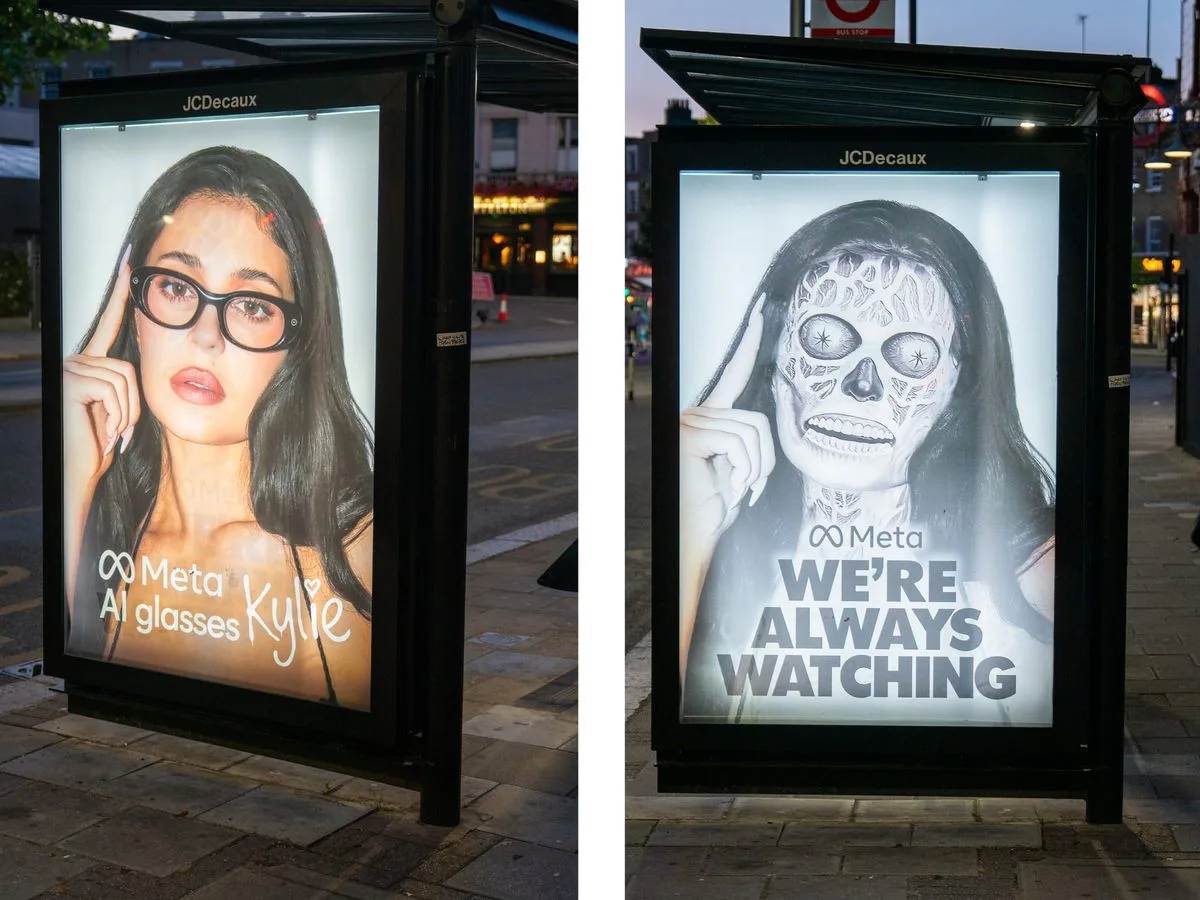
The stunt follows Meta’s recent push around a lower-cost, celebrity-backed version of its Ray-Ban partnership. Kylie Jenner makes obvious marketing sense: enormous reach, a carefully managed visual identity, and a customer base accustomed to shopping through social feeds. But attaching a lifestyle celebrity to Meta smart glasses also makes the company’s central problem more visible. You can make the hardware look normal. That doesn’t mean the social rules around it have caught up.
‘Meta has spent years tracking us online. Now it wants to track us in the real world too,’ an Everyone Hates Elon spokesperson said in a statement provided to Hyperallergic.
My read is that the group’s execution will travel further than another privacy-policy explainer ever could. People understand a bus ad changing in front of them. It makes surveillance feel like what it often is in daily life: ambient, hard to spot, and designed to blend into the furniture.
Why Meta smart glasses make consent so difficult
Meta’s first Ray-Ban Stories arrived in 2021 with a camera capable of short clips, initially up to 30 seconds and later a minute. Newer Ray-Ban Meta models can record for up to three minutes continuously. Three minutes may not sound like much in a world of hour-long livestreams, but that misses the point. A wearable camera is faster to start, easier to hide in plain sight, and much less likely to trigger the social caution that comes with lifting a phone.
Phones have developed a kind of public body language. When someone raises one, you usually know a photo or video may be happening. Glasses scramble that signal. Meta includes a recording LED, and the company has said it is working on measures that disable the camera when that light is covered or damaged. That’s a sensible technical guardrail, as far as it goes. Yet a white light on a glasses frame is a weak substitute for consent, especially in a noisy street, bar, gym, shop, or train carriage.
And, frankly, hardware safeguards are only half the issue. The disturbing use cases are already familiar. Creators in the so-called manosphere have posted point-of-view clips of approaching women in public, sometimes framing harassment as dating content. The person being filmed may not know a recording exists until it has been edited, uploaded, and fed to an audience that treats her reaction as entertainment.
The Everyone Hates Elon spokesperson put it bluntly: ‘Meta and Ray-Ban’s new AI glasses can be used to secretly record women and young people for sexual reasons. Simply put, that’s abuse.’ That language is confrontational, but it is aimed at a real gap in product thinking. A device can meet a narrow legal standard and still make everyday spaces less safe for people with less power in them.
The facial-recognition problem is no longer theoretical
The privacy argument around Meta smart glasses also goes beyond recording. In 2024, Harvard researchers demonstrated how recorded footage could be combined with facial-recognition software and online databases to locate names, addresses, and other information. The researchers called the project I-XRAY, and their point was not that Meta had built a doxxing product. It was that the pieces already exist, and putting them together takes far less technical skill than most people assume.
You can read the researchers’ own I-XRAY paper for the technical details. The unnerving takeaway is simpler: a face in a video is increasingly a lookup key. Once a wearable device makes collection frictionless, the task shifts from ‘can someone identify me?’ to ‘what information is available once they do?’
That distinction matters, but products are defined by what users can do with them, not only by the cheery use cases on launch day. Social platforms learned this lesson years ago with livestreaming and recommendation systems. The feature may be neutral in a slide deck; the incentives around attention rarely are.
Privacy law is walking, while wearables are running
Data-protection, harassment, voyeurism, and recording laws cover parts of the problem, but they leave a confusing gap for Meta smart glasses in the messy middle: semi-private businesses, fitness studios, changing areas, clinics, schools, apartment lobbies, and workplaces. A sign saying ‘no photography’ is not much of a defense when the camera is disguised as an ordinary pair of frames.
That doesn’t mean every wearer is a creep, or that every hands-free camera should be banned. Plenty of people use these devices to capture family moments, document travel, or get accessibility help without constantly staring at a screen. But the benefits are private and immediate; the risks are often imposed on bystanders. That imbalance is why the old tech-industry response — trust users and report bad actors later — feels inadequate here.
Meta smart glasses may yet become as socially ordinary as earbuds. People once thought Bluetooth headsets looked ridiculous too. But earbuds don’t point a camera at the rest of the room, collect biometric clues, and send the results through a company whose business has long depended on knowing as much as possible about its users.
Meta can improve LEDs, publish clearer safety guidance, and remove abusive accounts after the fact. Those are useful steps, not a complete answer. The harder question is whether a product designed to make recording effortless can ever give the people around it a meaningful chance to say no. London’s altered bus ad lands because it refuses to let that question fade into the background.

