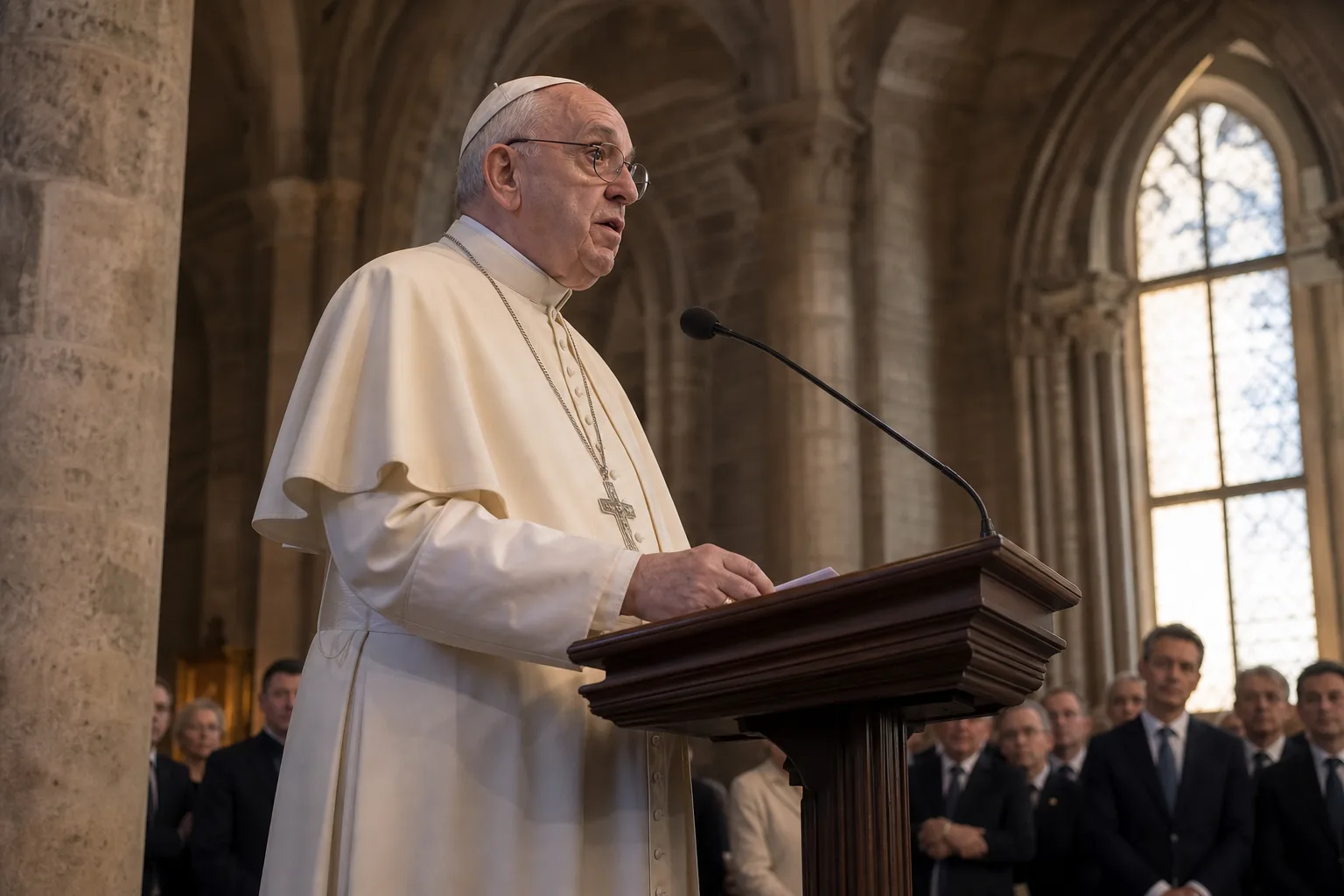
- Pope Leo’s AI warning — that the technology ‘needs to be disarmed’ — has triggered urgent debate among world leaders and tech executives.
- The Pope Leo AI warning frames unregulated artificial intelligence as a threat comparable to weapons, not just a policy inconvenience.
- Religious institutions are increasingly stepping into technology governance debates once left entirely to governments and corporations.
- The speech lands as global regulators struggle to keep pace with AI capabilities expanding far faster than existing legal frameworks.
Table of Contents
Pope Leo AI Warning Puts the Vatican at the Centre of a Tech Debate
The Pope Leo AI warning didn’t come with a product demo or a white paper. It came from a pulpit — and somehow, that made it land harder. In a statement that’s rippled well beyond Catholic circles, Pope Leo declared that artificial intelligence ‘needs to be disarmed,’ framing the technology not as a neutral tool but as something carrying inherent danger that demands urgent, collective action. The response has been immediate, global, and genuinely divided.
That a newly elected pope would make AI one of his earliest and most forceful public stances says something significant about where we are culturally. This isn’t a fringe concern anymore. When the Vatican is holding press conferences about large language models and autonomous systems, the conversation has clearly moved far beyond Silicon Valley boardrooms and Brussels policy committees.
What ‘Disarmed’ Actually Means
The word choice is deliberate and worth sitting with. ‘Disarmed’ isn’t the language of cautious optimism or calls for responsible innovation — the kind of soft framing we hear constantly from tech companies issuing their own AI ethics guidelines. It’s the language of threat neutralisation. It implies that AI, in its current trajectory, poses a danger analogous to a weapon, one that needs to be stripped of its capacity for harm before it’s allowed to operate freely in the world.
Pope Leo didn’t specify a particular system or company by name, but the timing is hard to ignore. We’re living through the fastest capability expansion in AI history. OpenAI’s GPT-4o, Google’s Gemini Ultra, Anthropic’s Claude 3, and Meta’s Llama models have all shipped in the past eighteen months, each one dramatically more capable than what came before. Autonomous agents are now being deployed in healthcare, legal services, financial advising, and military applications — often with minimal human oversight in the decision loop.
The concern isn’t hypothetical. It’s operational. The Pope Leo AI warning speaks directly to this operational reality, not to some distant hypothetical future.
Why the Church’s Voice Carries Weight Here
Secular technologists might be tempted to dismiss this as religious overreach into a domain that belongs to engineers and policymakers. That would be a mistake. The Catholic Church has roughly 1.4 billion members worldwide, and its moral authority on questions of human dignity, labour, inequality, and the common good has historically shaped legislation, international treaties, and public opinion in ways that are genuinely measurable.
Pope Francis — Leo’s predecessor — had already been quietly building the Vatican’s engagement with AI ethics. The Rome Call for AI Ethics, signed in 2020 alongside Microsoft and IBM, was an early signal that the Church intended to be a serious participant in this conversation rather than a spectator. The Pope Leo AI warning appears to be accelerating that direction, dramatically.
There’s also a class dimension to the Pope Leo AI warning that deserves attention. Automation and AI-driven job displacement disproportionately affect lower-income workers — the people the Church has historically positioned itself to defend. When the Vatican talks about AI, it’s not speaking abstractly about superintelligence scenarios. It’s speaking about the warehouse worker whose job is being automated away, the call centre employee replaced by a voice bot, the artist whose work is scraped to train a commercial model without consent or compensation.
The Regulation Gap Nobody’s Solved Yet
Here’s the uncomfortable reality: every institution with the power to meaningfully regulate AI is either moving too slowly, captured by industry interests, or both. The EU’s AI Act — the most ambitious legislative attempt yet — took years to pass and was significantly watered down during lobbying by major tech companies. In the United States, there’s still no federal AI legislation of substance. China regulates AI heavily, but largely to serve state interests rather than protect citizens.
Into that vacuum steps everyone else — ethicists, academics, civil society groups, and now, explicitly, the Vatican. The Pope Leo AI warning is partly a reflection of that gap. When official institutions fail to act, moral authority gets redistributed. People look for voices that seem genuinely concerned about human welfare rather than shareholder returns.
That’s not to say papal statements translate directly into law. They don’t. But they shape the political and cultural atmosphere in which laws eventually get written. The same dynamic played out with nuclear weapons, with environmental regulation, and with the ethics of genetic engineering. The Church was rarely the primary legislative actor, but it was rarely irrelevant either.
How the Tech Industry Is Responding
So far, the response from major AI players has been characteristically measured — which is a polite way of saying they’ve largely said nothing of substance. No major CEO has directly engaged with the Pope Leo AI warning in any meaningful public way. That silence is its own kind of statement.
The industry’s preferred posture is to position itself as the most qualified actor to manage AI risks — a stance that conveniently sidelines external regulators, moral philosophers, and yes, religious leaders. Companies like OpenAI publish safety research and operate teams dedicated to alignment. Anthropic has built its entire brand identity around responsible AI development. Google DeepMind has published extensively on AI safety. Whether any of that constitutes genuine ‘disarmament’ in the sense Pope Leo seems to intend is, at minimum, an open question.
What’s notable is that public sentiment may be shifting in ways that make dismissing these concerns harder. Polling consistently shows that majorities in most Western countries want stronger AI regulation. Trust in tech companies on this issue is not high. The Pope Leo AI warning lands in that context — not as an isolated religious statement, but as one more signal in a growing chorus of voices saying the current approach isn’t good enough.
The Bigger Picture
Debates about disarming AI will intensify over the next decade, not diminish. As systems become more capable and more embedded in critical infrastructure, the stakes of getting governance wrong increase substantially. The Pope Leo AI warning won’t write the regulatory framework that eventually emerges — that work will happen in legislative chambers, standards bodies, and international forums. But it contributes to the moral and political pressure that makes those frameworks more likely to be ambitious rather than toothless.
The real question is whether that pressure comes early enough to matter. AI capabilities aren’t waiting for consensus to form. By the time the world agrees on what ‘disarmed’ should mean in practice, the systems in question may already be considerably more powerful than anything we’re debating today.