


- Claude Mythos crypto fears are mounting as April hacks hit $629.7 million, the highest total since February 2025.
- The Claude Mythos crypto debate splits experts: some warn of zero-cost exploits, others say DeFi risks are overstated.
- Anthropic’s Project Glasswing found around 6,200 high or critical-severity vulnerabilities across more than 1,000 open-source projects.
- A limited group of cybersecurity providers will access a version of Mythos with some standard safeguards lifted.
- Claude Mythos crypto fears are mounting as April hacks hit $629.7 million, the highest total since February 2025.
- The Claude Mythos crypto debate splits experts: some warn of zero-cost exploits, others say DeFi risks are overstated.
- Anthropic’s Project Glasswing found around 6,200 high or critical-severity vulnerabilities across more than 1,000 open-source projects.
- A limited group of cybersecurity providers will access a version of Mythos with some standard safeguards lifted.
Table of Contents
Claude Mythos Crypto Alarms Are Ringing — But Is the Panic Justified?
The Claude Mythos crypto conversation has moved fast. Anthropic released its most capable AI model yet, and before most people had a chance to read the launch post, corners of the crypto industry were already in damage-control mode. The worry isn’t abstract: April 2025 saw $629.7 million worth of cryptocurrency stolen in hacks — the worst single month since February — and analysts have pointed to AI-assisted attacks as a contributing factor. Into that already-anxious environment, Anthropic dropped a model that its own benchmarks suggest is genuinely better at finding security vulnerabilities than anything that came before it.
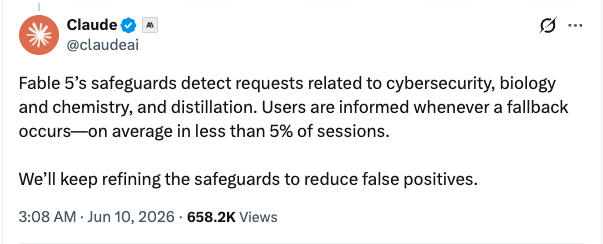
The guardrails Anthropic built into the public version of Claude Mythos haven’t done much to calm nerves. That’s partly because the model’s track record speaks for itself, and partly because the DeFi space has watched AI-enabled threats escalate quickly enough that ‘we added safety filters’ feels like cold comfort when billions of dollars sit in on-chain protocols. For many security researchers, the Claude Mythos crypto risk discussion is no longer hypothetical — it’s a question of timing.
What Project Glasswing Actually Showed
To understand why the Claude Mythos crypto reaction is so sharp, you have to look at what Anthropic published in May. Under a program called Project Glasswing, Mythos was pointed at real-world software and told to find problems. The results were striking: thousands of critical vulnerabilities identified across important software infrastructure. For open-source projects specifically — the same category of code that underpins most crypto protocols — Mythos found roughly 6,200 high or critical-severity vulnerabilities across more than 1,000 codebases.
That’s not a drill. Those are real bugs in real software that real people use. And when you frame it that way, it’s easy to see why DeFi developers and investors started asking the obvious next question: if Mythos can tear through millions of lines of open-source code and surface thousands of critical issues, what happens when someone points it at a smart contract? The Claude Mythos crypto threat, in this light, is really a question about how broadly those capabilities translate across different code environments.
The Doomsday Case: Exploits at Near-Zero Cost
Simon Dedic, founder of venture firm Moonrock Capital, laid out the bear case on X this week and it’s hard to dismiss entirely. His argument centers on economics: right now, finding an exploitable vulnerability in a smart contract requires time, skill, and money. Not a huge amount relative to the potential payoff — DeFi hacks are already depressingly common — but enough to serve as a natural filter. Dedic believes Claude Mythos crypto attacks could essentially eliminate that filter.
Dedic argued that the cost and skill required to find exploitable flaws in smart contracts is about to drop to essentially zero. He warned that unaudited protocols will become sitting ducks, that known exploits will get replayed on forks around the clock, and that even small projects will get targeted simply because trying costs next to nothing now.
That last point is the one that should make smaller DeFi teams genuinely uncomfortable. Historically, sophisticated attackers have tended to go after high-value targets — the TVL has to justify the effort. If the effort approaches zero, that calculus changes entirely. A protocol with $500,000 locked becomes worth attacking if running an AI scan costs almost nothing and takes minutes.
Dedic backed his concern with practical advice: revoke wallet approvals, pull value out of protocols where possible, and move holdings to fresh hardware wallets that have never been exposed to potentially compromised environments. Whether or not you think his threat assessment is calibrated correctly, those are sensible hygiene steps regardless. The Claude Mythos crypto debate has at least produced one clear consensus: basic security discipline is no longer optional.

The Counter-Argument: Smart Contracts Aren’t That Kind of Code
Not everyone in the industry is reaching for the panic button. Michael Egorov, co-founder of Curve Finance — a protocol that has itself been on the receiving end of a major exploit — offered a more measured take, and it’s worth taking seriously given his experience.
Egorov’s core argument is that the Claude Mythos crypto threat rests on a category error. The software Mythos tore apart in Project Glasswing had millions of lines of code. Smart contracts, by contrast, typically contain a few thousand lines. That’s not just a quantitative difference — it changes what kind of tool is actually well-suited to finding bugs. As Egorov put it, both humans and ‘usual’ AI already fit smart contract code entirely within their context window and can reason about it effectively. The marginal improvement Mythos offers over existing tools may be much smaller in that specific domain than the headline numbers suggest.
His prediction about where AI-driven attacks will hit harder is arguably more interesting than his dismissal of the smart contract risk:
‘I suspect we might not be having a wave of DeFi code hacks, but we may see a lot of things in OpSec getting hacked — looking like multisig key compromises — and supply chain attacks on frontend dependencies, and those are way less dangerous in true DeFi,’ Egorov said.
He’s pointing at operational security failures and front-end supply chain attacks as the more likely attack surface — the kind of infrastructure that does involve complex, sprawling codebases where Mythos’s capabilities would translate more directly. Frontend dependencies for DeFi protocols often pull in dozens of third-party JavaScript packages, any one of which could be compromised. That’s a familiar attack vector — the 2023 Ledger Connect Kit attack exploited exactly this kind of supply chain weakness and briefly affected multiple major DeFi frontends at once.
Anthropic’s Controlled Access Play
Anthropic isn’t releasing Mythos into the wild without guardrails. The standard public model keeps its safety filters intact. But separately, the company says a ‘small group’ of cybersecurity and infrastructure providers will get access to Claude Mythos — the same underlying model, but with some of those restrictions lifted in specific areas. It’s a structure that mirrors how other AI labs have handled dual-use capabilities: keep the powerful version away from the general public while making it available to the people whose job it is to find vulnerabilities before the bad actors do.
That’s a reasonable framework in theory. The problem is that ‘small group’ access arrangements have a mixed track record in practice. Once a model with lifted restrictions exists and is in use, the attack surface for leakage or misuse grows. The AI security community has learned, repeatedly, that jailbreaks and workarounds for restricted models tend to emerge regardless of initial intent. Claude Mythos crypto risk doesn’t disappear because the dangerous version is behind a vetting process — it just changes the timeline.

What DeFi Teams Should Actually Do Right Now
Whatever side of the debate you fall on, the practical implication for DeFi builders and users is the same: the threat environment is getting more capable, and preparation matters. For protocols, that means prioritizing audits — not as a one-time checkbox but as an ongoing process, particularly after any code changes. Unaudited forks of existing protocols are the most exposed, and Dedic’s point about known exploits being replayed on forks ‘around the clock’ is compelling precisely because it doesn’t require Mythos to find anything new — it just needs to automate what humans already know.
For users, wallet hygiene has always been important, and the Claude Mythos crypto conversation is a good reminder of why it remains so. Revoking unnecessary approvals is a low-effort, high-impact step that most people put off far longer than they should. Hardware wallets — especially fresh ones that haven’t been connected to potentially compromised applications — offer a meaningful additional layer of protection that no AI model can easily circumvent.
The broader picture here is one the industry needs to sit with honestly. AI is becoming a serious force multiplier for attackers, and the $629.7 million April figure isn’t an outlier — it’s a data point in an accelerating trend. Whether Mythos specifically becomes the tool that reshapes the DeFi exploit landscape or whether Egorov is right that its impact on smart contracts specifically will be limited, the underlying dynamic is clear: the asymmetry between attacker capability and defender readiness is widening. The protocols that treat Claude Mythos crypto escalation as someone else’s problem are the ones that are going to learn the hard way why they shouldn’t have.
Source: Cointelegraph
Frequently Asked Questions
What makes Claude Mythos a potential threat to crypto?
Claude Mythos found thousands of critical vulnerabilities in real-world software through Anthropic’s Project Glasswing. Critics worry that if the model applies similar capability to smart contracts, the cost and skill needed to exploit DeFi protocols could drop dramatically, making even small projects viable targets.
Does Claude Mythos crypto risk apply equally to all DeFi projects?
Not necessarily. Curve Finance co-founder Michael Egorov argues that smart contracts contain far fewer lines of code than the software Mythos targeted, meaning existing AI tools already handle that scale well. He believes the bigger near-term risk is operational security failures and supply chain attacks, not direct contract exploits.
Who can access the unrestricted version of Claude Mythos?
Anthropic says a small group of vetted cybersecurity and critical infrastructure providers will receive access to Claude Mythos 5 with some safeguards lifted. The general public version retains its standard guardrails.
What practical steps are being recommended for crypto users right now?
Moonrock Capital founder Simon Dedic has urged users to revoke wallet approvals, reduce value sitting in protocols, and move holdings to fresh hardware wallets. These are broadly sensible precautions regardless of the specific threat level Mythos ultimately represents.

