

Table of Contents
The Samsung Ballie robot first appeared publicly in 2020 as a small rolling assistant. Samsung showed it as a companion that could move through a home and interact with people. At that stage, Samsung presented it as a research project rather than a planned consumer device. The idea was simple. A sphere could roll through a room, capture information, and respond to commands. The company created a sense of excitement, but it also clarified that there were no plans for a retail release.
That position changed as Samsung expanded its work with AI. In 2024, the Samsung Ballie robot returned in a new form. It appeared larger, carried more sensors, and used AI to perform more actions. This updated version gained attention again at CES 2025. Samsung said that the Samsung Ballie robot would arrive in the first half of 2025. The company built anticipation by displaying it on stage and by sharing new video demonstrations. It also created a sign up page similar to those used for the next Galaxy smartphones.
By April 2025, Samsung repeated that the Samsung Ballie robot would reach consumers in the United States and Korea by summer 2025. The sign up page encouraged customers to follow updates and prepare for its arrival. However, as 2025 comes to a close, the Samsung Ballie robot remains unavailable. The sign up page still exists, but no one can buy the device.
Read more on our article, Tesla Robotics Staff Shift: Why Talent Departures to Sunday Robotics Matter, published on November 30th, 2025 SquaredTech.
Why the Samsung Ballie Robot Missed Its 2025 Launch
The Samsung Ballie robot delay raised enough questions that TechRadar contacted Samsung directly. A spokesperson said that the company is continuing to refine and perfect the technology to offer a better customer experience. This explanation confirms that the Samsung Ballie robot is not ready for everyday use. It also shows that Samsung wants to avoid releasing a device that fails to perform consistently.
The most important point is that the Samsung Ballie robot must act as a companion. It must move, answer questions, project visuals, respond to voices, and make decisions. These tasks require reliable sensors and strong AI models. A refrigerator or a television can rely on stable hardware. A moving assistant that interacts with a home environment must adapt to many situations. If the Samsung Ballie robot misinterprets voice commands or struggles with movement, the device loses practical value.
What Samsung Reveals About the Delay
At CES 2025, Samsung showed a controlled demonstration of the Samsung Ballie robot. This demo focused on visual projection features and on AI actions that played in a loop. Samsung did not allow attendees to use the device directly. That decision suggested that the Samsung Ballie robot could perform actions in a managed environment but might face problems in real homes where objects, lighting conditions, pets, and noise vary widely.
Read more on our article, CES 2025: Top Gadgets and Innovations That Stole the Show, published on January 13th, 2025 SquaredTech.
The Samsung Ballie robot must also compete with other AI devices introduced in 2025. Products like the Neo X1 Robot or the BDX Droids take different approaches to home assistance. Some offer physical arms. Some offer more expressive movement. Others rely on static positions and advanced microphones. Compared to those devices, the Samsung Ballie robot combines mobility, projection, sensors, and voice interaction. This combination creates pressure to deliver a stable system rather than a flawed early release.
Inside the Features of the Samsung Ballie Robot
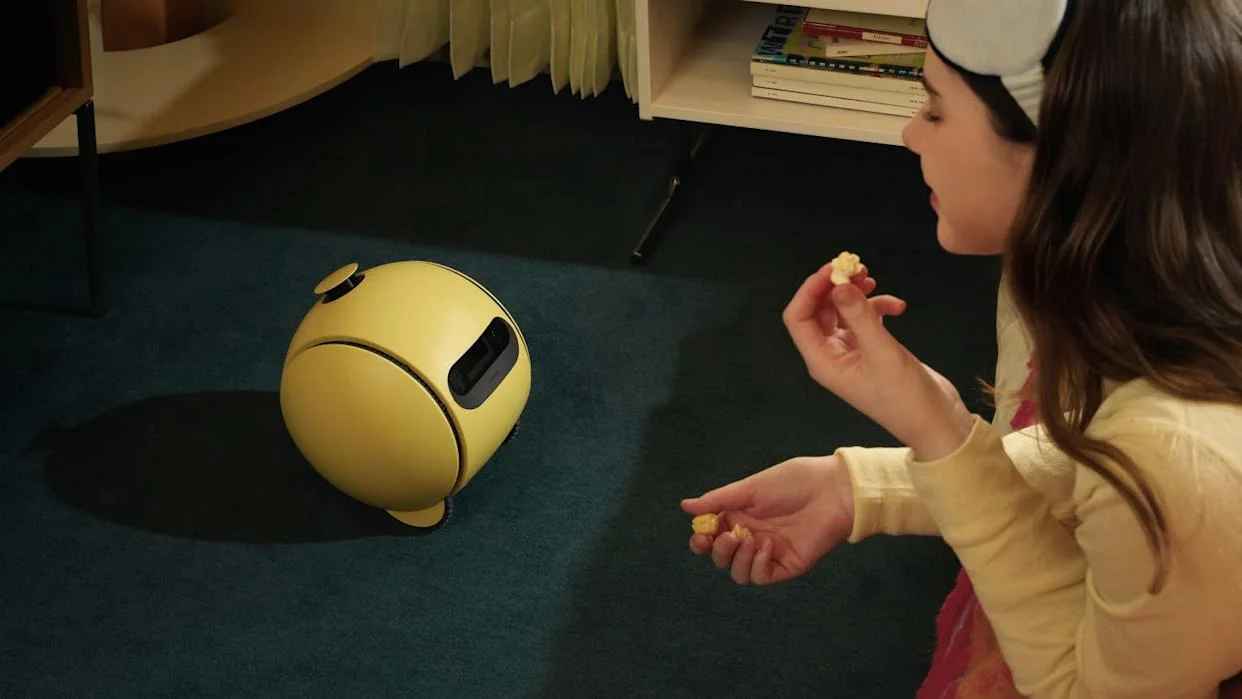
The Samsung Ballie robot uses many sensors and components that must work together. Samsung planned to equip the device with a LiDAR sensor stack and a Time of Flight sensor. These sensors allow the robot to map rooms and detect distances. The device also carries speakers, microphones, a rear 2K camera, a front 4K camera, and a built in projector. These features allow the Samsung Ballie robot to respond to voices, scan surroundings, take photos, record video, and project content onto walls or floors.
The Samsung Ballie robot rolls on wheels and moves across one floor at a time. It cannot climb stairs. Samsung expects the device to use sensors to avoid collisions, identify humans, track motion, and position itself for projection tasks. These tasks require precise sensor processing. If the mapping system misreads a chair or misjudges a wall, the Samsung Ballie robot may fail to navigate correctly.
Why the Technology Requires More Development
Samsung also announced that the Samsung Ballie robot will use Gemini through a partnership with Google Cloud. This means that the robot will rely on cloud processing for some tasks. Cloud models offer strong performance but also create latency concerns. If the Samsung Ballie robot waits for cloud responses, the delay must remain small enough to feel natural in daily use. Samsung must find a balance between cloud intelligence and onboard processing. This balance may also contribute to the extended development process.
The Samsung Ballie robot must also project clear visuals. Samsung wants the device to display movies, TV shows, and other content. Projection requires stable movement and strong image correction. If the robot projects while rolling or turning, the projected image may distort. Samsung must solve these issues before release.
These technical demands create a high level of pressure on the Samsung Ballie robot development team. Each feature depends on accurate hardware coordination and AI interpretation. A single error in motion tracking might affect projection. A mistake in voice detection might trigger the wrong action. A misread from the LiDAR sensor might cause the Samsung Ballie robot to collide with an object.
What This Delay Means for Consumers and the Future of the Samsung Ballie Robot
Consumers who followed the Samsung Ballie robot story may feel confused by the repeated delays. Samsung showed new demos, promised new timelines, and encouraged sign ups, yet the retail release remains unclear. The company continues to state that it is refining the device. This indicates that the Samsung Ballie robot may still require significant improvement before launch.
Samsung may provide a new update at CES 2026. The company often uses that event to share major announcements. CES 2026 may include another demonstration, a revised timeline, or new pricing details for the Samsung Ballie robot. However, Samsung could also choose to present another controlled demo without final answers. In that case, the Samsung Ballie robot would remain an anticipated device without a confirmed consumer release date.
The Samsung Ballie robot stands at an important point in Samsung’s AI strategy. It represents a future where devices move, think, and interact inside homes. If Samsung releases the Samsung Ballie robot too early, consumers may face problems that affect trust. If Samsung waits too long, interest could decline as new AI devices appear from other companies.
The Samsung Ballie robot delay shows that AI companions require precise development. Mobility, projection, and sensors demand accuracy. Samsung must solve these issues before the device can enter homes. Until then, the Samsung Ballie robot remains a project in progress.
Stay Updated: Tech News – Emerging technologies

