Table of Contents
Samsung has confirmed plans to launch smart glasses in 2026, marking a significant expansion of its augmented reality ambitions. The company referenced the project during its Q4 2025 earnings call, positioning smart glasses as a priority within its AI and XR roadmap.
Executives shared limited technical detail, but the direction was clear. Samsung sees lightweight, AI-powered glasses as the next step beyond smartphones and bulky headsets. The focus is on everyday usability, privacy-aware AI features, and deep integration with the Galaxy ecosystem.
The announcement places Samsung directly into an intensifying race with Meta and Apple, as the industry pivots from expensive headsets toward practical, wearable AR devices designed for daily use.
Samsung Smart Glasses Expand AI Ecosystem
Devices integrate multimodal AI features. Users access voice, visual, and gesture inputs seamlessly. Our team watches this space closely. AR hardware shifts from bulky headsets to everyday glasses. Samsung enters a crowded field. Companies race to make AR practical for consumers. Earnings calls serve shareholders first.
Samsung revealed high-level plans only. Leaders skipped demos or specs. No release window emerged yet. Production timelines stay private for now. Samsung Smart Glasses signal bigger ambitions. The company invests in hardware beyond phones. AR glasses expand Samsung’s ecosystem. Users pair glasses with Galaxy devices. AI processes data across screens. Samsung Smart Glasses promise hands-free computing. Workers analyze market trends at Squaredtech.
Smart glasses grow popular. Consumers demand lightweight wearables. Phones handle basic tasks well. Glasses overlay information in real view. Samsung positions Samsung Smart Glasses for daily use. The company draws from headset experience. Galaxy XR launched in October 2025. That device runs Android XR software. Google powers the platform. Samsung and Google partner closely. Android XR supports VR and AR.
Headsets debuted at $1,799 each. Sales limit to U.S. and South Korea so far. Controllers sell separate. Numbers remain undisclosed. Samsung reports record profits in Q4 2025. RAM chip demand drove gains. Phones contributed less. Headsets play small roles now. Samsung Smart Glasses target broader appeal.
Samsung Smart Glasses Follow Industry Pivot
Samsung Smart Glasses arrive amid major shifts. Apple changed course last year. Bloomberg reported the pivot in October 2025. Apple paused Vision Pro upgrades. Engineers shifted to smart glasses. Headsets demand high prices. Glasses offer lower entry points. Users accept lighter designs easier. Meta moves faster in this direction.
The company cuts Reality Labs staff by 10 percent. Meta closes three VR game studios. Leaders end Quest for business programs. Headsets lose priority status. Smart glasses gain focus instead. Meta sells Ray-Ban models now. Those units lack full displays. Future pairs add screens soon. Samsung likely copies this path. First Samsung Smart Glasses skip displays. Models with screens follow in 2027. We see logic here.
Displays raise costs and weight. Basic glasses test markets first. Audio and AI features draw users. Samsung Smart Glasses build on partnerships. Google supplies Android XR base. Software handles spatial apps. Developers code once for all devices. Galaxy XR headset tests the system. Launch drew limited buzz. High prices slow adoption. Samsung learns from that start. Glasses aim for affordability.
Consumers buy eyewear often. AR versions blend in naturally. Samsung Smart Glasses integrate Galaxy AI. Phone assistants extend to eyes. Users hear directions without pulling phones. Cameras capture surroundings quietly. AI summarizes views instantly. Samsung plans multimodal inputs. Voice commands activate features. Gestures control menus. Eye tracking selects options.
We predict strong demand. AR shipments climb yearly. Smart glasses lead growth segments. Samsung chases Meta’s lead. Ray-Ban units sell briskly. Partnerships with EssilorLuxottica boost reach. Samsung seeks similar deals. Eyewear brands shape styles. Samsung Smart Glasses target fashion crowds. Tech hides behind normal lenses. Battery life extends full days. Charging cases fit pockets. Samsung refines prototypes now. Teams test comfort levels. Frames adjust for all faces. Hinges fold compactly. Samsung Smart Glasses compete directly. Apple builds premium pairs. Meta owns casual markets. Samsung blends both worlds.
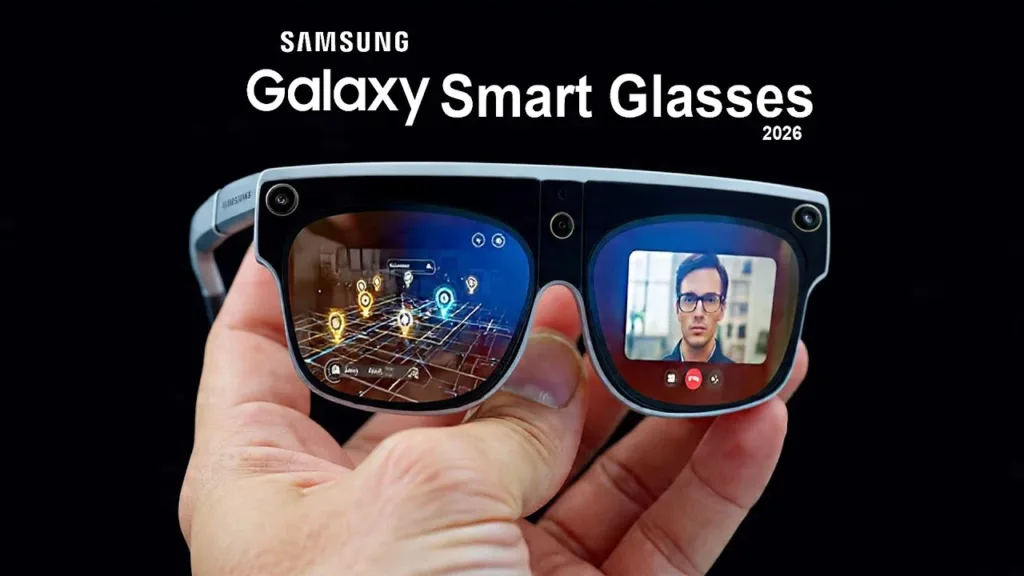
Samsung Smart Glasses Release Date & Features!
Samsung Smart Glasses Power AI Future
Samsung Smart Glasses build on Android XR’s growing momentum. Google refines the platform year after year, adding deeper AR tools, better spatial APIs, and smoother app performance. Samsung complements that software progress with serious hardware investment, including custom silicon designed to handle AI tasks directly on the device. Everyday processing stays local, while heavier workloads shift to the cloud when needed. Privacy remains central. Most data never leaves the glasses, and users control what gets shared, with clear, app-level permissions. It’s a familiar playbook, borrowed from Samsung’s success with Galaxy phones, now extended to spatial computing.
Bixby evolves here into a spatial assistant rather than a voice-only helper. The glasses wake on subtle cues, conversations feel more natural, and responses adapt to what users are seeing. Practical use cases are where the platform clicks. Drivers get lane-level navigation overlays. Runners see pace and performance metrics floating in view. Shoppers scan products to compare prices and surface relevant reviews instantly. In workplaces, technicians inspect machines hands-free as diagrams highlight faults and step-by-step instructions appear in real time. Meetings show names above faces, notes during calls, and live translation for foreign speech without breaking eye contact.
Enterprise adoption moves quickly, but consumer demand drives volume. Samsung prices the first models in the mid-range, with premium versions following later. Accessories expand functionality—battery cases extend usage, improved straps enhance comfort, and ecosystem integration ties everything together. Watches feed health data, phones handle setup, tablets mirror larger views, and cloud profiles store custom layouts across devices. Developer support rolls out early, with SDKs, hackathons, and live testing shaping the final product ahead of launch.
There are challenges. Battery technology still limits all-day use, and displays remain power-hungry. Samsung counters with micro-LED panels that shrink size, boost brightness, and stay readable in direct sunlight. Outdoor testing, water resistance, and sweat-proof durability bring the hardware closer to sports-grade reliability.
Samsung Smart Glasses are expected to launch in 2026, starting with limited releases in Korea, followed closely by the U.S. and Europe, then wider expansion across Asia’s major cities. The full reveal is likely timed with an Unpacked event, complete with hands-on demos, fast preorders, and retail availability ahead of the holiday season.
Samsung’s confirmation of smart glasses for 2026 marks a strategic shift in how the company approaches augmented reality. After years of experimentation with headsets, the focus is moving toward devices designed for everyday use rather than niche experiences.
While Samsung has shared limited technical details, the intent is clear. Smart glasses will serve as an extension of its AI and Galaxy ecosystem, prioritizing hands-free assistance, contextual awareness, and seamless integration across devices.
As competitors refine their own approaches, Samsung’s entry reinforces a broader industry conclusion: augmented reality is more likely to succeed when it feels invisible, practical, and natural. In 2026, smart glasses are no longer a side project—they are becoming a core platform.
Stay Updated: Gadgets