

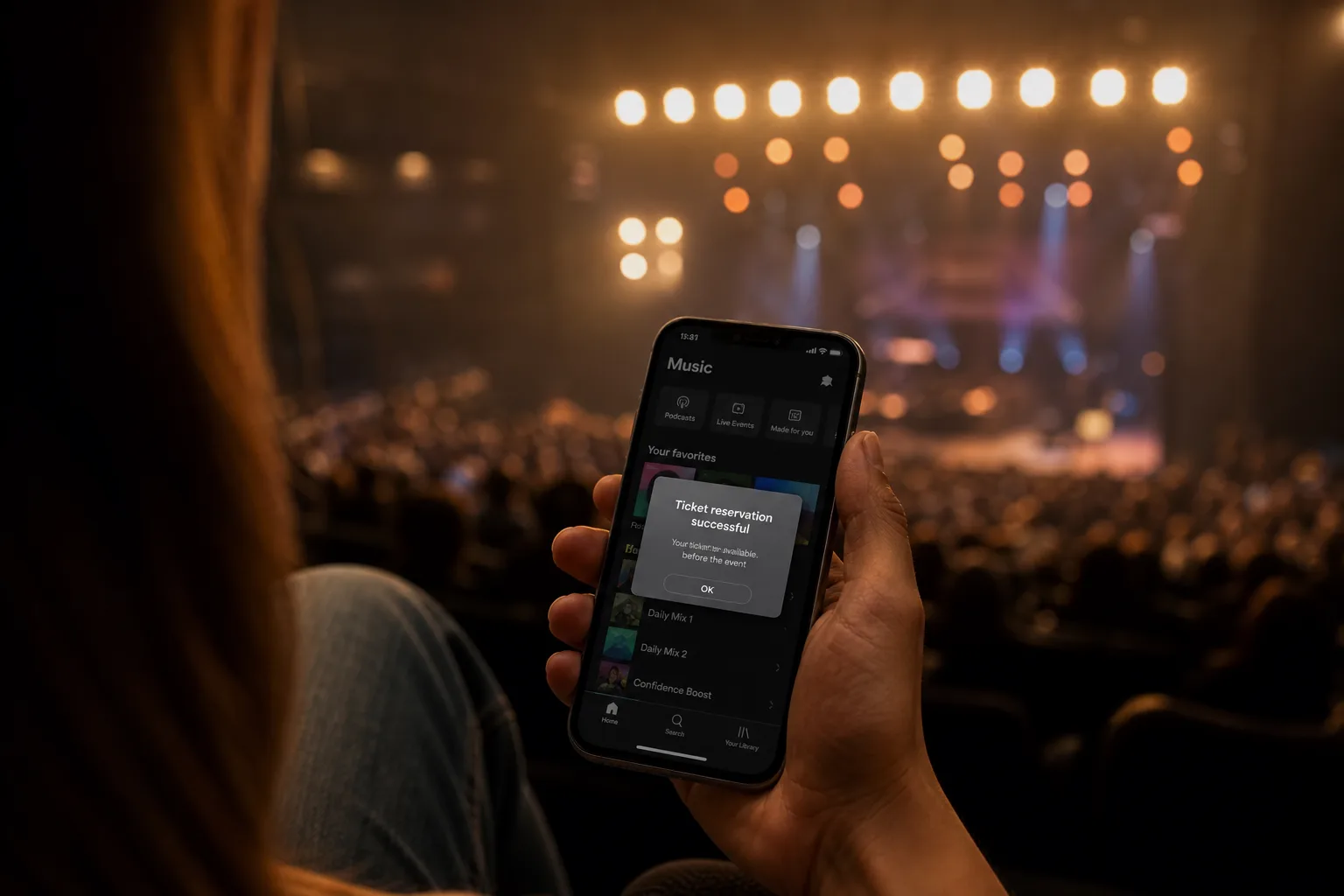
- Spotify concert tickets will be held in reserve for superfans through a new feature launching in the US this summer.
- The Reserved feature uses streaming and engagement data to identify superfans and give them a 24-hour purchase window for up to two Spotify concert tickets.
- Spotify has signed a multiyear deal with Live Nation to power the programme, deepening its push beyond music streaming.
- Spotify also unveiled an AI remix tool with Universal Music Group and a new standalone app called Studio by Spotify Labs.
Table of Contents
Spotify Concert Tickets Just Got a New Queue — and It’s Yours to Lose
Spotify concert tickets have long been an obvious gap in the streaming giant’s ecosystem. The company knows more about your music tastes than almost any other platform on earth, yet when it came to actually seeing your favourite artist live, you were still stuck refreshing Ticketmaster at 10am alongside millions of strangers. That changes this summer. At Spotify’s investor day, the company unveiled Reserved — a feature that holds a block of tickets back from general sale and offers them directly to the fans the platform’s data identifies as genuinely devoted to an artist.
“Getting concert tickets today can feel like a race you’re set up to lose,” Spotify wrote in its announcement. “You show up at the right time, refresh endlessly, and still miss out. Too often, the experience is stressful, unpredictable, and disconnected from what should matter most: whether real fans actually get tickets.” It’s hard to argue with that. Anyone who’s spent forty minutes in a virtual queue only to be told a show sold out while they were waiting knows exactly how broken the current system feels.
How Reserved Actually Works
The mechanics are relatively straightforward. Spotify will analyse streams, shares, playlist saves, and other engagement signals to build a picture of who an artist’s most dedicated listeners are. Those fans will be notified that Spotify concert tickets have been set aside for them, and they’ll have a 24-hour window to complete the purchase — up to two tickets per fan selected.
Artists opt into the programme, and they decide how many tickets to allocate through Reserved. Spotify hasn’t confirmed which artists will participate first, or how large those allocations will be. The company was upfront about one limitation: “there will be significantly more superfans than there are seats available on a tour, so not every fan will receive an offer.” That’s an honest caveat, and it matters. Reserved isn’t a universal fix — it’s a priority lane for a subset of the most engaged listeners, which still leaves plenty of people outside the rope.
The feature launches in the US this summer. No date has been given for international expansion, though Spotify’s scale — it has over 640 million monthly active users globally — suggests the eventual addressable audience is enormous.
The Live Nation Deal Is the Part Worth Watching
Spotify concert tickets through Reserved aren’t being handled in isolation. The programme is backed by a multiyear agreement with Live Nation, the world’s largest live entertainment company. That partnership is significant for reasons that go well beyond one feature.
Live Nation has faced enormous regulatory scrutiny in recent years. The US Department of Justice sued the company in 2024 seeking to break up its ownership of Ticketmaster, arguing the combined entity stifles competition in the live events industry. Spotify aligning itself with Live Nation on a fan-access initiative is, at minimum, a curious strategic choice given the optics. It could also be read as pragmatic: if you want Spotify concert tickets to actually reach fans at scale, you need the entity that controls a dominant share of ticketing infrastructure at the table.
Whether this deal deepens Spotify’s dependency on Live Nation’s ecosystem or positions it as a meaningful check on how tickets get distributed remains to be seen. What’s clear is that Spotify isn’t treating this as a small side project. Pairing the announcement with investor day signals this is core to its expansion strategy, not an experiment buried in a product blog.
Why Spotify Is Doing This — and Why Now
There’s a straightforward business logic here. Spotify’s premium subscription has always needed stronger hooks to justify the cost versus free tiers or rival services. Exclusive early access to Spotify concert tickets is a genuinely compelling differentiator — the kind of tangible, real-world benefit that subscription fatigue-weary users might actually notice.
But the deeper play is about identity. Spotify has spent years accumulating behavioural data on listeners. It knows your listening habits better than your friends do. Reserved is one of the first features that directly monetises that intimacy in a way that feels like it benefits the user rather than just the advertiser. If Spotify can reliably get tickets into the hands of people who would actually attend a show — rather than scalpers running bots — it becomes something more than a music app. It becomes infrastructure for fan culture.
That’s a positioning shift Spotify has been telegraphing for a while. The company has talked publicly about building tools for “superfans” — a segment it sees as underserved by both streaming economics and the live events industry. Reserved is the most concrete expression of that thesis yet.
The Rest of Investor Day: AI Remixes and a New App
Reserved was the headline, but Spotify’s investor day included a couple of other announcements worth noting. The company revealed a new standalone desktop app called Studio by Spotify Labs, which lets users create personalised podcasts and playlists shaped by their listening preferences. It’s positioned as a creative tool, though it’s early-stage and details are thin.
More provocative was the joint announcement with Universal Music Group. Spotify and UMG have struck a new licensing agreement that will allow subscribers to generate AI covers and remixes of select tracks from UMG’s roster. The implications of that are substantial and largely unresolved — questions around artist consent, royalty splits, and the long-term effect on session musicians and producers aren’t answered by a licensing deal, however well-structured. Still, the fact that UMG — historically one of the most cautious major labels when it comes to AI — is willing to sign off on this kind of agreement suggests the industry’s posture toward generative audio tools is shifting faster than many expected.
Will Reserved Actually Fix the Ticket Problem?
Spotify concert tickets through Reserved won’t end scalping. They won’t eliminate bot purchases or make Taylor Swift’s next tour accessible to everyone who wants to go. The structural problems in the live events industry are deep, legally tangled, and not going to be solved by a streaming platform’s data model.
But that’s probably not the right frame for judging this. Reserved doesn’t need to fix everything to be meaningful. If it reliably gets a few thousand tickets per tour into the hands of people with genuine, documented attachment to an artist — rather than people with faster internet connections or better bot scripts — that’s a real improvement over the current free-for-all.
The bigger question is whether artists will commit meaningful allocations. A feature that holds back 50 tickets per show for a 20,000-seat arena is a PR story, not a solution. If Spotify can persuade artists and their management to route a genuinely significant percentage of inventory through Reserved, the feature could reshape fan expectations around how tickets are earned rather than simply bought. That’s a much harder cultural shift than writing a new algorithm — but it’s the one that would actually matter.

