

- Apple’s formal verification of ML-KEM and ML-DSA provides mathematical proof its quantum-secure code matches NIST’s FIPS 203 and 204 specs exactly.
- The formal verification libraries Apple built are now public, letting independent experts scrutinise the strongest correctness results for any production cryptographic implementation.
- corecrypto underpins encryption, hashing, and digital signatures across more than 2.5 billion active Apple devices — a bug there has catastrophic reach.
- Apple is open-sourcing the tools behind this effort, a rare move that could push the entire industry toward higher cryptographic assurance standards.
Table of Contents
Formal Verification and the Quantum Threat Apple Can’t Ignore
Apple has published what it’s calling a blueprint for formal verification of corecrypto — its foundational cryptographic library — and the timing couldn’t be more deliberate. The release coincides with the company’s open-sourcing of its implementations of two NIST-standardised post-quantum algorithms, ML-KEM and ML-DSA, complete with the mathematical proofs that confirm the code is a faithful translation of the FIPS 203 and FIPS 204 specifications. This isn’t a press release about future intentions. It’s finished work, put out for public scrutiny.
The backdrop matters here. Quantum computers capable of breaking today’s public-key cryptography don’t exist yet, but the threat they represent is real enough that security teams at major tech companies have been quietly preparing for years. The most immediate concern isn’t a quantum computer cracking your messages tomorrow — it’s the harvest now, decrypt later attack model, where adversaries are already hoarding encrypted data today, betting they’ll have the compute to unlock it in a decade. Apple’s push into post-quantum cryptography for iMessage, VPN, and TLS networking is a direct response to that scenario.
What Formal Verification Actually Means Here
Formal verification is one of those phrases that gets thrown around loosely, so it’s worth being precise about what Apple has actually done. In software, formal verification means using mathematical methods to prove that a program behaves exactly as its specification requires — not just testing it extensively, but proving correctness. For cryptographic code, that distinction is enormous.
Testing finds bugs you thought to look for. Formal verification proves bugs of certain classes cannot exist. Apple’s engineers built new libraries and tooling specifically to apply this to ML-KEM and ML-DSA, and the company claims the results represent the strongest known correctness guarantees for any widely-deployed production implementation of these algorithms. That’s a significant claim — and by publishing both the proofs and the tools, Apple is inviting the cryptographic research community to validate or challenge it.
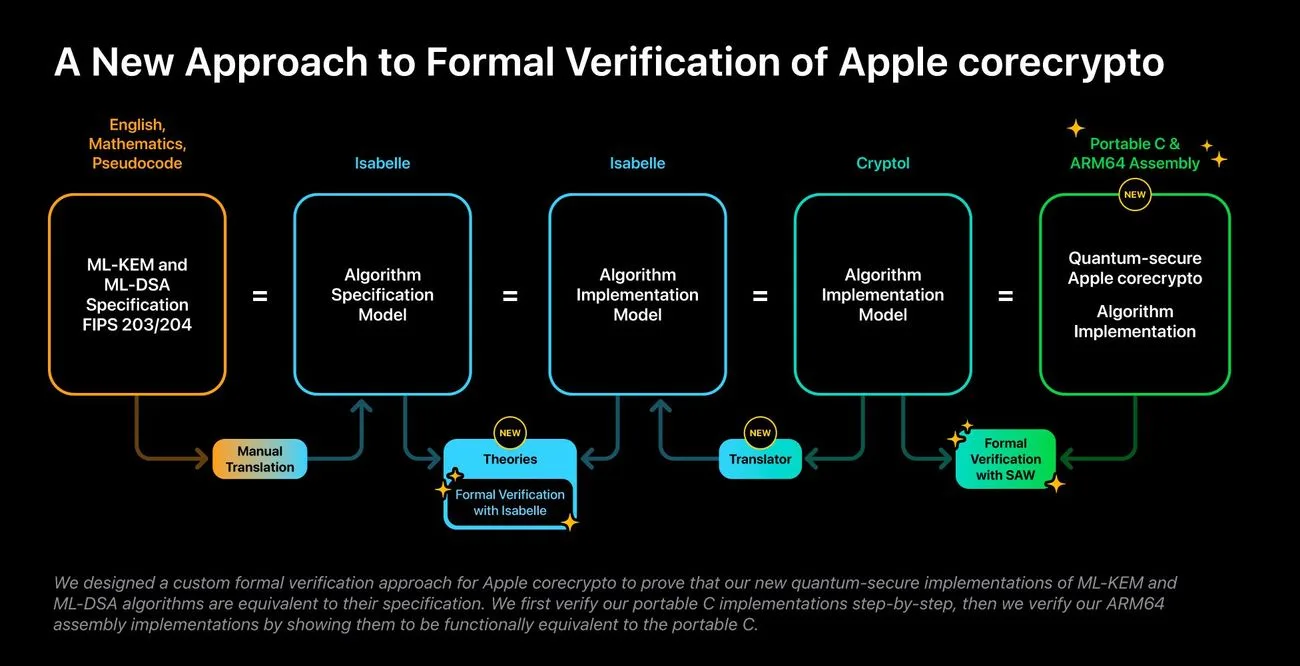
What makes this particularly interesting is that ML-KEM and ML-DSA are relatively new constructions. The mathematical underpinnings — both algorithms are based on the hardness of problems in structured lattices — have less collective real-world implementation experience behind them than, say, RSA or AES. Subtle errors in implementing lattice-based cryptography can be catastrophic and non-obvious. Formal verification is arguably more valuable here than almost anywhere else in applied cryptography right now. NIST’s finalised standards for these algorithms, FIPS 203 and FIPS 204, are publicly available for anyone who wants to examine the specifications Apple’s proofs are measured against.
The Scale Problem: 2.5 Billion Devices Leave No Room for Error
Apple’s corecrypto isn’t some isolated module used in one or two apps. It’s the cryptographic backbone of every Apple operating system — iOS, macOS, watchOS, tvOS — providing encryption, decryption, hashing, random number generation, and digital signatures. The company says it runs on over 2.5 billion active devices. A critical bug doesn’t compromise one app or one service. It potentially compromises every app and feature that depends on cryptographic operations across Apple’s entire installed base.
That scale is why Apple’s bar for adding new code to corecrypto is unusually high even by security-focused standards. New algorithms must demonstrably improve security, survive sustained cryptanalysis from the global research community, perform efficiently on every Apple chip, and keep key sizes and ciphertext lengths tight enough to avoid straining network performance or memory. That last point is more practically important than it sounds — ML-KEM and ML-DSA generate larger keys and signatures than classical algorithms, and at scale across billions of devices, even modest overhead adds up fast.
How Apple Builds and Hardens Corecrypto Implementations
The implementation process Apple describes is layered in ways that reflect hard lessons from years of real-world cryptographic attacks. Every algorithm starts as portable C code — necessary because corecrypto runs on a wide range of Apple chips with different microarchitectures. But portable C is just the starting point.
The security requirements are strict. The code must avoid leaking secret values through execution timing — a class of side-channel attack that has broken real-world implementations of algorithms that were mathematically sound but carelessly coded. Apple’s engineers write code that prevents compilers from inadvertently stripping out timing protections, and they take explicit advantage of hardware features in Apple silicon: Data Independent Timing (DIT), which guards against micro-architectural timing channels, and Pointer Authentication (PAC), which hardens the code against memory corruption exploits.
On top of that baseline, Apple’s team rewrote the most performance-sensitive and security-sensitive subroutines by hand, applying mathematical optimisations to squeeze out better performance without touching the underlying algorithm. For a company with Apple’s silicon expertise, hand-optimised cryptographic code gives precise control over exactly how the processor executes — which matters enormously when you’re trying to prevent timing signals that could leak cryptographic secrets to an attacker sitting on the same network or even the same machine.
Why Publishing the Tools Is the More Interesting Story
The ML-KEM and ML-DSA implementations are notable. But the decision to publish the formal verification libraries and tools Apple built to prove their correctness is arguably the more significant move here. Apple isn’t just saying

