

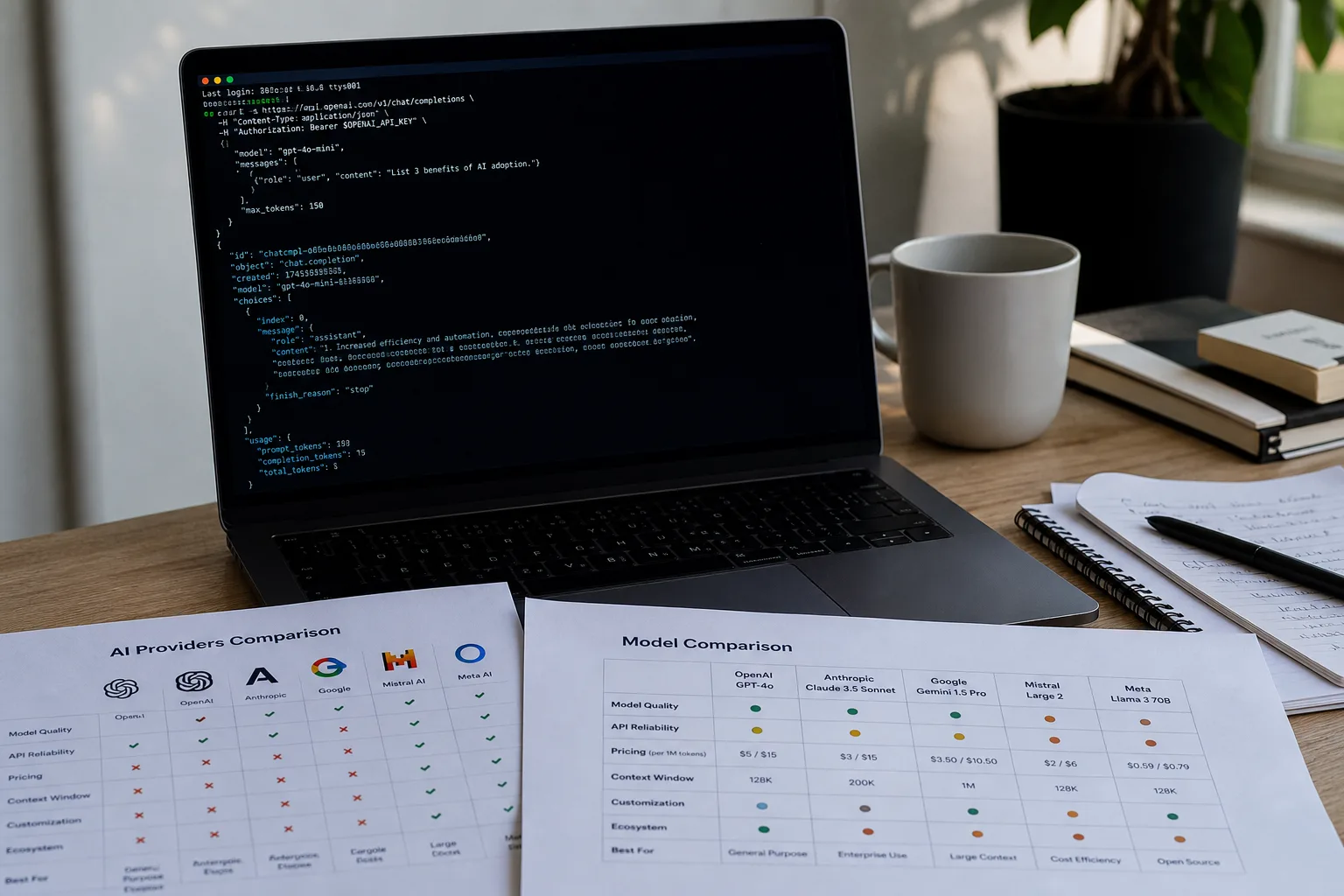
- Models.dev launches as a community-driven AI model database covering specs, pricing, and capabilities across all major providers.
- The AI model database is freely accessible via a simple API endpoint, making it easy to integrate into developer tooling.
- Data is stored as TOML files in a public GitHub repo, and anyone can contribute new models or update existing ones.
- Built by the team behind opencode, Models.dev fills a real gap — no single source previously tracked all AI models in one place.
Table of Contents
The AI Model Database Nobody Built Until Now
There’s no shortage of AI models right now. OpenAI, Anthropic, Google, Mistral, xAI, Meta — the list keeps growing, and so does the chaos. If you’re a developer trying to compare context windows, token costs, or tool-calling support across a dozen providers, good luck. Until recently, you were cobbling together information from scattered documentation pages, Reddit threads, and educated guesses. That’s exactly the problem Models.dev is trying to fix. This new AI model database centralises specs, pricing, and capability flags for every major model in one open, community-maintained place.
The project comes from the team at Anomaly, the same people building opencode, an open-source AI coding assistant. They needed reliable, structured model data internally, couldn’t find it anywhere clean, and decided to build it themselves. Classic open-source origin story — solve your own problem and open it up for everyone else.
What the AI Model Database Actually Tracks
Models.dev goes well beyond just listing model names and prices. Each entry in the AI model database captures a detailed snapshot of what a model can and can’t do. That includes the obvious stuff — input and output token costs, context window size, maximum output tokens — but also capability flags that developers genuinely care about: does the model support tool calling? Structured output? File attachments? Reasoning or chain-of-thought? Temperature control?
There’s also metadata that’s easy to overlook but surprisingly useful: knowledge cutoff dates, first public release dates, and whether the model’s weights are openly available. For teams making architectural decisions — especially those weighing open-weight models like Meta’s Llama family against closed API models — that last field alone is worth a lot.
Pricing data gets granular too. The schema tracks not just standard input and output token costs, but also reasoning tokens, cache reads, cache writes, and audio input and output tokens. That level of detail reflects how billing has evolved. A year ago, most APIs charged a flat per-token rate. Now, with prompt caching, extended thinking modes, and multimodal inputs all priced differently, developers need this breakdown to actually budget accurately.
The Schema in Detail
Data lives in TOML files, organised by provider and model inside a public GitHub repository. A typical model entry looks clean and readable — human-editable without specialised tooling, version-controllable, and easy to diff when something changes. Provider details like npm package names, API endpoints, and environment variable keys are stored separately in a provider.toml file, keeping things modular.
One particularly smart design choice: wrapper models — think AWS Bedrock serving Claude, or Azure OpenAI serving GPT-4 — can use an extends field to inherit from the canonical model definition rather than duplicating the entire spec. That keeps the database clean as providers increasingly resell each other’s models under different names and pricing tiers.
The API itself couldn’t be simpler: a single curl https://models.dev/api.json call returns the whole thing. SVG logos for each provider are also served directly, which is a genuinely useful touch for anyone building a UI on top of this data.
Why an Open-Source AI Model Database Matters Right Now
The AI infrastructure space has a fragmentation problem. Every provider has its own documentation site, its own pricing page layout, its own terminology for the same concepts. Anthropic calls it a “context window,

