- AI plagiarism is killing the open web — creators are already watching copied versions of their work outrank them on Google.
- AI plagiarism operates at a scale traditional copyright law was never designed to handle or even anticipate.
- AI companies train on scraped web content without consent, then sell access to that knowledge for profit.
- The real damage isn’t just legal — it’s hollowing out the incentive to create original content at all.
AI Plagiarism Is Killing the Open Web — A Real Victim, A Real Name
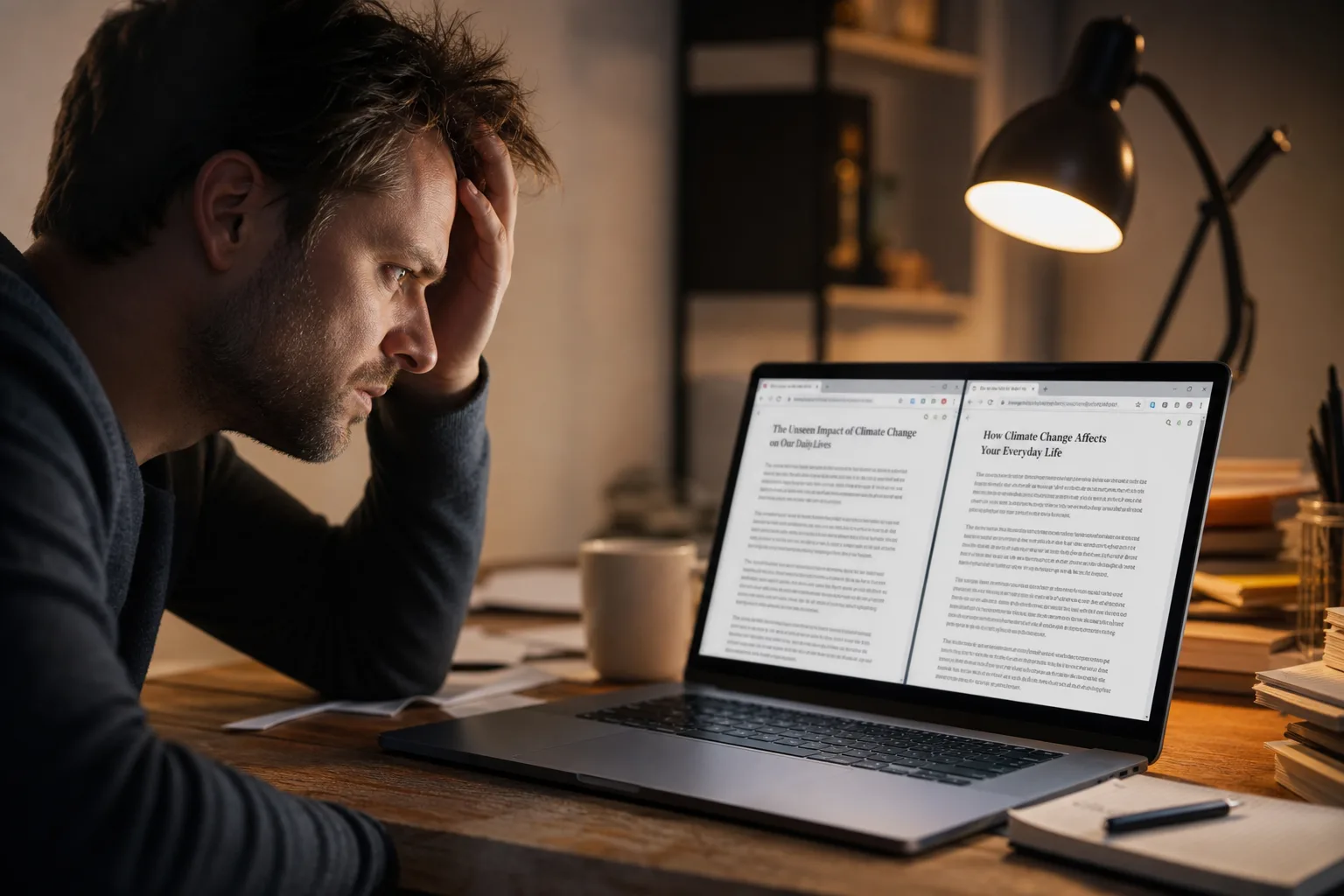
AI plagiarism is killing the open web, and one e-commerce tutorial writer found that out firsthand. He noticed something odd in a competitor’s article: it contained links back to his own website, complete with his exact anchor text. Someone had fed his work into ChatGPT, published the output under their own name, and — here’s the part that stings — that copycat page was ranking higher on Google than the original. The writer, Axel K, documented the experience bluntly: the competing site hadn’t even bothered to strip out the internal links that pointed back to his domain. That’s how he caught them.
It’s a small, specific story. But it illustrates something much bigger that the tech industry has largely been happy to talk around: the entire value proposition of large language models is built, at least in part, on content that was never offered up for this purpose.
How the AI Plagiarism Machine Actually Works
To understand why this matters, it helps to trace the chain. AI companies — OpenAI, Google DeepMind, Anthropic, Meta — train their models on vast datasets scraped from the public web. Common Crawl, one of the most widely used training corpora, contains petabytes of web content gathered without explicit permission from individual authors. GPT-4, Llama, Gemini — they’ve all ingested enormous quantities of text written by journalists, researchers, developers, educators, and hobbyists who had no idea their work would end up as training data.
The AI companies then sell access to those trained models. Businesses and individuals pay subscriptions or API fees to query systems whose intelligence was, in meaningful part, assembled from other people’s labour. A third layer then emerges: content farms and “AI tools bros,” as Axel K memorably calls them, who use these tools to mass-produce derivative articles, flood the web with them, and monetise the traffic. Original creators sit at the bottom of this chain, contributing everything and receiving nothing.
That’s not an accident of the technology. It’s a business model.
The Copyright Argument Is Messier Than Either Side Admits
The legal picture around AI plagiarism is genuinely complicated, and anyone who tells you it’s settled is selling something. In the US, the fair use doctrine has traditionally allowed for transformative uses of copyrighted material — which is why Google can cache web pages and why academic researchers can quote published works. AI companies lean hard on this, arguing that training a model is transformative rather than reproductive.
But that argument starts to crumble when you look at the outputs. When a model reproduces the structure, specific links, and even the internal anchor text of a source article — as happened to Axel K — it’s hard to characterise that as transformation. It’s closer to a photocopier with extra steps.
There are active lawsuits testing these boundaries. The New York Times sued OpenAI and Microsoft in late 2023, alleging that ChatGPT could reproduce Times articles nearly verbatim. Getty Images has sued Stability AI over image generation. The Authors Guild has filed complaints on behalf of novelists. Courts in the US and UK are wrestling with how existing intellectual property frameworks — written decades before anyone imagined this technology — apply to models trained on billions of documents simultaneously.
The honest answer is that current copyright law wasn’t built for AI plagiarism at this scale, and it’s going to take years of litigation and probably new legislation before there’s any clarity.
Google’s Role in Killing the Open Web Can’t Be Ignored
What makes Axel K’s story particularly galling isn’t just that someone copied his work. It’s that Google — whose search algorithm is supposed to surface quality, original content — rewarded the plagiarist with better rankings. This isn’t an isolated complaint. Since the widespread adoption of AI content generation tools in 2022 and 2023, there’s been a documented surge in low-quality, AI-generated pages cluttering search results.
Google has repeatedly insisted that it doesn’t penalise AI-generated content per se, only low-quality content regardless of how it’s produced. But that position feels increasingly difficult to defend when demonstrably plagiarised pages outrank the originals they were copied from. Google’s Helpful Content system and its various spam-fighting algorithms clearly aren’t catching everything — or even most of it.
There’s a dark irony here, too. Google’s own Gemini models are trained on web content. Google benefits commercially from AI tools. And Google’s search index is the primary distribution mechanism through which AI plagiarism reaches audiences and earns revenue. The company is simultaneously the victim, the enabler, and the referee. That’s a conflict of interest that deserves far more scrutiny than it’s received.
Why AI Plagiarism Is Killing the Open Web’s Information Ecosystem
Step back from any individual grievance and the systemic risk becomes clear. The web works — to the extent that it works — because people create original content expecting some return on that effort. That return might be direct, through advertising or subscriptions, or indirect, through reputation, career opportunities, or just the satisfaction of being the authoritative source on something.
AI plagiarism attacks that incentive structure at the root. If a well-researched, carefully written tutorial can be cloned in seconds by anyone with a ChatGPT subscription, then passed off as original and ranked above the source material, why would anyone invest the time to write the tutorial in the first place?
This isn’t hypothetical. Across niches from coding to cooking to personal finance, original creators are already reporting declining traffic and engagement as AI-generated derivative content floods the same search queries they’ve spent years optimising for.
The web feeds AI training data. AI degrades the web. That feedback loop, left unchecked, points toward a future where the training data for the next generation of models is increasingly composed of AI-generated content trained on previous AI-generated content — a kind of intellectual monoculture that researchers have already started calling model collapse.
What Needs to Happen — and Who Has to Move First
There’s no clean fix here, but there are levers that haven’t been pulled. Opt-out mechanisms like the proposed robots.txt extensions for AI crawlers are a start, but they’re voluntary and chronically under-enforced. What’s actually needed is some form of mandatory licensing framework — similar to how music streaming services pay royalties to rights holders — that would require AI companies to compensate creators whose work contributed to their training datasets.
That idea faces enormous resistance from the AI industry, which argues it would be technically impossible to attribute training value to individual documents at scale. Maybe. But that argument would carry more weight if the same companies weren’t simultaneously generating billions of dollars in revenue from models trained on those documents.
Search engines, meanwhile, need to do better — and faster. Google’s spam systems need to get significantly tougher on AI-generated content that can be shown to derive from identifiable source material. That’s a hard technical problem, but it’s not an unsolvable one, and the stakes are high enough that it warrants serious engineering investment rather than incremental tweaks.
The broader question is whether the tech industry will wait for courts and regulators to force its hand or get ahead of the problem voluntarily. Given the track record on data privacy, social media misinformation, and platform accountability, the smart money is probably on waiting for the lawsuit. The original creators paying that price in the meantime deserve better than that.