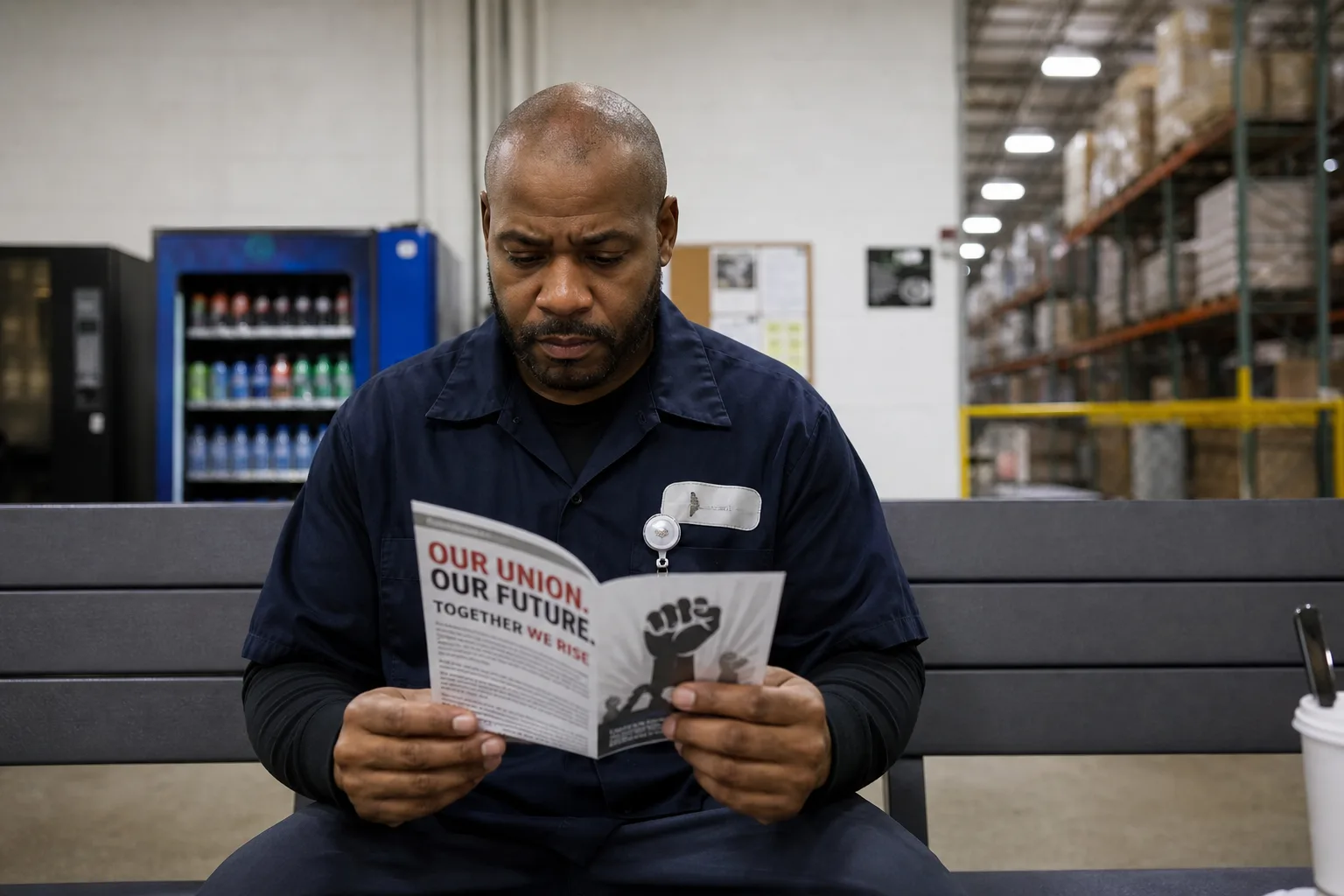
- US employers spend over $1.5 billion a year on union avoidance consultants, law firms, and legal services.
- Union avoidance spending by Amazon alone hit $26.6 million in 2025, according to federal labor filings.
- US union membership has collapsed from 20.3% in 1983 to just 10% today, despite broad public support.
- Workers still face an average of 465 days to reach a first contract, even after winning a union vote.
Table of Contents
Union Avoidance Is a $1.5 Billion Industry
American employers are spending more than $1.5 billion every year on union avoidance — a figure that, when you actually sit with it, is staggering. That’s not money going into wages, benefits, or training. It’s money spent specifically to prevent workers from collectively bargaining. A new report from the Economic Policy Institute puts hard numbers on what has long been an open secret in US labor relations: there is a well-funded, professionally organized infrastructure whose entire purpose is to stop unions before they start.
The EPI estimates that $442 million of that total goes directly to union avoidance consultants annually. These are specialists — often called “persuaders” in the legal filings that document them — hired to intervene when workers begin to organize. The remaining spend flows to law firms, litigation costs, and legal representation during union elections and organizing campaigns. Add it all together and you have an industry that rivals the GDP of small nations, built entirely around one goal: keeping labor organized labor out.
Amazon’s $26.6 Million Tab
The biggest individual spender in the EPI’s dataset is Amazon, which paid $26.6 million in 2025 on union avoidance consultants alone, based on filings with the US Department of Labor. That number is striking not just for its size but for what it represents strategically. Amazon employs around 1.5 million people in the US. The company has invested enormously in warehouse automation, last-mile logistics software, and fulfillment infrastructure. And yet it also maintains what amounts to a parallel operation dedicated to managing the human side of that workforce — specifically, managing it away from unions.
An Amazon spokesperson pushed back on the framing, telling reporters: “It’s important that our teammates and partners understand the truth, so we’ve continued to work with experts in the field who are able to share objective facts about what it actually means to have an external party take their voice.” The statement is worth reading carefully. Amazon frames union avoidance consultants as providers of “objective facts.” Critics would say that’s exactly the rhetorical sleight of hand these consultants are paid to deploy.
Starbucks is in a similar position. The coffee chain has faced sustained organizing since late 2021, when a Buffalo store became the first US Starbucks to vote union. As of mid-2026, Starbucks workers have still not reached a first contract — a delay that stretches across years, not months. Littler Mendelson, one of the country’s most prominent union avoidance law firms, has represented both Amazon and Starbucks, along with Delta Air Lines, in union campaigns.
The Firms Behind the Strategy
Littler Mendelson deserves particular attention because its role goes beyond courtrooms and bargaining tables. The firm operates its own Workplace Policy Institute, which functions as a policy lobbying arm — tracking and opposing legislation that would expand workers’ rights. The EPI report highlights Littler’s opposition to AB5 in California, a law designed to curb worker misclassification in the gig economy, and its support for Proposition 22, the ballot measure that allowed Uber, Lyft, and DoorDash to continue classifying drivers as independent contractors rather than employees.
That’s a significant expansion of the union avoidance playbook. It’s not just about winning or losing individual elections anymore. It’s about shaping the legal environment in which those elections take place. When a law firm can simultaneously represent clients in labor disputes and lobby against the rules governing those disputes, the line between legal service and political advocacy gets very blurry.
Margaret Poydock, a senior policy analyst at the EPI and co-author of the report, put it plainly: “These law firms and consultants are essentially exploiting loopholes and weaknesses in our federal labor law and reporting requirements for these persuaders reports, but despite that, workers are still organizing, they are still winning elections and reaching first contracts.”
What Union Avoidance Spending Actually Costs Workers
The financial argument against union avoidance spending is intuitive. As Poydock noted, “This is millions or even billions of dollars that’s not going towards workers and investing into their workplace.” But the costs are more concrete than that framing suggests. A previous EPI report found that employers are charged with violating labor law in 41.5% of all union elections. That’s not a marginal figure — it means that in nearly half of all organizing campaigns, workers face conduct that a federal agency has determined crosses a legal line.
Even when workers win, they often face a drawn-out battle to get to a first contract. The average time from a successful union election to a first contract is 465 days. In high-profile cases like Starbucks, it’s been years. During that window, employers can implement delay tactics, file appeals, and run out the clock on worker enthusiasm and momentum. The union avoidance industry didn’t invent these tactics, but it has professionalized and systematized them.
Teke Wiggin, strategic coordinator at LaborLab and co-author of the EPI report, framed it in terms of power: employers already hold enormous structural advantages over individual workers — control over schedules, promotions, references, and the threat of termination. Consultants and law firms, Wiggin argues, amplify that asymmetry further. “Employers always have the choice to voluntarily recognize a union or agree to a neutrality agreement,” he said. “If they don’t, that’s a choice to try to bend the will of workers who are seeking to exercise their rights to free association.”
The Gap Between Public Opinion and Union Membership
Here’s the contradiction at the heart of the US labor story: Americans broadly support unions. Gallup’s polling consistently shows approval rates near 70%. And yet union density — the share of workers who are actually union members — sits at just 10%, down from 20.3% in 1983. That’s not a failure of public sentiment. It’s a structural outcome. The EPI report argues that the union avoidance industry is a significant driver of that gap.
This matters for the tech industry in ways that aren’t always obvious. Tech companies have largely avoided the organized labor battles that define sectors like logistics, retail, and hospitality. But Amazon’s position as both a major tech employer and the biggest disclosed spender on union avoidance consultants blurs that distinction. The conditions that made organizing appealing in Amazon warehouses — physical demands, algorithmic monitoring, high injury rates — are increasingly present in other parts of the tech-adjacent workforce: data center operators, hardware assemblers, content moderators, gig platform workers.
Where This Goes Next
The EPI report lands at a politically charged moment. The National Labor Relations Board has faced significant budget pressure and staff cuts, raising questions about its capacity to investigate and prosecute the labor law violations that already occur in nearly half of all union elections. If the enforcement arm weakens, the union avoidance industry’s ability to operate with impunity only grows.
What’s notable is that workers are still organizing despite all of this. Election win rates have actually been relatively strong in recent years, even as the structural obstacles remain daunting. The question isn’t whether workers want representation — the polling and the organizing activity both suggest they do. The question is whether the legal and regulatory framework can keep pace with an industry that has spent decades learning exactly where the gaps are. At $1.5 billion a year, it’s not a fair fight — but it’s clearly not a finished one either.