

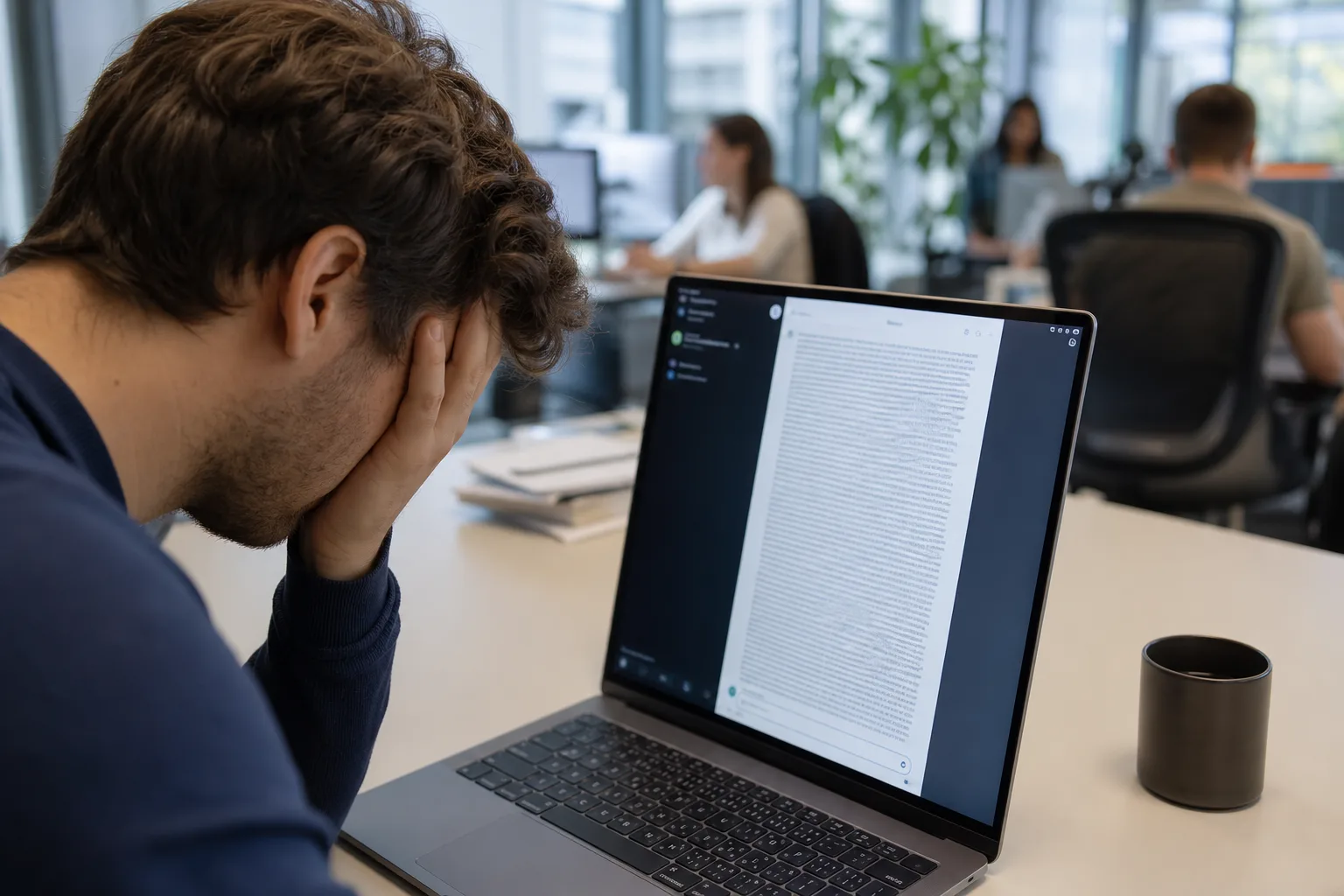
There is a new kind of rudeness spreading through workplaces, and most people have not named it yet. It arrives as a block of AI-generated text, copied wholesale from ChatGPT or Claude and dropped into a Slack message, an email reply, or a Teams thread. The sender may believe they are being helpful. The recipient often experiences the opposite.
This habit is quietly making digital communication worse. Not in some abstract, philosophical sense. In a very immediate, practical one: it wastes people’s time, kills conversation, and signals that the sender could not be bothered to actually think.
- AI-generated text dumped into chat destroys conversational norms and wastes the recipient’s time immediately.
- Pasting AI-generated text into a simple message is the digital equivalent of reading a manual to answer one question.
- People ask colleagues questions because they want human judgment — not a document an AI assembled in seconds.
- The real problem isn’t AI itself — it’s using it to replace thinking rather than sharpen it.
Table of Contents
The AI-Generated Text Problem Nobody Wants to Talk About
You have probably seen it. Someone asks a quick question in a group chat — “When does the trial period end?” or a similarly narrow request that should produce a short, useful answer. Instead, they receive several paragraphs of qualifications, generic background, a list of possible interpretations, and a politely worded ending that restates the question without resolving it.
The issue is not merely length. A long answer can be valuable when the subject is difficult, consequential, or genuinely uncertain. The issue is mismatch. Conversation has an economy: people use a chat message because they want a quick exchange, a relevant answer, or a person’s read on a situation. When one participant responds with a polished text wall, they shift the work back to the person who asked.
Now the recipient has to scan for the actual answer. They have to decide which parts are relevant. They may need to ask again because the AI-shaped response carefully covered every possibility except the practical decision at hand. What looked like assistance is often just unedited output transferred from one screen to another.
That is why pasting AI-generated text into a simple message feels like the digital equivalent of reading a manual to answer one question. A manual may contain the answer. It may even be accurate. But handing someone the manual instead of saying what they need to know is not the same as helping them.
Conversation is not a document-delivery system
Work chat has always had bad habits: reply-all emails, vague requests, messages that begin with “quick question” and become a project. AI text walls add a distinct problem because they mimic care without necessarily containing any. They have the shape of a considered response: headings, caveats, neutral language, tidy summaries. But that shape can conceal the absence of prioritisation.
A colleague does not need you to produce every plausible answer to a question. They need you to exercise judgment about which answer matters. If the information is uncertain, say that plainly. If there are two sensible paths, name them and explain which one you favour. If the question is simple, answer it simply.
That last point should not be controversial, yet it is where AI use most often goes wrong. Tools that can generate an instant document encourage people to treat every interaction as a prompt-and-output task. But a conversation is not a search query. It contains context that may never be written down: what the team has already tried, who is responsible, what deadline is looming, what kind of answer the person is really seeking.
People ask colleagues questions because they want human judgment — not a document an AI assembled in seconds. They may want confirmation from someone who understands the organisation. They may want a recommendation. They may want a concise answer from a person willing to own it. A generic response, however fluent, cannot automatically provide that.
The hidden cost is attention
The usual defense of an AI-generated reply is efficiency. The sender saved time, perhaps. But workplace communication is not efficient merely because one person typed fewer words. It is efficient when the group reaches clarity with the least unnecessary effort.
A pasted response frequently externalises the effort. The sender avoids reading, weighing, editing, and deciding. The recipient takes on those tasks instead. In a busy team, that trade is particularly irritating because it asks everyone else to spend attention on a message the sender did not spend attention preparing.
It also makes follow-up harder. A concise human answer invites a useful next question: “Does that apply to this case?” “Who should approve it?” “Can you send the link?” A sprawling AI response can shut that down. It feels finished even when it is not useful, and challenging it means untangling a text that nobody in the conversation may fully stand behind.
There is a trust problem here, too. When someone sends a polished explanation without indicating what they personally believe, know, or checked, recipients cannot tell where the judgment ends and generated filler begins. That uncertainty matters in ordinary work, not just high-stakes decisions. Teams function through small acts of reliability: people answering the question asked, admitting what they do not know, and distinguishing a useful lead from a settled answer.
Use AI before the message, not instead of it
None of this requires rejecting AI. The real problem is not AI itself; it is using it to replace thinking rather than sharpen it. A generated draft can help someone organise a messy idea, identify questions they have missed, or turn rough notes into clearer language. It can be useful as preparation.
But preparation is not communication. Before sending an AI-assisted reply, the person still needs to ask a few basic questions: What is the actual question? What does this person need from me right now? Which sentence contains the answer? What can I remove?
That editing step is where responsibility returns. It turns a generic output into a response with a point of view, a clear level of confidence, and a relationship to the actual conversation. Sometimes the right final message will be one sentence. Sometimes it will be a short explanation and a link. Sometimes the honest answer will be, “I’m not sure, but here’s what I found.”
Those responses may look less impressive than a perfectly formatted block of prose. They are usually more useful. Good communication has never been about producing the maximum possible amount of text. It is about respecting the other person’s time enough to do the thinking before you hit send.

