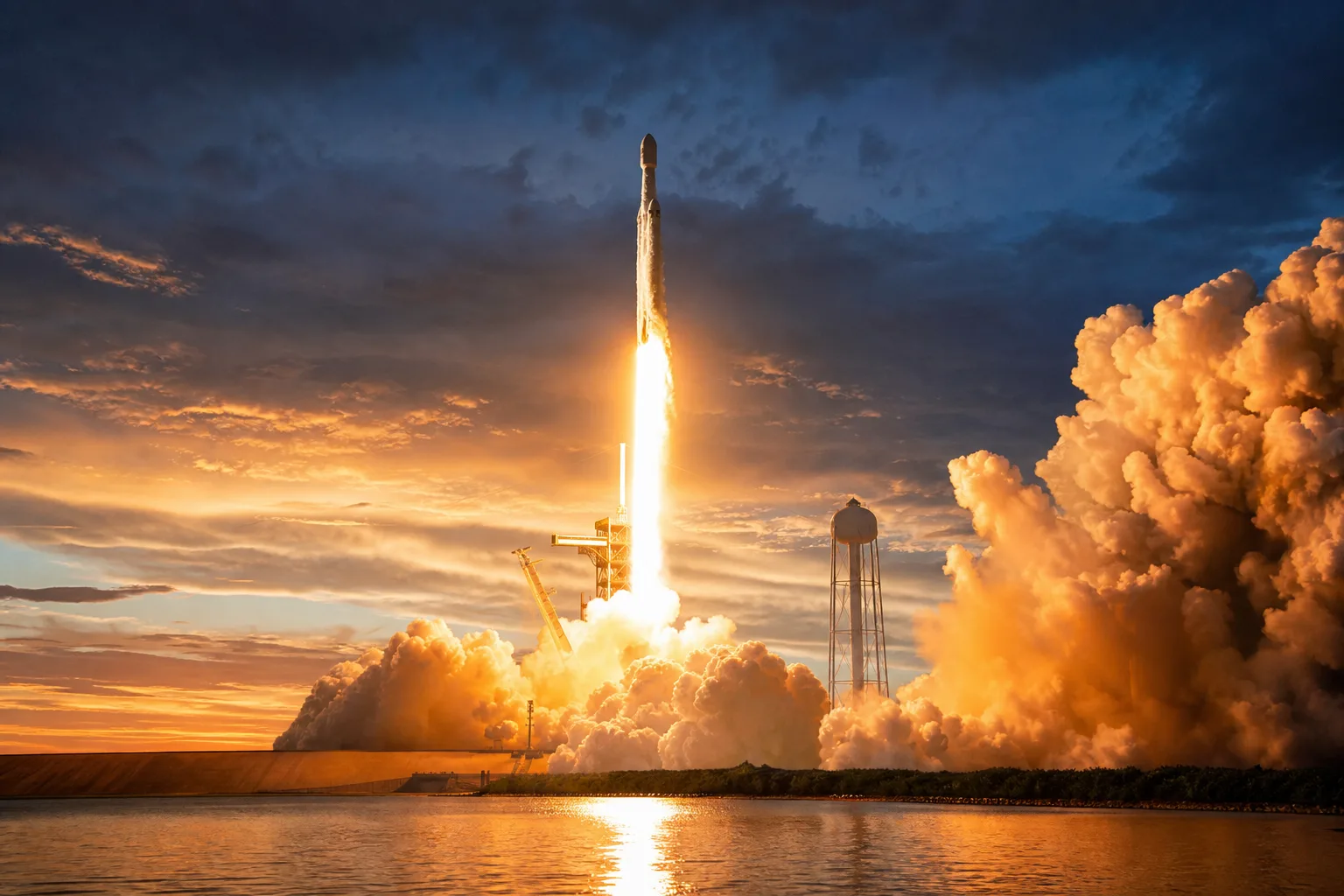
- The SpaceX Starship launch of the V3 prototype signals a new phase in the company’s push toward full reusability.
- This SpaceX Starship launch follows a scrubbed earlier attempt and represents one of the most closely watched rocket tests in years.
- NASA’s Artemis III mission depends heavily on Starship, making every test flight a high-stakes moment for lunar exploration.
- SpaceX is competing with a broader commercial space race, with companies like Vast already planning orbital stations.
Table of Contents
SpaceX Starship Launch Clears a Major Hurdle
The SpaceX Starship launch of its V3 prototype is the kind of moment the aerospace industry has been circling on its calendar for months. After a scrubbed attempt that sent engineers back to the drawing board — or at least back to the telemetry screens — SpaceX successfully put its most ambitious rocket through its paces in a test that carries consequences well beyond a single flight. This isn’t just a win for Elon Musk’s company. It’s a signal to every government space agency and private competitor watching from the sidelines that Starship is getting closer to the operational reality SpaceX has been promising for years.
Starship is, by almost any measure, the largest and most powerful rocket ever built. Standing taller than the Saturn V that carried Apollo astronauts to the moon, the fully stacked vehicle — Super Heavy booster plus Starship upper stage — produces roughly 16.7 million pounds of thrust at liftoff. That’s not a spec you bury in a footnote. It fundamentally changes what humanity can put into orbit, and more importantly, what it can send beyond it.
What the V3 Prototype Actually Means
Each iteration of Starship has taught SpaceX something new. The early test flights were spectacular, sometimes literally — the vehicle exploded more than once, each time generating equal parts horror and useful data. That’s not a bug in SpaceX’s methodology; it’s a feature. The company has always treated rapid, iterative testing as a faster path to reliability than designing for perfection in a vacuum.
The V3 prototype pushes that philosophy further. SpaceX has refined the Raptor engines, improved thermal protection systems for reentry, and made adjustments to the catch mechanism that allows the Super Heavy booster to be grabbed mid-air by the launch tower’s mechanical arms — a system SpaceX calls “Mechazilla.” That booster catch, demonstrated successfully in earlier flights, is central to the reusability economics that make Starship viable as a commercial platform. If you can catch the booster, refuel it, and relaunch it within hours rather than months, you’ve changed the math of spaceflight entirely.
This particular SpaceX Starship launch is being watched especially closely because the clock is ticking on several fronts simultaneously.
NASA’s Artemis III Hangs in the Balance
NASA selected Starship as the Human Landing System for Artemis III, the mission intended to return American astronauts to the lunar surface for the first time since Apollo 17 in 1972. That’s not a minor subcontract. Starship is the vehicle that’s supposed to take astronauts from lunar orbit down to the surface and back up again. Without a flight-proven, reliable Starship, Artemis III doesn’t happen on any schedule that NASA or its political backers can defend.
The Artemis program has already faced its share of delays and cost overruns. Artemis II — the crewed lunar flyby — only recently completed its mission, with the crew returning to Earth to considerable fanfare. NASA described the mission’s success as deliberate preparation rather than fortune, which is the kind of careful framing you’d expect from an agency that needs congressional support to stay funded. But Artemis III is a different beast. Landing on the moon requires a lander that works, repeatedly, in the harshest environment humans travel to. SpaceX has to prove Starship can do that.
Every successful SpaceX Starship launch, then, is also a NASA milestone — even if NASA’s name isn’t on the rocket.
The Commercial Space Race Is Accelerating
It’s easy to view the SpaceX Starship launch in isolation, as a single company’s engineering achievement. But the broader context makes it more interesting. The commercial space sector is moving faster than at any point in history. Vast, a startup backed by significant private capital, is actively developing what it calls the first commercial space station. Rocket Lab continues to expand its launch cadence. Blue Origin has finally gotten its New Glenn rocket off the ground after years of delays.
What SpaceX is doing with Starship sets a benchmark that everyone else has to respond to. If Starship delivers on its promise of dramatically lower cost-per-kilogram to orbit — SpaceX has suggested figures as low as $10 per kilogram at scale, compared to thousands of dollars per kilogram on legacy systems — it doesn’t just compete with existing rockets. It makes some of them economically obsolete.
That’s a pressure that incumbent players like United Launch Alliance and even Arianespace feel acutely. And it’s why international competitors, including China’s growing cadre of state-backed and private launch companies, are watching every SpaceX Starship launch with intense interest.
Reusability Is the Real Story
The technical achievement of a successful launch is real, but the deeper story is about reusability. SpaceX has already demonstrated that booster reusability works with Falcon 9 — the same booster has flown more than 20 times in some cases. Starship is designed to take that further, with both the booster and the upper stage intended for rapid reuse.
If SpaceX pulls that off at scale, the economics of space access shift in ways that are difficult to overstate. Satellite deployment becomes cheaper. Space station resupply becomes routine. And missions to the moon and eventually Mars stop being once-in-a-generation events and start looking more like ambitious but achievable infrastructure projects.
That’s the vision Musk has been selling for years. The gap between vision and reality has always been the question. Each successful SpaceX Starship launch closes that gap a little more — and the V3 prototype suggests the closure rate is accelerating.
What Comes Next
SpaceX hasn’t confirmed a precise timeline for the next Starship test flight, but the company’s cadence has been picking up. The goal is to reach a point where Starship launches are frequent enough to support NASA’s Artemis schedule, build out SpaceX’s own Starlink satellite constellation on a new scale, and eventually carry paying passengers — both private astronauts and, if Musk’s roadmap holds, crews bound for Mars.
The scrubbed V3 launch that preceded this success is a reminder that none of this is easy. Rockets are unforgiving machines operating at the edge of what materials science and engineering can currently achieve. A scrub is often better than a failure, and SpaceX’s willingness to stand down and fix problems before they become catastrophic failures is part of what makes its overall track record as strong as it is.
But standing down costs time, and time is the one resource NASA’s Artemis program doesn’t have in abundance. The next SpaceX Starship launch will be watched just as closely as this one — probably more so. The stakes are only going up from here.