

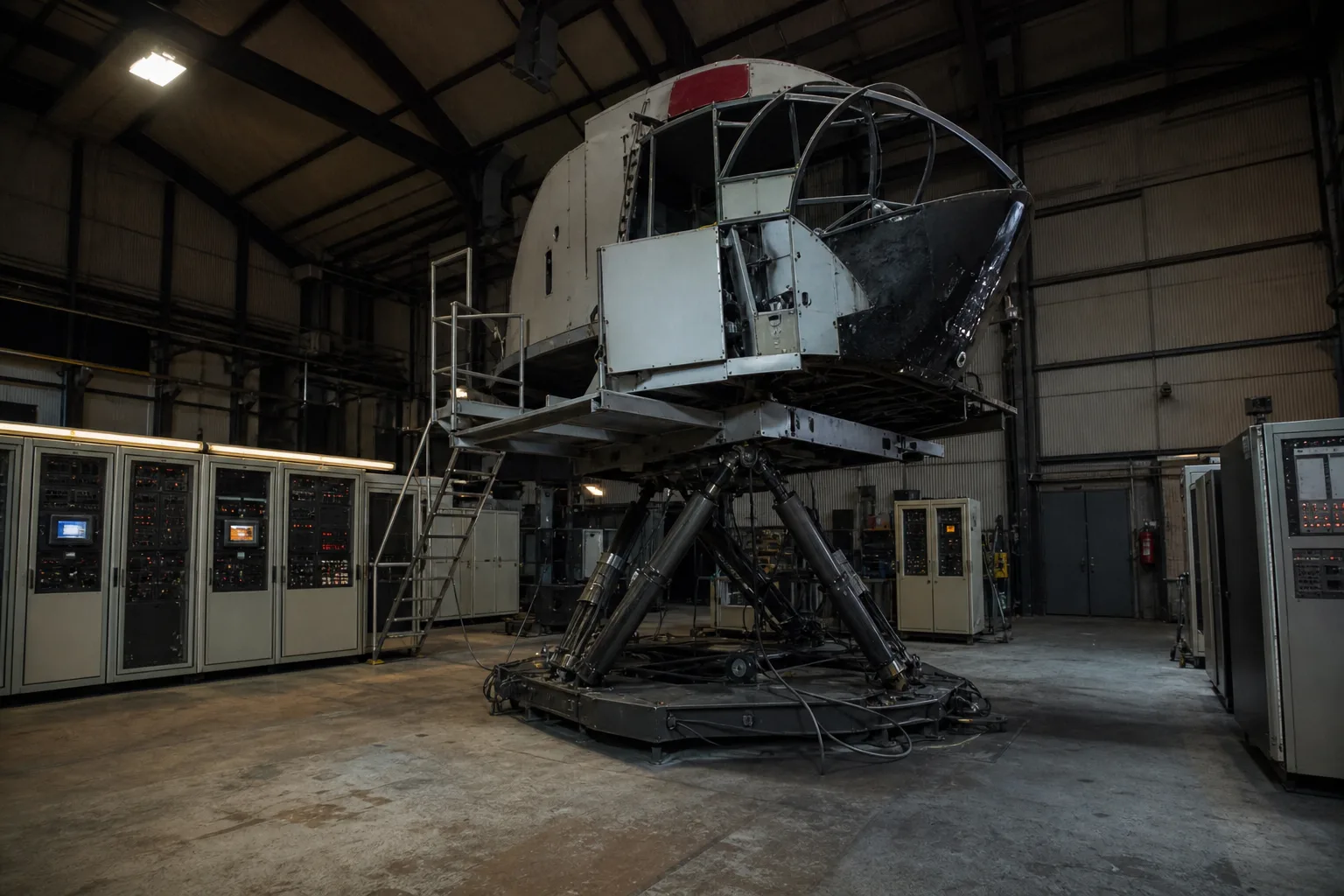
- Three full-motion flight simulators for sale at $20,000 each as Houston’s 1940 Air Terminal Museum closes its doors.
- The flight simulators for sale include Southwest Airlines’ very first 737-200 training rig, donated by the carrier itself.
- Buyers face serious logistical challenges — a forklift rated for at least 22,700 lbs is required to extract the simulators.
- The museum must vacate its hangar at Hobby Airport by end of June, making this a tight window for serious buyers.
Table of Contents
Flight Simulators for Sale at a Houston Museum — But Act Fast
If you’ve ever wanted to own a full-motion flight simulator — and let’s be honest, who hasn’t — there are three flight simulators for sale right now in Houston, Texas, each priced at $20,000. The catch? They’re sitting in a sealed hangar at William P. Hobby Airport, they haven’t been powered on in over a decade, and you’ll need an industrial-grade forklift just to get them out the door. Welcome to the liquidation of the 1940 Air Terminal Museum.
The museum, which operated out of one of America’s last surviving 1930s-era passenger terminals, is shutting down and has until the end of June to vacate its hangar space at 8323 Travelair Street. That’s created an unusual fire sale of aviation hardware that’s already caught the attention of the tech and aviation communities online.
What’s Actually Up for Grabs
The three flight simulators for sale are genuinely significant pieces of aviation training history. The headline item is Southwest Airlines’ first-ever Boeing 737-200 simulator, donated by Southwest itself. For context, the 737-200 was the variant that Southwest launched its entire operation with back in 1971 — it’s the aircraft that defined the airline’s low-cost model before the world caught on. Owning the simulator Southwest’s pilots trained on in those early years isn’t just a novelty; it’s a tangible piece of commercial aviation history.
The other two are a Beechcraft King Air 200 simulator and a Hawker 700 simulator, both donated by FlightSafety International — one of the world’s largest aviation training companies, now a Berkshire Hathaway subsidiary. FlightSafety did flag that some proprietary hardware or software was removed from its two units before donation, which is fairly standard practice for commercial training companies protecting their intellectual property. The museum says it doesn’t have further details on exactly what was stripped out.
Each simulator comes with its associated computer cabinets. The 737 setup is by far the most involved — the majority of the room it’s stored in is dedicated to it, including banks of blue cabinets, full manuals, a large hydraulic pump, and all associated piping on a separate frame. The King Air and Hawker each have a few cabinets to their name, but nothing close to the 737’s sprawl.
The Honest State of the Hardware
The museum is refreshingly upfront about what buyers are getting into. All three simulators were taken out of active service before being donated in 2010, and were reportedly functional at that point. Since then? Nothing. Nobody has connected them to power once.
The museum’s own assessment: “We are 99% sure that if you connect anything to power now, you’re sure to release the magic smoke.” That’s the kind of candor you don’t often see in a sale listing. Capacitors degrade, solder joints corrode, and proprietary hardware from the late 1980s and 1990s isn’t exactly well-supported by modern repair ecosystems. Anyone buying these flight simulators for sale needs to go in with eyes open — this is a restoration project, not a plug-and-play purchase.
The motion systems are another question mark. Even when the museum considered restoring the simulators, it decided against enabling motion due to space constraints. Full-motion platforms — typically six-axis hydraulic or electric systems — require significant floor clearance and structural considerations. Getting one of these actually moving again would be a serious engineering undertaking, not a weekend project.
The Logistics Are No Joke
Here’s where it gets complicated for anyone seriously eyeing these flight simulators for sale. The 737 simulator is physically blocking the other two. So even if you only want the King Air or the Hawker, you still have to arrange removal of the 737 first — and then put it back if you’re not buying it. That alone makes coordination between multiple buyers essentially mandatory.
The forklift situation is equally demanding. Photos from when the simulators were originally moved show a forklift marked “CAP22700LBS” straining to handle the 737. You’ll need something at least that capable, and Hobby Airport’s ramp access adds another layer — all vehicle movements require an escort onto the Airport Operations Area (AOA), which the museum says it will coordinate.
The museum has no transport capability of its own. Buyers handle everything: logistics, the forklift, removing a temporary wall section facing the ramp, and reinstalling it afterward. It’s an unusual set of conditions, but for the right buyer — a flight school, a simulator restoration enthusiast, a tech company building VR training tools — the terms aren’t unreasonable given the price point.
Why This Matters Beyond the Novelty
There’s a broader story here about the precarious state of aviation history preservation. Full-motion flight simulators are expensive to maintain, expensive to store, and they don’t exactly fit in a standard museum case. The 1940 Air Terminal Museum did something genuinely difficult by acquiring these machines and making them accessible to visitors — even if “accessible” meant walking a constructed ramp into the cockpit and making airplane noises, as the museum’s listing charmingly notes.
FlightSafety and Southwest both deserve credit for donating rather than scrapping the hardware. These machines would almost certainly have been destroyed otherwise. The commercial simulator industry cycles through hardware quickly — newer platforms with higher-fidelity visual systems and updated avionics databases replace older rigs constantly, and the economics rarely favor long-term storage. Opportunities to find full-motion flight simulators for sale at any price are genuinely rare, which makes this listing stand out.
The real question now is who buys them. At $20,000 per simulator, the price is low enough that a well-funded flight school or a private collector could genuinely absorb it. The restoration cost is the real unknown. Getting a 1980s-era simulator back to operational status — sourcing obsolete components, rebuilding hydraulic systems, reverse-engineering stripped proprietary software — could run into the hundreds of thousands of dollars. But the 737-200 sim in particular has historical cachet that might make that math work for the right institution.
How to Buy (If You’re Serious)
The museum is taking contact via email at info@1940airterminal.org or through its website contact form. Phone calls won’t be answered — the museum is closed and staff are checking messages intermittently. In-person inspections in the Houston area can be arranged, with a liability waiver required due to the museum’s lapsed insurance policy. Remote buyers can arrange a video call instead.
Payment is by check or wire transfer. Once cleared, logistics scheduling begins. All sales are final, no warranties, no guarantees — you’re buying hardware of unknown functional capacity, and the museum is explicit about that.
The end-of-June deadline is real. If these flight simulators for sale don’t find buyers before then, the museum will need to make harder decisions about what happens to them. Given how rarely full-motion flight simulators for sale from this era surface on the open market, that would be a genuine loss. Someone with the right combination of resources, storage space, and appetite for a restoration challenge should be making calls right now.

