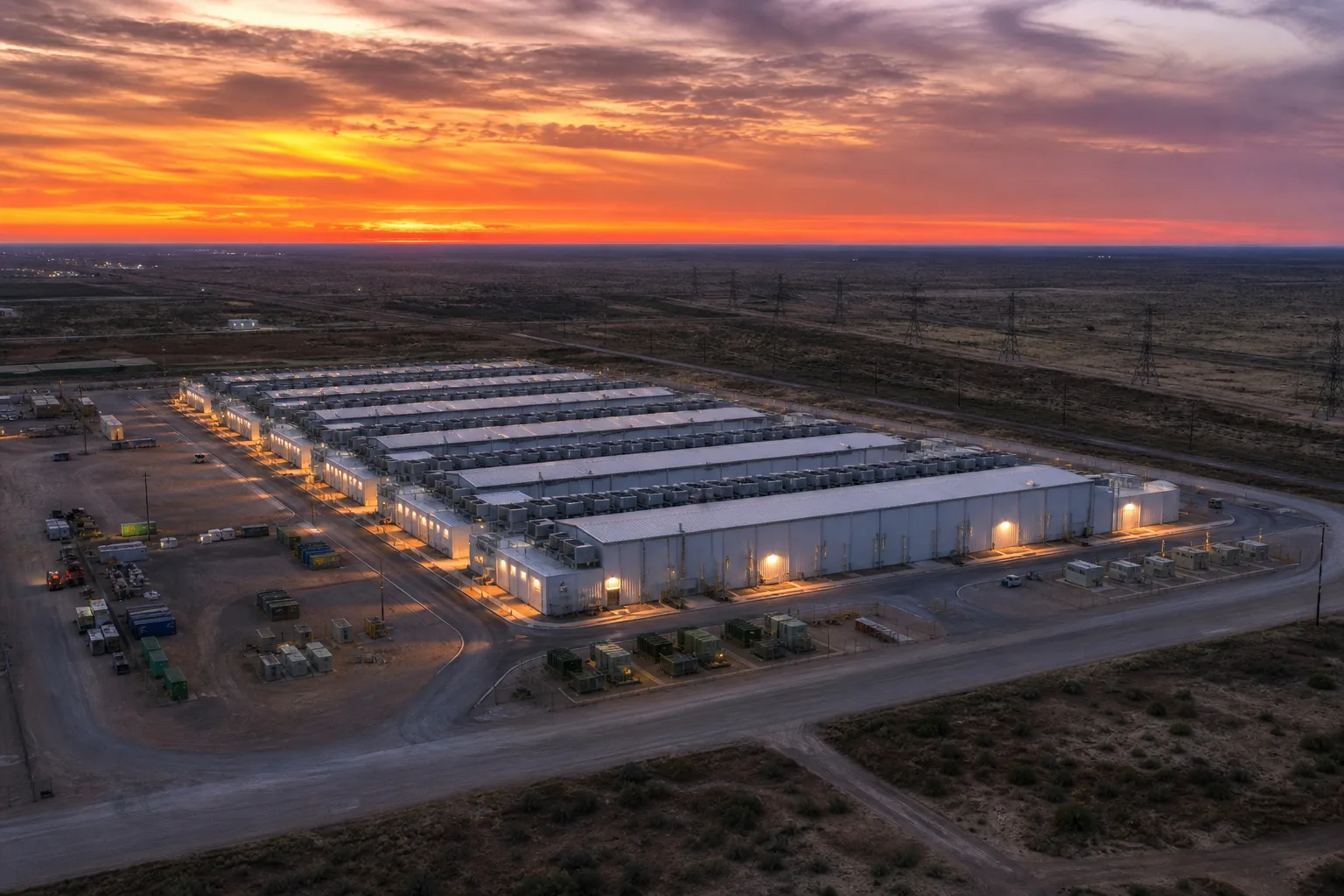
Galaxy Digital’s bitcoin mine to AI hub transformation at its Helios campus in West Texas has cleared its first major hurdle. The company has successfully delivered 133 MW of critical IT load to CoreWeave, completing Phase I of what is shaping up to be one of the more significant infrastructure pivots in the post-crypto-boom era.
- Galaxy’s bitcoin mine to AI hub conversion at Helios has completed Phase I, delivering 133 MW of critical IT load to CoreWeave.
- The bitcoin mine to AI hub transition reflects a broader industry shift as AI compute demand outpaces traditional crypto mining economics.
- CoreWeave, which recently went public, is expanding its GPU cloud infrastructure and the 133 MW Helios deal adds meaningful capacity.
- West Texas is emerging as a key battleground for AI data center development, driven by land availability, power access, and favorable conditions.
Table of Contents
From Bitcoin Mine to AI Hub: What Happened at Helios
The Helios facility, located in West Texas, was originally built as a large-scale bitcoin mining operation — the kind of energy-hungry, low-margin business that looked a lot more attractive when Bitcoin was trading near all-time highs. As mining economics tightened and AI compute demand exploded, Galaxy made the strategic call to repurpose the site entirely.
That decision has now produced its first concrete result. The 133 MW handed over to CoreWeave represents Phase I of the conversion, and it’s a meaningful number. To put it in context, a single modern AI training cluster for a large language model can consume anywhere from 10 MW to 50 MW depending on its GPU density. Handing over 133 MW in one phase isn’t a pilot programme — it’s a real deployment at real scale.
CoreWeave, which reportedly went public, has been aggressively locking in data center capacity to meet demand from a growing roster of AI customers. Adding 133 MW in West Texas fits squarely into that expansion strategy.
Why West Texas Makes Sense for AI Infrastructure
It might seem counterintuitive to build cutting-edge AI infrastructure in a remote corner of Texas, but there’s a logic to it that the industry has been acting on for years. Power is abundant, largely because the region sits on the ERCOT grid with significant wind energy generation nearby. Land is cheap. And crucially, the same characteristics that once made West Texas attractive for bitcoin mining — cheap, plentiful power with relatively lax zoning constraints — translate almost directly to AI data center requirements.
The bitcoin mine to AI hub conversion works here precisely because the underlying infrastructure is actually quite similar. Both workloads demand enormous amounts of electricity, high-density cooling, and reliable connectivity. The difference is in the economics: AI inference and training workloads can command significantly higher revenue per megawatt-hour than competitive bitcoin mining, especially in a post-halving environment where miner margins have compressed further.
West Texas is increasingly crowded with hyperscaler and AI cloud ambitions. Microsoft has committed to major data center investments in Texas, and the broader Lone Star State has become a genuine competitor to Virginia’s Northern Virginia corridor as the default home for large-scale compute in the US.
Galaxy’s Broader Strategic Shift
For Galaxy Digital, the Helios bitcoin mine to AI hub pivot is part of a wider repositioning. The company built its reputation primarily as a crypto-native financial services firm — trading, asset management, mining — but the push into AI infrastructure signals an intent to diversify revenue streams in a meaningful way.
That’s a smart move on the timing. The AI infrastructure buildout is in a phase where demand for GPU compute and the physical facilities to house it is outrunning supply. Hyperscalers are signing multi-year power purchase agreements, cloud providers like CoreWeave are racing to secure capacity, and anyone who already controls large blocks of grid-connected power — as bitcoin miners do — has an asset worth monetising differently.
Galaxy isn’t alone in making this bitcoin mine to AI hub calculation. Hive Digital rebranded from Hive Blockchain to explicitly signal its HPC ambitions. Iris Energy has been converting mining capacity to AI workloads in Australia and North America. Applied Digital is building dedicated AI cloud campuses. The pattern is consistent enough that it’s no longer a novel pivot — it’s becoming the standard playbook for well-capitalised miners with access to power.
CoreWeave’s Infrastructure Hunger
On the other side of this deal, CoreWeave’s appetite for capacity is genuinely remarkable. The company went from a niche Ethereum mining operation to one of the most talked-about GPU cloud providers in the span of a few years, riding the wave of demand from AI developers who couldn’t get enough Nvidia H100 and H200 time from the hyperscalers.
Its IPO was one of the most closely watched tech listings of 2025, in part because it offered a rare public window into the economics of AI infrastructure. The company’s revenue growth has been extraordinary, but so has its capital expenditure. Taking on 133 MW at Helios — a ready-made bitcoin mine to AI hub conversion — rather than building greenfield is exactly the kind of move that helps CoreWeave scale faster than a ground-up construction timeline would allow.
There’s also a strategic benefit in geographic diversification. Concentrating AI compute in a single region creates risk — whether from grid instability, natural disaster, or regulatory pressure. A West Texas footprint complements whatever capacity CoreWeave has in other markets.
What Phase II Looks Like
The completion of Phase I leaves an obvious question hanging: what comes next at Helios? The framing of this delivery as a phase strongly implies further capacity is in the pipeline, and the original Helios campus was designed with significant total power in mind across all development phases.
If Galaxy can execute subsequent phases of its bitcoin mine to AI hub programme at the same pace, it could become one of the larger AI infrastructure landlords in the country within the next two to three years. That’s a remarkable trajectory for a facility that was, not long ago, burning power to mint bitcoin.
The broader implication is that the bitcoin mine to AI hub shift is blurring the line between crypto infrastructure and AI infrastructure in ways that would have seemed far-fetched even two years ago. Power assets built for one compute-intensive workload are proving readily adaptable to another. That flexibility is turning former mining operators into unlikely players in the AI infrastructure stack — and deals like the one at Helios suggest the trend still has a long way to run.