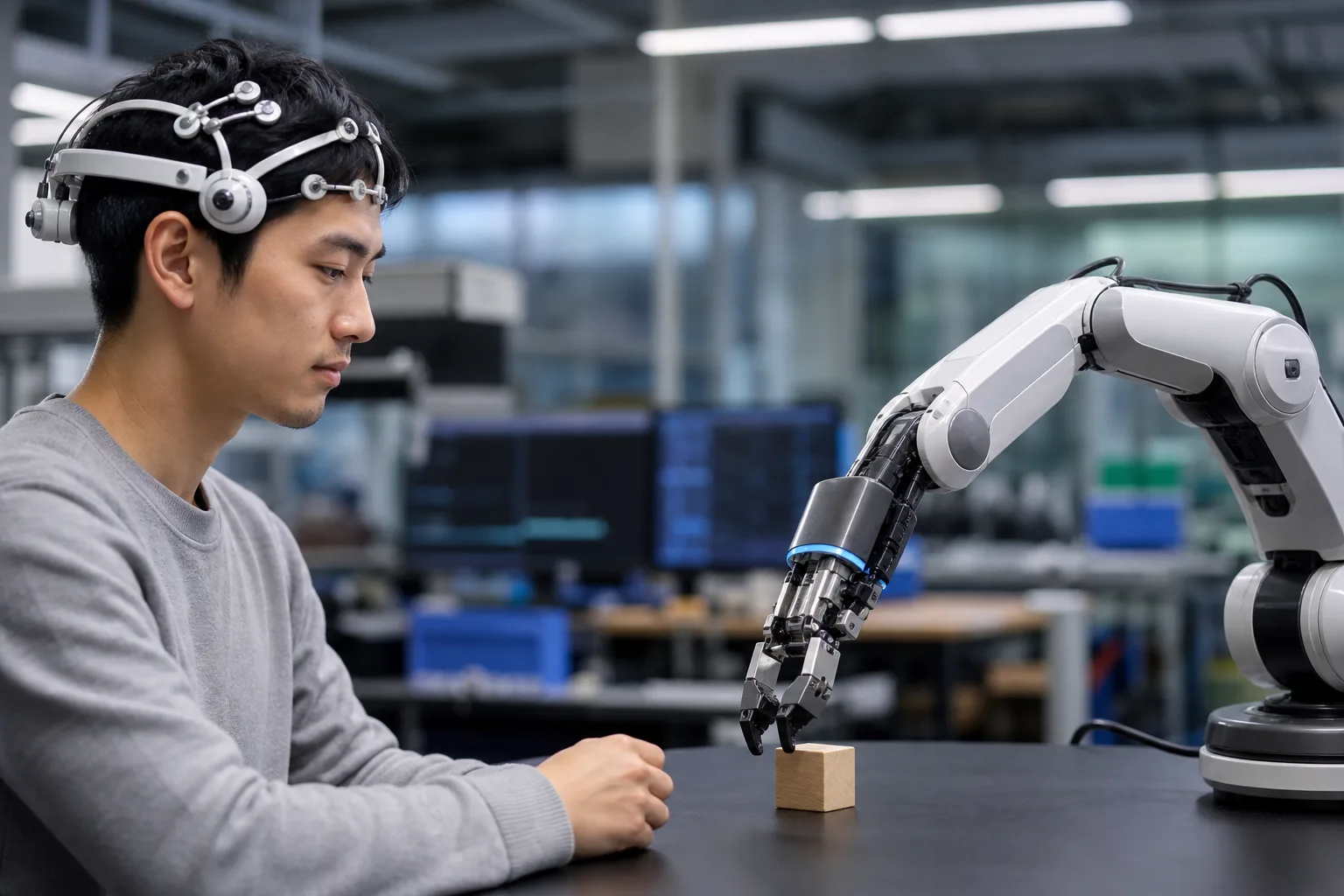
- The reported brain-to-robot platform aims to translate neural activity into commands for physical machines without conventional handheld controls.
- A brain-to-robot platform could matter most in assistive technology, where hands-free control may offer people with disabilities greater independence.
- The announcement leaves major questions about accuracy, training time, safety systems, and whether the technology works outside controlled demonstrations.
- China is joining a crowded global race that includes Neuralink, Synchron, university labs, and robotics companies pursuing practical brain-computer interfaces.
Table of Contents
The brain-to-robot platform claim needs a closer look
Controlling a robot by thought sounds like the sort of promise technology companies have been making since science-fiction became a business plan. But a newly reported brain-to-robot platform from a Chinese startup is still worth watching, because the underlying idea has moved well beyond laboratory curiosity.
The company says its system can translate a user’s brain activity into commands for a robot, creating a direct route from intention to machine movement. In plain English: instead of reaching for a joystick, keyboard, touchscreen or voice assistant, a person concentrates on an intended action and software attempts to interpret that signal.
That framing matters. The phrase “mind control” tends to produce an instant eye-roll, and rightly so. Today’s brain-computer interfaces do not read a person’s private thoughts like an open book. They look for measurable patterns associated with trained, deliberate tasks: imagining a hand movement, focusing on a target, selecting a direction, or making a familiar mental command. Think less telepathy and more like learning to operate a very odd, invisible keyboard.
Still, a credible brain-to-robot platform could become genuinely useful. For people with paralysis or severe mobility limitations, even a small set of dependable commands could control a robotic arm, a service robot, a wheelchair interface, or parts of a smart home. That’s the practical prize here, not a party trick involving a robot fetching a bottle of water.
How brain signals become robot commands
Most systems in this category rely on a brain-computer interface, or BCI. A non-invasive version usually uses an EEG headset that places electrodes against the scalp. Those sensors record tiny electrical fluctuations generated by groups of neurons. Software then filters out noise, searches for a trained signal pattern, and maps that pattern to an instruction.
There are also implanted BCIs, where electrodes sit closer to the brain and can often capture more detailed signals. That approach has produced some remarkable research results, including systems that let participants move cursors, type, or communicate after paralysis. But surgery changes the risk calculation dramatically, which is why non-invasive approaches remain attractive for consumer and rehabilitation use.
The trade-off is brutal: scalp-based EEG signals are faint, messy, and easily disrupted by blinking, facial muscles, poor sensor contact, electrical interference, and simple fatigue. A user may be able to select between a few commands in a carefully calibrated demonstration, yet struggle with the same task after an hour of use in a noisy room. That gap between a demo and a dependable product is where many ambitious BCI projects go to die.
A brain-to-robot platform must also solve the robotics half of the problem. A robot is not a cursor on a monitor. It occupies physical space, may carry objects, and can hurt someone or damage property when a command is misunderstood. Sensible systems need confirmation steps, collision detection, speed limits, emergency stops, and enough autonomy to handle the little corrections humans normally make without thinking.
Frankly, the safest version of this technology may not be one where the user mentally pilots every millimeter of a robotic arm. It may be a shared-control model: the person chooses “pick up the cup,” while the robot’s vision and motion software handles grip angle, route planning, and obstacle avoidance. The human supplies intent; the machine handles the tedious precision.
Why the brain-to-robot platform race is heating up
China’s reported effort arrives during a wider surge of interest in neural interfaces. Elon Musk’s Neuralink has drawn the most headlines with its surgically implanted device, while Synchron has pursued an implant delivered through blood vessels. Academic teams have spent decades refining speech decoding, cursor control, prosthetics, and neurorehabilitation tools.
The research foundation is real. Other studies have demonstrated robotic limb control and communication interfaces. The exciting part is no longer whether neural signals can be translated into useful computer output. They can.
What remains unresolved is whether the technology can become affordable, repeatable, and safe for far more than a handful of highly supported participants. An brain-to-robot platform has to work for people with different brain signals, different hair and skin conditions, different levels of concentration, and different needs. It also has to be practical enough that users do not spend twenty minutes adjusting a cap before asking a robot to turn on a lamp.
Chinese companies and research institutions have strong incentives to compete here. The country has invested heavily in robotics, manufacturing automation, AI, and medical technology. Brain-computer interfaces sit at the intersection of all four. A domestic brain-to-robot platform that can connect to locally made service robots or industrial machines could eventually have commercial as well as clinical appeal.
But “eventually” is doing a lot of work in that sentence. Remember the broader robotics industry’s habit of showing smooth autonomous demos and then discovering that real kitchens, warehouses, and homes are full of inconvenient surprises? Neural interfaces add another unpredictable layer: the human brain.
The unanswered questions are the whole story
The announcement is intriguing, but it does not by itself establish that this is the world’s first system of its kind. Researchers have demonstrated thought-controlled robot and prosthetic control in multiple forms for years. Claims of being first often depend on a carefully selected definition: first commercial product, first particular sensor arrangement, first local deployment, or first integration with a named robot model.
My read is that the meaningful questions are more mundane and much more important. What kind of sensor does the brain-to-robot platform use? How many commands can it distinguish? What accuracy rate does it achieve, over how many users and sessions? How long does training take? Does it retain performance over days or weeks? What happens when the system is uncertain?
There is also a privacy issue that the industry cannot hand-wave away. Brain data is not magic, but it is deeply personal biological data. Companies handling neural recordings should be explicit about what they collect, how long they retain it, whether it is used to train models, and whether users can delete it. We have already watched consumer tech firms treat location data, voice recordings, and health metrics as tempting inventory. Neural data deserves stricter instincts from day one.
Regulators will have to distinguish between a wellness gadget, a communications aid, a medical device, and a machine-control system. Those categories bring different standards for safety, clinical evidence, cybersecurity, and liability. If a robot receives the wrong command because an EEG classifier misfires, who is responsible: the user, the device maker, the software provider, or the operator supervising the robot?
The useful future is likely less flashy
The most believable path for a brain-to-robot platform is not a general-purpose household android obeying every passing thought. It is a focused tool built around a constrained job. A rehabilitation clinic could use one to help a patient practice intentional movement. A person with limited mobility might operate a robotic feeding aid or select preset actions from a bedside system. A factory worker could potentially issue a hands-free command where gloves, noise, or physical constraints make normal controls awkward.
Those are smaller ambitions than the movie version, but they are also where technology earns trust. If this Chinese startup can show independent testing, clear safety design, and consistent results with ordinary users rather than a polished one-off demonstration, it will have something substantial.
The headline may be thought-controlled robots. The real contest is whether anyone can make that control boringly reliable. That is a far harder achievement — and the one that would actually matter.