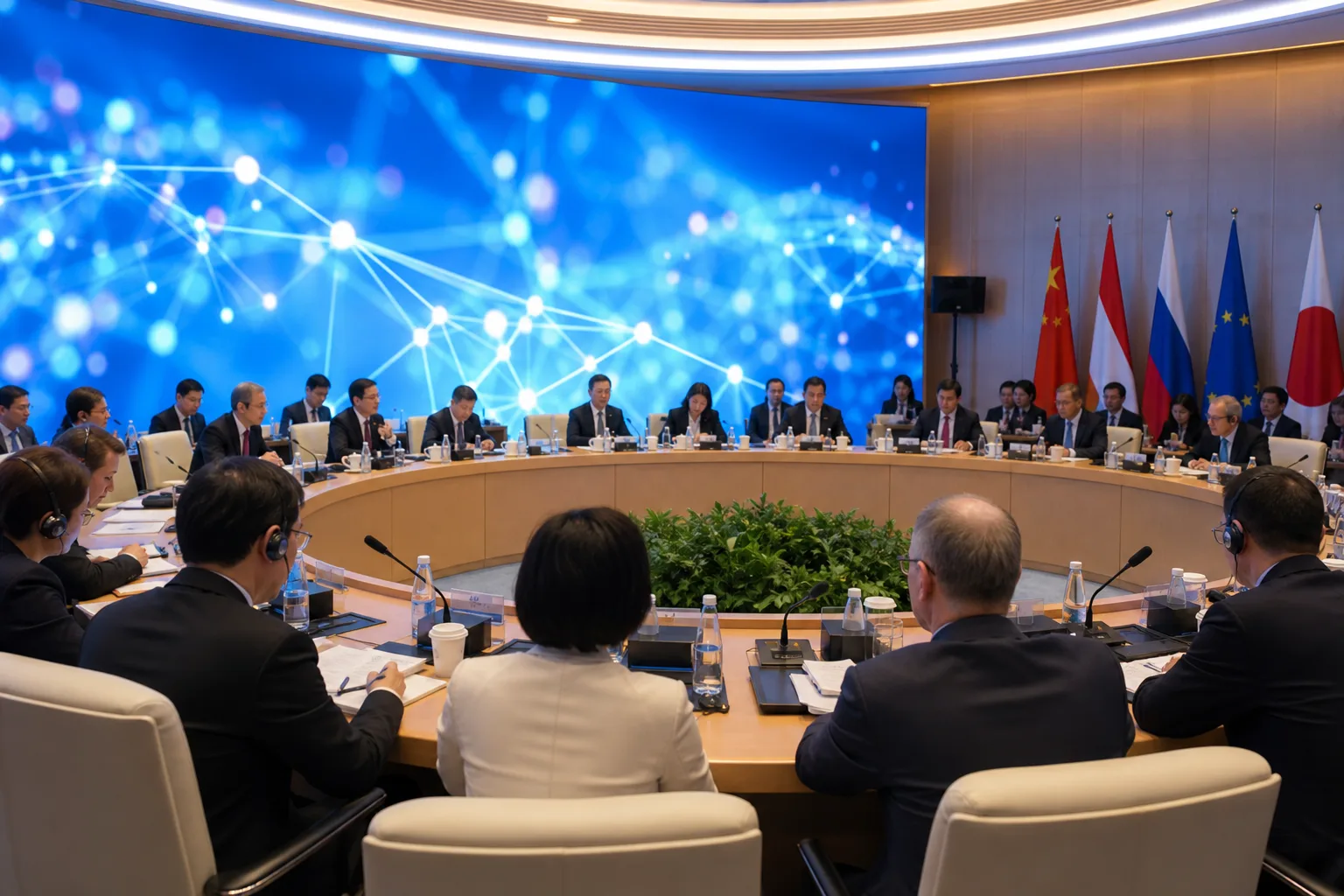
Another international meeting has produced another statement on global AI governance. That may sound like diplomatic wallpaper, but it matters because artificial intelligence has become the rare technology race where the rules are being argued over while the products are already shipping.
The chair’s statement from the 2026 World Artificial Intelligence Conference and High-Level Meeting on Global AI Governance, published through China Daily, tells us where Beijing wants to sit in that argument: not on the sidelines, and not merely as a market regulated by standards drafted in Brussels or Washington.
My read is that this is less about one conference document than about a growing struggle to decide who gets to define acceptable AI behavior across borders. The industry has spent years treating governance as a panel-discussion topic. It is now tied directly to trade, national security, cloud access, chips, public-sector procurement and the simple question of which companies can sell models internationally.
- The 2026 WAIC chair’s statement puts global AI governance back at the center of a rapidly fragmenting technology policy debate.
- Global AI governance needs enforceable standards, not another collection of broad principles that companies and governments can interpret differently.
- China’s role in AI rules is becoming inseparable from the wider competition over chips, cloud infrastructure, model access and data.
- The real measure of the meeting will be whether its commitments influence product development, procurement rules and cross-border AI cooperation.
Table of Contents
Global AI governance has moved from theory to infrastructure
For a while, AI policy could feel abstract. There were papers about safety, principles about fairness and earnest calls for transparency. Then generative AI reached hundreds of millions of people, governments began deploying automated systems, and powerful models became intertwined with a small club of firms that control advanced chips and hyperscale computing.
That changes the stakes of global AI governance. A country that shapes model-evaluation rules, incident-reporting requirements or standards for synthetic media is also shaping the commercial conditions under which AI companies operate. Regulation is not separate from industrial policy anymore. It is part of the machinery.
The World Artificial Intelligence Conference, generally known as WAIC, has become one of China’s biggest annual stages for making that case. The Shanghai event brings together officials, researchers and companies at a moment when Chinese AI firms are pushing hard to prove they can compete despite US export controls on advanced semiconductors.
China is hardly alone in treating AI rules as a strategic asset. The European Union has the AI Act. The US has favored a looser mix of executive action, agency enforcement and voluntary commitments, although that approach can shift sharply with a new administration. The United Kingdom has tried to position itself as a convening power on AI safety. Each approach carries a different political instinct about risk, markets and state control.
A high-level statement earns its keep only if it can help bridge those systems. The trouble is that bridges are easy to announce and very hard to build.
The problem with global AI governance statements
Chair’s statements and declarations are not treaties. They usually do not create a regulator, impose penalties or settle a dispute between governments. They can establish shared language, signal political priorities and give later negotiations a starting point. That is real value. But the technology sector has seen this movie before.
Companies endorse voluntary AI principles, then release features at a pace that makes external review feel optional. Governments call for international cooperation, then restrict exports, screen investment and require domestic control over sensitive data. Nobody should pretend those choices are irrational; AI has genuine military, economic and surveillance implications. Still, they expose the central contradiction in global AI governance: everyone wants common guardrails, right up until those guardrails constrain their own strategic advantage.
There are concrete areas where cooperation could move beyond slogans. Shared protocols for reporting serious model failures would help. So would common methods for testing whether a system can assist with cyberattacks or dangerous biological work. Provenance standards for AI-generated images, audio and video are another practical target, particularly as election misinformation becomes cheap to make and difficult to trace.
The US National Institute of Standards and Technology’s AI Risk Management Framework offers one example of the kind of vocabulary that can travel across institutions: identify risks, measure them, manage them and document the process. It is not a universal answer, and it was designed in a US context, but technical methods are more likely to travel than grand political declarations.
That is the uncomfortable part. Real global AI governance may end up being built through testing standards, audit practices and procurement checklists rather than a single glamorous international agreement. Less dramatic, perhaps. Much more likely to affect the software people actually use.
China wants a seat at the standards table
Beijing has already developed a substantial domestic AI regulatory framework, including rules covering recommendation algorithms, deep synthesis technology and generative AI services. Those rules reflect China’s own priorities: content controls, security reviews, accountability for platforms and state oversight of data-intensive systems.
Critics will reasonably point out that these priorities do not map neatly onto Western ideas about speech and individual rights. That disagreement cannot be waved away by a conference statement. A framework for global AI governance that avoids questions of censorship, surveillance and due process would be incomplete at best.
But excluding China from the conversation would be fantasy. Its companies build major models, its manufacturers supply enormous volumes of AI hardware, and its researchers contribute to the field at global scale. Any standard meant to govern cross-border AI deployment has to engage with China, even when that engagement is difficult and politically awkward.
There is a second, more commercial reason China cares about standards. Chinese AI firms need routes into overseas markets. If global conformity assessments are written around US or EU assumptions without Chinese input, those assessments can become another barrier to entry. Standards bodies may sound sleepy, but they are often where future market access is quietly decided.
What would count as progress after WAIC 2026?
The test is not whether delegates endorse responsible development. Every serious actor already says it supports that. The test is whether this latest push for global AI governance produces work that can be inspected six months from now.
Look for named institutions, published technical benchmarks, a timetable for follow-up meetings and commitments to share safety research. Watch whether governments can agree on a minimum threshold for notifying others about major AI incidents. And pay attention to whether smaller countries get a genuine role, rather than being handed standards created by the US, China and Europe after the real decisions have been made.
There is also an industry question. Will the biggest model developers accept independent testing that reveals uncomfortable weaknesses? They have every incentive to frame safety as a competitive differentiator, yet far less incentive to reveal security flaws or risky capabilities before a rival does. This is where voluntary pledges tend to hit the wall.
The 2026 WAIC chair’s statement will not settle those conflicts. Frankly, no single meeting could. But it reflects a reality the AI industry can no longer dodge: the era of building first and negotiating consequences later is ending. Whether global AI governance becomes a workable system or a pile of incompatible national rulebooks now depends on what governments and companies do when the conference lights are off.