

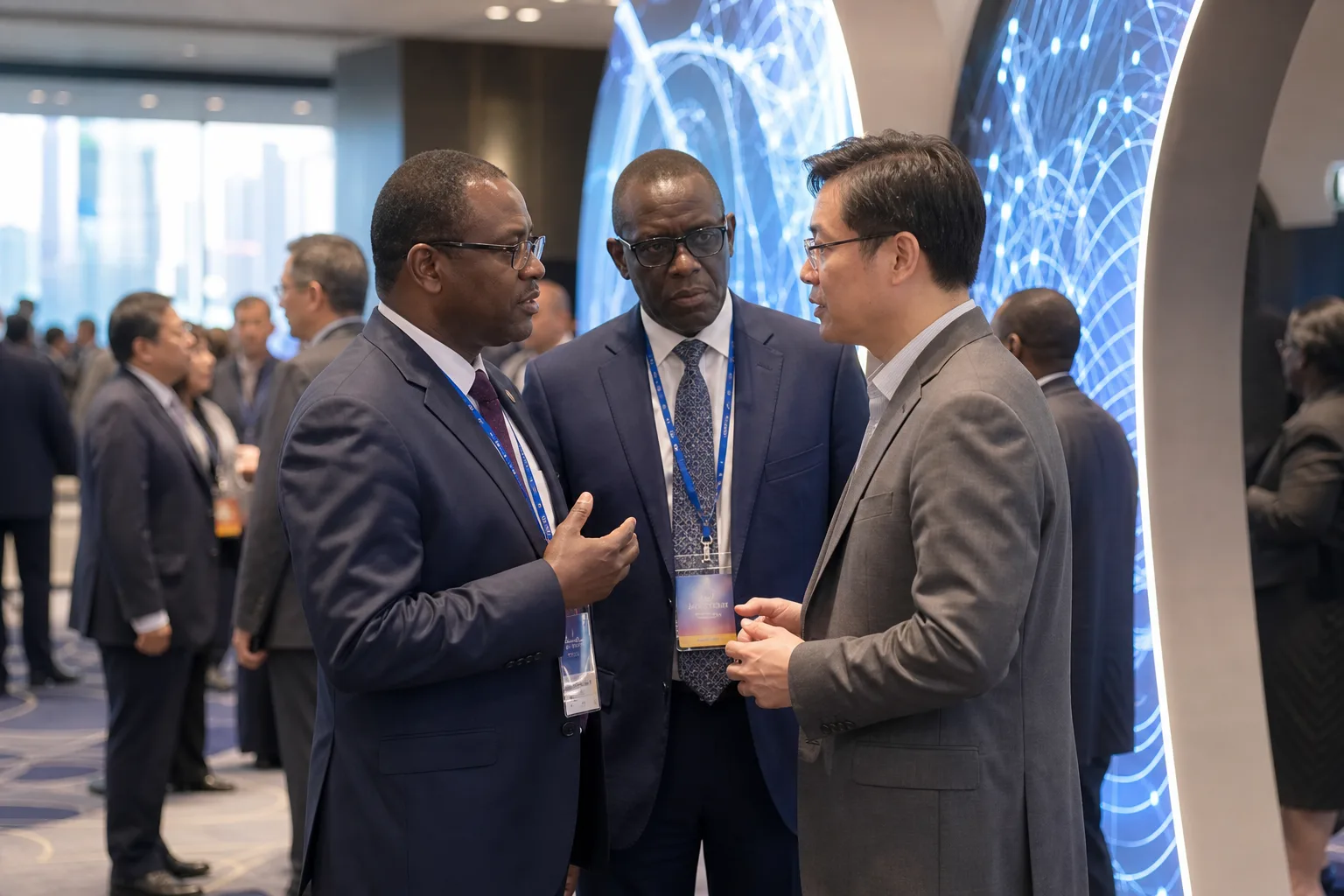
- The Shanghai AI Conference gives African ICT ministers a direct forum to press for infrastructure, skills and fairer AI partnerships.
- At the Shanghai AI Conference, Africa’s policy challenge is turning diplomatic visibility into local compute capacity and usable public services.
- China’s AI ambitions make Shanghai a consequential venue for governments seeking alternatives to technology dependence on US and European firms.
- African governments must balance rapid AI adoption with data protection, public accountability and long-term control over critical digital systems.
Table of Contents
Shanghai AI Conference brings Africa into the room
Artificial intelligence diplomacy can sound painfully abstract until you ask who owns the servers, trains the workers and writes the rules. That is why the reported participation of African ICT ministers at the Shanghai AI Conference matters. The gathering, associated with Shanghai’s World Artificial Intelligence Conference, puts officials responsible for national connectivity and technology policy alongside the companies and governments shaping the AI supply chain.
The headline is easy enough: African ministers are joining global leaders in Shanghai. But the more interesting story is what they need from the room. AI has become a race for computing power, data, chips, energy and skilled people. Most African countries have some version of an AI ambition on paper; far fewer have the cloud capacity, reliable electricity, high-speed networks or domestic research budgets needed to turn that ambition into an everyday reality.
That gap doesn’t mean Africa is a passive market. Far from it. Mobile money, digital public services and a young, fast-growing population have made the continent an unusually important testing ground for technology that has to work under real constraints. Patchy connectivity, multiple languages, limited access to formal financial records and uneven public infrastructure are not edge cases there. They are the operating environment.
My read is that African representation at a major Chinese AI event is less about ceremony than bargaining power. Ministers have a chance to ask hard questions about financing, deployment terms, data access and local capability. Whether those questions get credible answers is another matter.
What African ICT ministers need from the Shanghai AI Conference
The most obvious agenda item is infrastructure. Generative AI is not a lightweight app economy. Training and running advanced models requires vast data centres, expensive accelerators and dependable power. Even when governments use externally hosted models rather than build their own, they are still paying someone else for the underlying compute.
That puts digital sovereignty back on the table. A health ministry using an AI system to triage patients, or a revenue agency using one to detect fraud, cannot casually ignore where the data sits, how long it is retained or whether a foreign vendor can change the price. Those are procurement questions, yes, but they are also questions of state capacity.
The Shanghai AI Conference is particularly relevant because China is trying to position itself as a full-stack technology partner: telecom networks, cloud services, hardware, smart-city systems and AI tools. Huawei, Alibaba Cloud, Baidu and a growing group of Chinese AI firms have reasons to pursue international markets as competition and regulation intensify at home. African governments, meanwhile, have reasons not to let a handful of US hyperscalers dictate the terms of their digital futures.
Competition can help. It may produce lower prices, more flexible partnerships and more pressure to build local facilities rather than merely sell imported software. But diversification is not the same thing as independence. Replacing one foreign dependency with another is still dependency, just with different logos on the invoice.
Ministers attending the Shanghai AI Conference should be pushing for practical commitments: local data-centre investment where feasible, regional cloud availability, scholarships and research partnerships, support for African-language datasets, transparent security reviews and contracts that do not lock public institutions into a single provider for a decade. The flashy demo is the easy part. The boring contract details are where national interests tend to disappear.
AI policy cannot be imported wholesale
The stage tends to make one governance problem disappear: AI regulation is moving at very different speeds across the world. The European Union has adopted its AI Act. The United States has relied more heavily on executive action, agency rules and state-level legislation. China has developed rules around recommendation algorithms, deep synthesis and generative AI services, alongside tighter state control of information.
African governments should study all of these approaches without copying any of them wholesale. The continent contains countries with different legal systems, languages, economies and institutional capacity. A regulatory template written for Brussels, Beijing or Silicon Valley will not automatically fit Kampala, Kigali, Accra or Johannesburg.
The bigger risk is that governments rush to deploy systems in high-stakes public services before they have the capacity to audit them. Automated decision-making can reinforce old exclusions with impressive new vocabulary. If a credit-scoring model has little meaningful data on informal workers, it may penalise precisely the people it claims to bring into the financial system. If a public-sector chatbot cannot handle local languages well, it will serve the already-connected first and everyone else second.
The Shanghai AI Conference therefore has value as a place to compare policy approaches, but it should not become a showroom where governments buy technology because it looks modern. Remember the smart-city boom? Plenty of cities bought sensor-heavy systems before deciding who would maintain them, secure them or measure whether they improved anything. AI could repeat that mistake at a much larger scale.
Language, jobs and public services are the real test
For citizens, the eventual value of AI will not be measured by how many ministers attended a summit. It will be measured by whether tools work in local languages, whether teachers can use them without handing student data to opaque platforms, and whether small businesses can access them without enterprise-level cloud bills.
Africa has many languages, while the largest language models remain heavily skewed toward English and a small group of widely represented languages. That creates a genuine opening for local researchers, universities and startups. It also creates a risk: models trained on thin or poorly sourced regional data can produce confident nonsense. Anyone who has watched an AI assistant invent a restaurant’s opening hours knows the basic problem. Now imagine it doing that in a health, legal or agricultural advisory service.
Jobs will be another unavoidable subject around the Shanghai AI Conference. Automation may improve customer support, translation, coding assistance, logistics and government administration. It may also put pressure on outsourced service work and entry-level white-collar roles, sectors that have offered an on-ramp to the formal economy in several African markets. Policymakers cannot stop technological change, and trying to do so would be self-defeating. They can, however, invest in training before displacement arrives rather than holding a workshop after the layoffs.
A summit is useful only if the follow-through is visible
African ministers have a good reason to show up in Shanghai. The US-China technology contest is reshaping supply chains and standards, while Europe is asserting regulatory influence. African countries should not be absent from those conversations, particularly when their populations will use the resulting systems and their resources, markets and data are increasingly valuable.
Still, the test after the Shanghai AI Conference is brutally simple. Do participating governments return with announced partnerships that produce local skills, accountable systems and lasting infrastructure? Or do they return with photographs, memoranda of understanding and another set of vendor pitches?
AI investment is coming to Africa either way. The question is whether African governments can use this moment to negotiate as builders of their own digital economies, rather than as an audience invited to admire everyone else’s.
For broader context on the event’s stated mission and programming, readers can consult the official World Artificial Intelligence Conference site.

